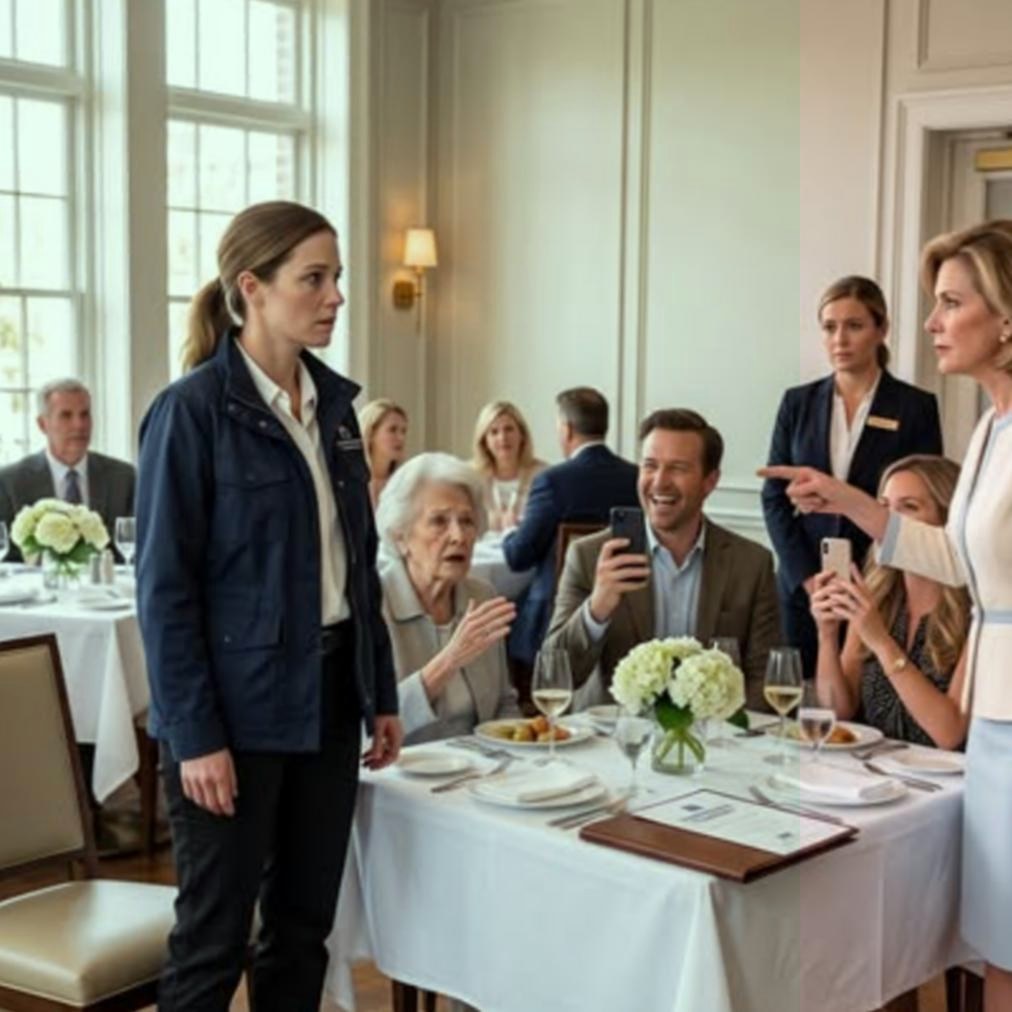

My mother asked the restaurant manager to move my chair to the small table standing by the service door, while my brother immediately started filming.
It was my grandmother June Hart’s eighty-sixth birthday. The Belvedere Hotel stood on the Charleston waterfront — white columns, polished brass railings, and hydrangeas everywhere, as if the building had never once been a warehouse in the past.
I was twenty-seven years old and ran a restoration company. My employees reinforced old buildings after hurricanes, replaced water-damaged floors, and crawled into places where others were afraid to enter. That morning, water was coming through the roof of a children’s center, and I spent four hours there.
So instead of a festive dress, I was wearing clean black pants, a white shirt, and my dark green work jacket. In the jacket pocket I still carried my grandfather’s brass divider compass, which I always took with me when I had to make a difficult decision.
When my grandmother saw me, she held out both hands.
“There’s my girl,” she said.
But my mother looked at the jacket and closed her eyes for half a second.
“Did you come straight from a construction site?” my sister Kendall asked.
“From the children’s center,” I answered.
“Is there a big difference?” Nolan snickered.
I did not smile. To them, my life was always a subject for jokes. My brother Pierce worked at a development company, Kendall was a public relations specialist, and Nolan sold expensive apartments. But my phone rang even at two in the morning if some roof collapsed.
My mother had also hired a photographer that day. She wanted a family picture that would be published in the charity circle’s newsletter. It said that three generations of the Harts served the preservation of historical heritage.
That was especially ironic. My grandmother paid for my first two semesters of college when my parents told me that “working was too difficult a choice for a woman.” It was she who took me to my first job, where I was the only woman in a group of eighteen men.

My mother praised the coffee first, and then noticed my jacket.
“Willa, maybe you should take it off?” she said to me.
“My shirt is wrinkled underneath. It is better this way.”
Her smile hardened.
“Then at least stand at the back.”
For the photograph, I moved to the back. But even that was not enough.
My mother came over to me and said quietly, though everyone could hear:
“Let’s take it without the work clothes first. People should not think that there are no rules in our family.”
My grandmother’s hand tightened around my wrist.
“Corinne,” she warned.
“Ten minutes ago you were praising the people who work in clothes like this,” I told my mother. “One jacket cannot ruin your newsletter.”
Pierce laughed. Kendall took out her phone. The public smile disappeared from my mother’s face.
“You enter every room to prove that you do not need anyone’s rules,” she told me.
“I came because of Grandma.”
“Then show respect to her. Everyone is wearing appropriate clothes except you.”
I moved away from the table. I thought that would end everything. But my mother turned toward the manager.
“Could you move Willa’s place by the service door?” she said. “If she looks like a worker, maybe she’ll feel more comfortable there.”

Silence fell over the room.
My grandmother tried to get up from her chair and almost fell. I supported her.
“No,” she said. “Willa is sitting beside me.”
“Not today, Grandma,” I told her and kissed her forehead.
I took a small wrapped box from my bag. Inside was my grandfather’s brass divider compass, restored with his initials.
“Happy birthday. I love you.”
My mother was calling my name, but I walked toward the door. I got into my car and stared at my hands for several minutes; they were shaking so much that I could not start the engine.
That evening I ignored sixteen messages from my family. At nine seventeen p.m., I received a message from an unfamiliar person. The author was architect Graham Bell.
“I need to apologize for what I saw at the hotel today. But the main thing is something else. Please look at the attached file immediately.”
I opened the file. There was a forty-two-million-dollar offer from a development company. My company was listed as the main restoration partner. It said that my group would be fully available for the project for eighteen months.
My name was at the bottom of the page.
And beneath it — a digital signature that I had never made…

I opened the file again and stared at the screen as if I could make the letters change.
“Graham, where did you find this?” I called.
“In the proposal documents. They are planning to submit it tomorrow morning.”
“I did not write anything.”
“I know. That is why I sent it to you.”
I turned on the printer. The smell of hot ink came from the paper, and I touched the signature with my finger. It was my name, but it was not mine.
Graham told me that the project’s client already had my company’s insurance certificate and special permits.
“I sent those documents to Pierce three months ago,” I said.
“Then contact a lawyer tomorrow. The tender committee is meeting in the morning.”
I hung up and called my mother. She answered on the third ring.
“Not now, Willa. I do not have the strength for your drama.”
“A forty-two-million-dollar offer has been submitted in my company’s name.”
Silence.
“Talk to Pierce,” she finally said.
“Why Pierce?”
“Because he is working on this project.”
That answer frightened me more than the document. The next morning I went to a lawyer and took all the old emails, contracts, and access records.

When he saw the last page, his face changed.
“Willa, this is not only a forged signature,” he said. “There is another application here too.”
“What application?”
The lawyer opened the folder, but he took too long to answer. Just then his phone rang and he looked at the screen.
“Your mother is calling…”
The midday sun entered between the blinds in the lawyer’s office. The coffee on the table had gone cold, but I still wrapped my hand around the cup because my fingers were freezing again.
“Answer it,” I said.
The lawyer put the call on speaker.
“Willa,” my mother said, “you are making too big a deal out of this. Pierce told me that it is simply a preliminary document.”
“With my signature?”
“Your company’s success is the result of our family’s support.”
“I received neither money nor partnership nor permission from you.”
“Not everything in a family requires a contract.”
The lawyer raised his hand. Another folder lay in front of him.
“Mrs. Hart, we also have a grant application. It says that your mother’s charity circle financed you, opened your professional path, and helped you create your company.”
“That is a lie,” I said.
My mother’s voice hardened.
“This is our family history.”
“A grant application is not a family photo album,” the lawyer replied. “It is a request for money.”

That same evening I sat before the charity circle’s board. Drawings of old buildings hung on the walls of the room, while brochures with my company’s logo lay on the table. The board chair asked me directly:
“Is it true that the circle financed your education?”
“No. My grandmother paid for two semesters. I covered the rest through work, a scholarship, and a loan.”
My mother sat opposite me. Her hands were clasped together so tightly that her fingers had turned white.
“I meant that we supported her as a family,” she said.
“You wrote that the organization created my company,” I told her.
The chair looked at the document.
“And this statement is certified with your signature, Willa.”
“That is not my signature.”
Just then the lawyer turned on the computer and displayed the file history on the screen. It showed that the signature had been cut out of an old supplier document and inserted into the new application. And access had been made from Pierce’s work account.
My mother’s face reddened.
“Pierce only provided us with technical assistance.”
“He knew that no agreement existed,” I said.
The lawyer opened another recording. It was a voice message Pierce had sent to the project administrator.
“Willa will sign in the end anyway. If not, we will have a family conversation.”
Complete silence fell over the room.
Pierce pushed his chair back.
“That was a private conversation.”
“And it was a public offer in my company’s name,” I answered.
The board withdrew the application immediately and began an independent investigation. But before I left the room, Graham looked at me strangely.
“Willa, these documents do not concern only this tender,” he told me. “We found another contract in the archive, drawn up in your name.”
“What contract?”
Graham received a message on his phone, read it, and went pale.
“Your company may already have been transferred to someone else…”
პირსმა საკუთარი ხმა მოისმინა და პირველად გაჩუმდა…
მე მეგონა, ყველაზე მძიმე უკვე გავიარე. მაგრამ ნამდვილი ფასი მაშინ გამოჩნდა, როცა სიმართლემ ყველა ჩვენგანს თავისი ადგილი მიუჩინა.
„მე უბრალოდ აღარ დაგიფარე.“
პირსმა თვალები დახარა.
👇 ისტორიის ფინალი უკვე გახსნილია






