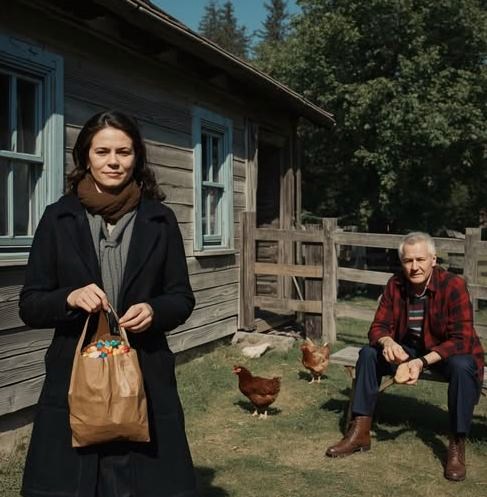
The woman on the phone swore my grandfather had been buried before I even reached the village, and I believed her until I saw smoke rising from his chimney.
It was Friday evening in Moscow. I had just stepped out of the accounting office, my eyes burning from nine hours of figures and reports, when the unknown number rang again. The area code belonged to the republic where I had grown up.
“Katya?” an elderly woman asked. “This is Nina, your grandfather’s neighbor. You need to come home.”
“What happened?”
She breathed into the receiver. “Your grandfather died last night. In his sleep.”
The traffic roared around me. A courier brushed my shoulder, but I barely felt it.
“When is the funeral?” I asked.
“Tuesday. You can still make it.”
“I’ll come.”
I ended the call and stared at my shaking hand. For several seconds, I could not cry. Then the memory of my grandfather’s voice rose inside me: “Katya, I’ll heat the bathhouse. You just come.”
I had said I was busy.
That had been five years ago.
After my parents died in a highway accident, I was six years old and terrified of every room that went dark. My grandfather, Yegor Stepanovich, arrived the next day in a grease-stained quilted jacket. He crouched in front of me, his rough hands resting on his knees.
“Well, Katya,” he said. “We’ll live.”
And we did. He raised me beside the wide northern river, feeding me warm milk, black bread, and stories he invented himself. He taught me to swing a scythe, ride a mare through snow, and endure pain without making it bigger than it was.
When I left for university, he stood at the bus stop holding a paper bag of apples.
“Call when you arrive,” he said.
“I will.”
I did not.
Over the years, visits became yearly, then occasional, then impossible. My career grew. My apartment lease grew. My excuses became polished enough to sound like facts.
I bought the first ticket I could find. The journey took two days: a train to the regional center, a bus through black spruce forests, then a battered car driven by a farmer who smelled of diesel and peppermint.
At noon on Monday, I walked the final three kilometers across a wind-whipped field. My black scarf snapped against my cheek. A paper bag of sweets knocked against my knee—the ridiculous gifts I had bought for a dead man.
The village appeared over the hill. Thin smoke curled above one roof.
His roof.
The gate stood open. Chickens scratched beneath the porch. A kettle whistled somewhere inside the house.
Then I saw him.
My grandfather sat on the porch in a checked shirt, padded boots, and wool trousers, calmly peeling potatoes into a metal bowl.
The bag slipped from my hand. Sweets scattered across the frozen ground.
He looked up, narrowed his eyes, and put down the knife.
“Oh,” he said. “You came.”
“Grandfather?”
“Alive, Katya. I’m alive.”
My knees weakened. “Nina said you died.”
“I asked Nina to tell you.”
The wind pulled my scarf loose. “You asked her to what?”
He stood slowly, wiping potato starch from his fingers.
“Five years,” he said. “Five years you didn’t come. I thought perhaps a funeral was the only thing that could bring you back.”
I wanted to scream. I wanted to embrace him. Instead, tears ran down my face while he watched me with an expression far more painful than anger.
“Why would you do this?” I whispered.
He looked toward the house, where the kettle continued to shriek.
“Come inside,” he said. “There is something you need to see…”
PART 2
The words landed harder than the lie about his death.
“What do I need to see?” I demanded. “Your medical file? A coffin you rented? A list of all the people you frightened?”
He picked one of the scattered sweets from the dirt and brushed it against his sleeve.
“You brought these for me?”
“For a funeral.”
“Then they will taste better with tea.”
“Do not joke.”
His face changed. The small amusement disappeared, leaving the deep lines around his mouth exposed. He opened the wooden door, and the smell of smoke, boiled potatoes, and dried mint rolled over me.
At 12:40 on Monday afternoon, I stepped into the kitchen where I had once done my homework beside the blue enamel stove. The same cracked clock hung above the table. The same copper ladle rested by the basin. But a second chair had been placed beside the window, and on it sat a canvas travel bag.
“Are you leaving?” I asked.
“Not today.”
“Then why is that packed?”
He poured tea into two thick glasses. His hand trembled once, barely noticeably, and I hated myself for seeing it only after I had been forced to come home.
“Nina told me you would arrive angry,” he said.
“She was right.”
“She also told me you would pretend you were not afraid.”
I stared at him. “Afraid of what?”
He pushed a glass toward me. A teaspoon clicked against the rim.
“Of finding out what you missed.”
I sat down. The chair creaked beneath me, and something inside my chest tightened.
He reached beneath the table and took out a small metal tin. Its lid was dented near the corner, the same dent I remembered making with a hammer when I was nine. He opened it and removed a bundle tied with brown cooking twine.
My school medal lay on top. Beneath it were postcards I had sent, every one carefully flattened. There were also hospital receipts, a bus timetable, and a stack of letters with my name written in his uneven hand.
“Why didn’t you send them?”
“Some things should be said to a face.”
“Then say them.”
His eyes lifted to mine.
“I have a heart condition.”
The room seemed to shrink around the stove.
“How serious?”
“Serious enough that the doctor told me not to live alone through winter.”
“You never told me.”
“You were working.”
“That is not an answer.”
“It is the answer I had.”
I pushed back from the table. “You frightened me across the country because you wanted attention.”
“I wanted proof that I still mattered.”
The sentence stripped the anger from my hands. I looked at the travel bag again.
“Where were you planning to go?”
“To the district home for the elderly. Nina found a place. I signed the papers last week.”
“You signed?”
“Tomorrow morning, if you had not come, I would have gone.”
I rose so fast the teacup tipped. Dark tea spread across the table and dripped onto the floorboards.
“You were going to leave this house without telling me?”
“You had not asked me to stay.”
“I did not know you were leaving!”
“That was my point.”
For a moment we stood facing one another, separated by the wet tablecloth and all the years I had called adulthood.
Then someone knocked at the window.
Nina stood outside, pale beneath her knitted red hat. She motioned urgently toward the yard.
“What now?” I asked.
She came in clutching a leather folder against her coat.
“Katya,” she said, “your grandfather didn’t tell you everything.”
My grandfather’s fingers closed around the edge of the table.
“Nina,” he warned.
She placed the folder between us.
“Because if she stays, she needs to know what will happen to this house…”
PART 3
The leather folder landed beside the spilled tea with a dull slap.
My grandfather reached for it, but Nina caught his wrist.
“No,” she said. “You dragged her here with a lie. She gets the truth without another one.”
At 1:15 on Monday afternoon, the kitchen seemed to hold its breath. Outside, a chicken clucked beneath the porch. Inside, the stove popped, sending a red spark through the iron grate.
I looked from Nina to my grandfather.
“What will happen to the house?”
He pulled his hand away. “Nothing that concerns you.”
“That is not what she said.”
Nina opened the folder and removed three pages stamped by the district administration. The first was a notice about the bridge road. The second concerned an abandoned quarry near the river. The third bore my grandfather’s signature.
I read it twice before the words made sense.
“The land is being transferred?”
“To a development company,” Nina said. “They want the riverbank for a private recreation complex. Your grandfather signed an agreement to sell.”
I turned to him. “You are selling the house?”
His jaw tightened. “I am old. The roof leaks. The well is failing. I cannot maintain it.”
“You could have told me.”
“You were not here.”
“You could have called.”
“I called.”
“Not about this.”
His fingers began tapping the table, one slow beat after another.
Nina leaned toward me. “He did not sign because he wanted money. They promised to rebuild the village road and keep him in the house until he died. Then their representative came with a new paper. It moved the boundary and included the garden, the bathhouse, everything.”
My grandfather looked at her sharply. “Enough.”
“No,” I said. “Continue.”
She swallowed. “The company has already marked the trees near the river. They planned to start clearing the eastern bank next week.”
I lifted the final page. The signature at the bottom was my grandfather’s, but the ink looked strangely dark and fresh.
“Did you sign this version?”
“I signed something.”
“That is not an answer.”
His silence told me more than his words.
A vehicle stopped outside. A door slammed. Through the window, I saw a tall man in a brown coat walking toward the porch, carrying a black document case.
My grandfather’s face went gray.
“Who is he?” I asked.
“Viktor Malin,” Nina said. “The company’s representative.”
The door opened without a knock. Viktor entered, shaking snow from his polished shoes.
“Good afternoon,” he said. “I see the family meeting has begun.”
I stepped between him and my grandfather. “You came early.”
“Your grandfather agreed to complete the transfer tomorrow.”
“He also agreed to sell only the river meadow, didn’t he?”
Viktor smiled. “People remember agreements differently.”
My grandfather gripped the table so hard his knuckles whitened.
Viktor placed a fresh document before him. “Sign this, and the care facility deposit is paid today. Refuse, and the offer disappears.”
The truth struck me: the lie about his death had brought me back, but the sale was what had driven him to the edge.
I looked at the document. Then at the man who believed an old farmer had no one left to stand beside him.
Viktor uncapped his pen.
“Mr. Stepanovich,” he said, “you promised me your signature.”
My grandfather reached for the pen. I caught his hand.
“No,” I said. “He promised you something else.”
From the bottom of Nina’s folder, a folded sheet slid onto the table. It bore a witness stamp and a date from thirty-two years earlier.
My grandfather saw it and whispered, “Where did you find that?”
Nina looked at me.
“In the school archive,” she said. “Your grandfather never told you what he did with the land before you were born…”
My grandfather’s last signature changed everything…
I thought his cruel lie was the whole story. Then one forgotten document revealed why he had risked losing the only home we shared.
“I protected the land from everyone except myself.”
No one at the table looked away.
👇 The final part is already open






