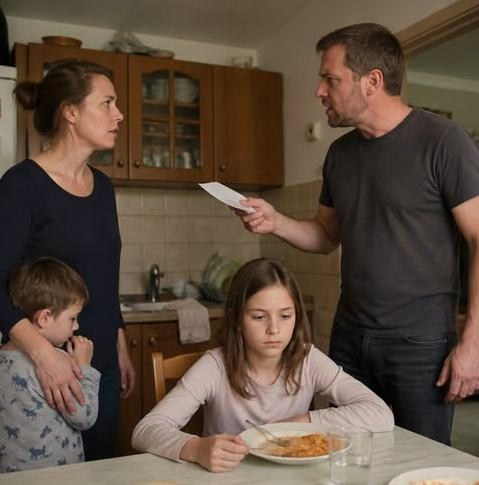
The bank envelope was still trembling in Gábor’s hand when my nine-year-old daughter dropped her spoon and my little boy grabbed the hem of my shirt.
It was 4:17 on a Tuesday afternoon in our kitchen. The sink held two plates streaked with tomato sauce, steam clouded the window above the radiator, and the smell of boiled pasta clung to the air. Everything looked painfully ordinary.
Until Gábor slapped the envelope against the table.
“Eight hundred and sixty thousand forints,” he said. “Explain this.”
Lili stared at the printed amount. Máté pressed his face against my hip.
“Not in front of them,” I said.
“Of course. Suddenly I’m the monster.” His fingers crushed the corner of the envelope. “You hid our money from me.”
“It isn’t yours.”
The sentence left my mouth before fear could stop it.
His expression changed. Not much. Just a tightening around the eyes, like a door being locked from the inside.
“What did you say?”
I looked at Lili. She had gone pale, but she was trying to sit straight, the way she did when she pretended not to be frightened. Máté’s small fingers dug into my sweater.
“Take the children to the bedroom,” I told her.
Gábor laughed once. It was a dry, ugly sound.
“You think you give orders here?”
I had opened the account three and a half years earlier, after he had made me justify a packet of ham for twenty minutes. I had saved family allowance money, small amounts from my bookkeeping work, whatever survived after medicine, shoes, school fees, and his demands. Some months it was ten thousand forints. Some months it was five. Some months there was nothing.
I wore the same winter coat for three years. The cobbler repaired my boots twice. Gábor called me frugal. He never understood that I was building an exit one coin at a time.
“You’ve been stealing from this family,” he said.
“I bought the children’s medicine with that money.”
“You bought yourself a secret.”
Then he leaned close enough for me to smell the beer on his breath, though it was barely past four.
“Who were you planning to run to? Your mother? Some man?”
“No one.”
“Then what was the money for?”
I heard the wall clock ticking above us. I heard Máté begin to cry without making a sound.
“It was for the day you became dangerous again,” I said.
His hand moved so quickly that Lili screamed. He did not hit me. He struck the ceramic sugar bowl beside my head, and white shards scattered across the table like teeth.
For one second nobody moved.
Then a knock sounded from the hallway.
Our neighbor, Ilona, stood outside with a paper bag of apples. She looked at the broken bowl, then at Gábor’s raised hand.
“Everything all right?” she asked.
Gábor smiled at her.
“Family argument.”
Ilona did not look at him. She looked at me.
“Eszter, come downstairs with me for a minute.”
“I’m not going anywhere,” Gábor said.
His hand closed around the bank envelope again. Then he pulled my phone from the counter and slid it into his pocket.
“You’re going to the bank tomorrow,” he whispered. “You’re closing that account. And tonight, you’re telling me every place you’ve hidden money.”
Behind him, Lili quietly moved Máté toward the bedroom. I saw her place one hand over his mouth to stop his sobs.
Ilona’s eyes hardened.
“Give her the phone.”
Gábor turned toward her. I knew that look. I had seen it before the broken lamp, before the dent in the door, before apologies that lasted exactly until the next drink.
He reached into his pocket, pulled out my phone, and held it above the sink.
“Say goodbye to it,” he said.
I stepped forward.
Then the screen lit up in his hand.
One message appeared beneath the cracked glass. Gábor read the first line, and the color drained from his face as his thumb moved toward it…
PART 2
The message was from Júlia, the manager of the bank branch on Kossuth Street.
Gábor’s thumb stopped above the screen.
“Who is Júlia?” he asked.
I felt the blood leave my hands. Ilona was still in the doorway, one palm resting against the chipped frame. Behind me, Lili had pulled Máté into the bedroom, but I could hear his frightened breathing through the half-closed door.
“She works at the bank,” I said.
“What does she want?”
“Give me the phone.”
He read the message aloud, slowly, as though each word were evidence against me.
“Please come before nine tomorrow. Bring identification. Do not discuss this with anyone who has access to your household accounts.”
The kitchen seemed to shrink around us.
Gábor’s eyes lifted.
“What have you done?”
“Nothing.”
“Then why is the bank warning you about me?”
Ilona stepped inside. The apples in her paper bag knocked softly against one another.
“Because she asked them to,” she said.
Gábor turned on her.
“You should leave.”
“No.”
The word was quiet, but it landed heavily.
He moved toward her. I caught his sleeve before he reached the doorway.
“Don’t.”
For a moment I thought he would shove me into the table. Instead, he looked down at my hand as though it were something filthy touching him.
“You’ve been poisoning everyone against me.”
“I have been trying to keep the children safe.”
He pushed past me and stormed into the bedroom. A drawer opened. Then another. Clothes hit the floor. Máté screamed.
I ran after him.
“What are you doing?”
“Finding the rest of it.”
“There is no rest.”
He threw a small blue suitcase onto the bed. It was the one we used for the children’s summer trips, its broken wheel wrapped in silver tape.
“You think I don’t know you?” he shouted. “You’ve been planning this for months.”
“I’ve been planning to survive.”
That stopped him for half a breath.
Then he grabbed the folder from the top of my wardrobe.
My stomach dropped.
Inside were copies of my employment records, the children’s birth certificates, the lease to my mother’s unused apartment, and a list of emergency numbers I had written on the back of an old grocery receipt. I had hidden the folder beneath winter blankets, certain he would never search there because he hated dust.
He opened it.
“Your mother’s apartment?”
“It has been empty for years.”
“So that’s where you were taking my children.”
“They are not property.”
His laugh was louder this time.
“You don’t get to decide that. You don’t even have enough money to feed them for a month.”
He pulled out his own phone and held it in front of me. A banking application showed our joint account balance. It was almost empty.
“Look,” he said. “You made a secret account, and I had to cover the household.”
I stared at the screen. There should have been nearly two hundred thousand forints there. Money from his last salary, child support, and the payment from my employer.
“Where did it go?”
“Bills.”
“Which bills?”
He shoved the phone into his pocket.
“Tomorrow you will close your account and transfer everything to me. If you refuse, I will tell the school you abandoned the children. I will tell your boss you stole from the family. I will make sure no one believes you.”
Ilona appeared behind me.
“Your boss already knows she works until her hands ache.”
Gábor’s face twisted.
He snatched the folder, folded it in half, and tucked it under his arm.
“You’re coming with me,” he told me.
“Where?”
“To the bank. Right now.”
“It’s closed.”
“Then we’ll wait outside.”
At 5:02, he pushed us into the narrow hallway. The stairwell smelled of wet wool and boiled cabbage. Lili held Máté’s hand. I held the railing and tried to make my breathing steady.
At the entrance, Gábor’s phone rang.
He answered with an irritated greeting. Then his expression changed.
“No,” he said. “You were supposed to wait until Friday.”
He listened.
“What do you mean, they called her?”
I saw his knuckles whiten around the phone.
“Who found the signature?” he asked.
He turned away from us, but not before I heard the next sentence.
“Tell them Eszter knows nothing about that loan.”
The call ended.
He looked back at me.
For the first time that evening, he was afraid of something I had not yet seen…
❤️ Thank you for staying with my story. The continuation is waiting in the first comment. 👇
If it does not appear right away, tap “See all comments.”
If you want to know what happens next, leave a like and write “Yes.”
PART 3
At 5:19 on Wednesday morning, I sat across from Júlia in the bank’s small consultation room while rain ticked against the metal awning outside.
Gábor had refused to let me go alone, but Ilona had called my employer, and my employer had called Júlia before opening time. When we entered through the staff door, two people were waiting for us: Júlia and a woman from the bank’s security department.
Gábor kept one hand on my shoulder.
“Whatever this is,” he said, “my wife is confused.”
Júlia placed a thin brown file on the table.
“She is not confused.”
His fingers tightened against me.
Júlia opened the file and slid a copy across the table.
“This is a loan application filed three weeks ago in Eszter’s name.”
I saw my address, my birth number, and a signature that looked almost like mine.
Almost.
The final letter in my name curved too sharply. I had never written it that way.
“I did not sign this,” I said.
Gábor’s chair scraped the floor.
“You signed it online.”
“I was at work that day.”
“You forget things.”
Júlia looked at him.
“The application was submitted from a device registered to your telephone number. The attached income documents were altered. The stated purpose was home renovation.”
I looked at Gábor.
“What home renovation?”
He said nothing.
The security officer placed another page in front of me. It showed a transfer from our joint account to a betting company, followed by three cash withdrawals from an automated machine near the railway station.
My throat tightened.
“That money was for the rent,” I whispered.
Gábor stood up.
“This is ridiculous. She is my wife. I am allowed to manage our finances.”
“Managing an account does not authorize forging a signature,” Júlia said.
His face reddened.
“I didn’t forge anything.”
“Then explain why the bank’s handwriting examiner found that the signature was traced from her identity card.”
The room went still.
Gábor looked at me, not Júlia.
“You brought them into this?”
“I didn’t know.”
“You knew enough to hide money.”
The security officer quietly moved between us.
Júlia closed the file.
“The loan is frozen. The joint account is restricted. Eszter’s savings cannot be touched by anyone but her.”
Gábor’s mouth opened.
“That money belongs to the household.”
“No,” Júlia said. “It belongs to the account holder.”
For three years, I had believed money could disappear so quietly that nobody would call it theft. Now I watched the word settle over the table like a heavy object.
Gábor grabbed the brown file.
I caught his wrist.
“Put it down.”
He stared at my hand.
“You think a few papers will save you?”
“No,” I said. “But they might save the children.”
He released the file.
At 6:03, we left through the side entrance. Ilona was waiting beside the pharmacy with Lili and Máté. The children ran to me, and Máté buried his face in my coat.
Gábor did not follow us.
His phone rang again.
He answered while standing beneath the pharmacy sign. I could not hear the person on the other end, but I watched his expression collapse into disbelief.
“What do you mean the apartment cannot be sold?” he demanded.
Then he looked directly at me.
Júlia had told me the loan was frozen. She had not told me everything.
Gábor crossed the pavement.
“You knew about your mother’s apartment,” he said. “You knew it was still registered in your name.”
I felt the paper folder against my ribs inside my coat.
“My mother left it to me.”
“She left it as security.”
The rain suddenly sounded louder.
He leaned closer.
“Your mother signed an agreement years ago. If I cannot repay what I borrowed, the apartment is gone.”
I looked at Júlia.
Her face had turned white.
“What agreement?” I asked.
She opened the folder again, reached beneath the loan application, and pulled out a page I had never seen.
At the bottom was my mother’s signature.
And beneath it, in a different ink, was a second name…
FINAL PART
The signature beneath the document belonged to someone dead…
I thought the money was the whole secret.
Then the bank opened one more page, and every lie changed shape.
“Tell them I did it for the family.”
Lili’s small reply stopped him cold.
👇 The final part of the story is open now.






