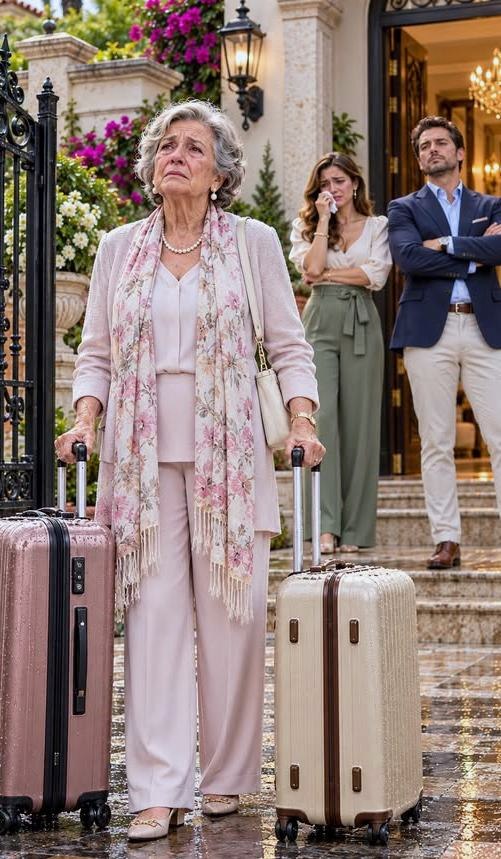
The first thing I saw after leaving church was my life packed into two suitcases beneath the rain, while my son-in-law toasted from my balcony.
A white sign with red letters hung across the iron gate I had painted every summer with my late husband: SOLD.
Sergio lifted his glass when he saw me.
“You’re late,” he called. “The priest must have held you hostage.”
I stood beneath the dripping awning, my rosary still wrapped around my wrist, and looked past him toward the living-room window. My daughter Lucía was there, frozen behind the curtain.
“Tell me this is a mistake,” I said.
Lucía stepped outside. Her face was wet, though she had not been standing in the rain.
“Mom, please. It’s better this way.”
“Better for whom?”
Sergio came down the stone steps and nudged one of my suitcases with his polished shoe. The brass clasp snapped open, spilling a folded nightgown into a puddle.
“The house is sold, Carmen,” he said. “A residence is collecting you at six.”
I stared at him. “I have not sold my house.”
“You signed a power of attorney last week.”
The words struck harder than the cold. Last week, Lucía had placed several papers beside my coffee.
“Sign here, Mom,” she had said. “They’re insurance forms and the doctor’s review.”
I signed because she was my only child. I signed because I had paid for her university by sewing school uniforms until my fingers cracked. I signed because when Sergio’s businesses collapsed, I had opened my pantry, my savings account, and eventually my home to them.
I had trusted my daughter.
Sergio leaned close enough for me to smell the expensive wine on his breath.
“The buyer has already transferred sixty thousand euros as a deposit. Don’t make a scene.”
“Where is my money?”
“That is family business.”
“No,” I said. “My money is my business.”
I picked up the suitcase. The handle cut into my palm, but I felt no pain. Lucía began to cry.
“Sergio owes people,” she whispered. “They threatened us.”
“Then you should have told me.”
“We were trying to protect you.”
“By putting me in a residence without asking?”
Sergio blocked the gate.
“You cannot come inside now. The property belongs to the buyer.”
I looked at the man who had once called me his second mother.
“Move.”
Perhaps it was my voice. Perhaps it was the way I held his gaze. He stepped aside.
Inside, strangers had already labeled my furniture. My mother’s porcelain plates lay wrapped in newspaper. Family photographs were stacked face down in cardboard boxes. On the mantel, a red sticker marked the clock my husband had repaired every Christmas.
Lucía followed me upstairs.
“Mom, just give us the money when it arrives. We can solve everything.”
“Where are the sixty thousand euros?”
She covered her mouth.
Sergio answered from the landing. “Stop interrogating her.”
I entered my bedroom and opened the wooden sewing chest my husband had built from walnut scraps. Beneath the thread spools was a false bottom. I lifted it and removed a blue folder I had hidden there for years.
Sergio laughed.
“What is that? An old deed?”
I ran my fingers over the worn cover.
“I have spent fifty years finding the one stitch that ruins a perfect-looking garment.”
I opened the folder.
Lucía stopped breathing.
Sergio reached for it, and the bell at the gate rang again. A man’s voice called from below, “Mr. Ortega? I’ve come for the handover.”
I turned the folder toward the light and placed my finger on page two. Sergio’s hand hovered inches above the paper…
PART 2
Sergio’s fingers stopped above the folder.
“Put it down,” he ordered.
I closed the cover against my chest. “You have ordered me around in my own bedroom for the last time.”
The visitor rang again. This time the sound seemed to travel through the entire house, shaking the little glass pendants on my grandmother’s chandelier.
Sergio hurried downstairs.
“Stay here,” Lucía whispered.
“I have stayed quiet for seven years.”
We followed him into the hallway. A tall man in a soaked charcoal coat stood beyond the gate, holding a leather case and a folder of his own.
“Mr. Ortega?” he asked. “Álvaro Sanz. We spoke about the property.”
Sergio forced a smile. “There has been a small family complication.”
Álvaro looked at my suitcases, the labels on the furniture, and then at me.
“I was told the house would be empty.”
“It will be,” Sergio said. “Carmen is confused.”
I stepped toward the gate. “I am not confused. I live here.”
He opened his case and removed a signed contract. The paper was protected by a clear sleeve, but rain had already dotted its edges.
“I transferred the deposit this morning,” Álvaro said. “Sixty thousand euros.”
“Into which account?” I asked.
Sergio’s jaw tightened.
“That is irrelevant.”
“No,” I said. “It is the most relevant thing in this garden.”
I opened my blue folder and placed the first deed on the small stone table beside the gate. Álvaro bent over it. His index finger followed the lines.
“Bare ownership transferred to the Saint Gabriel Foundation,” he read. “Lifetime usufruct reserved for Carmen Valdés.”
He looked up. “What does this mean?”
“It means I can live here until I die,” I said. “And no one can sell the whole property without the foundation’s consent.”
Sergio snatched the page. “That document is outdated.”
“It was notarized eleven years ago,” I replied. “The updated property extract is behind it.”
Lucía’s face crumpled. “I told you she kept important papers.”
“You told me she had dementia,” Sergio snapped.
The sentence hung between us.
My stomach twisted, not because I was surprised, but because my daughter heard it too.
I took out my phone and called emergency services. I explained that my son-in-law was attempting to remove me from my home using papers I had signed under a false description. My hand shook only once, when I gave the address.
Sergio moved toward me.
“Hang up.”
“Touch me and I will tell them you threatened me.”
His face hardened. “You are destroying your daughter’s life.”
“You destroyed it when you made her carry your debts.”
Lucía flinched.
A few minutes later, two officers entered through the open gate. Their boots left dark prints on the tiled hall. One carried a small notebook; the other examined the power of attorney.
“Who signed this?” the older officer asked.
“I did,” I said. “But not for a sale.”
“What did you believe you were signing?”
“Medical insurance documents.”
Sergio interrupted. “She knew exactly what it was.”
I opened the folder again. “Then read page two.”
The officer studied the authorization, then the deed, then the deposit receipt Álvaro handed him. The younger officer asked Sergio where the money had gone.
“Into the company account,” he said.
“What company?”
Sergio’s lips parted, but no answer came.
Lucía suddenly whispered, “The account is not in his company’s name.”
Everyone turned toward her.
Sergio grabbed her wrist. “Enough.”
The older officer stepped between them. “Let go of her.”
She pulled free, trembling. “He used my name. He opened it using the identification papers from our tax file.”
Sergio stared at her as if she had betrayed him.
Then the officer read the final line of the power of attorney and slowly closed the notebook.
“Mr. Ortega, before anyone leaves, we need to establish who prepared this document.”
Sergio looked toward the street. A dark van had stopped beside the gate. Two men remained inside, watching the house.
His face drained of color.
“They’re here for the money,” he whispered. “And they know I signed the sale…”
Then Lucía pointed at the blue folder.
“Mom,” she said, “why is there a second signature on page two?”…
PART 3
“Because that signature is not mine,” I said.
The room seemed to shrink around us. Rain tapped against the stained glass above the entrance, and the red SOLD sign rattled outside like a loose warning.
The older officer held the page beneath the lamp.
Sergio stepped backward. “This is absurd.”
Álvaro looked from him to me. “You told me Carmen personally approved everything.”
“I had a power of attorney.”
“You told me she had authorized the sale.”
“I did.”
“Then why is there another signature?”
I pointed to the lower margin. “That is the notary’s certification. But the notary’s name is wrong.”
Lucía stared at the paper. “What do you mean?”
“The notary who witnessed my deed was Elena Robles. This says Elena Rojas.”
Sergio gave a brittle laugh. “A clerical mistake.”
I opened the second pocket of the folder and removed a small cream-colored card, its corners softened from years of handling.
“Clerical mistakes do not change a person’s name, office number, and seal.”
The card belonged to Teresa Molina, a retired lawyer who had helped me prepare the original deed. I called her on speaker.
She answered from her apartment, breathless. “Carmen?”
“Teresa, I need you to tell them what you told me eleven years ago.”
A pause. Then her voice sharpened. “The house belongs to the Saint Gabriel Foundation. Carmen holds the lifetime right to occupy it. No power of attorney can erase that.”
Sergio shook his head. “You are both old women inventing legal theories.”
Teresa ignored him. “And I warned Carmen never to sign a broad authorization without reading every page.”
“I thought I was signing insurance forms,” I said.
“Then the document was obtained by deception. Send me a photograph.”
The officer took the phone and asked Teresa several questions. She answered each one precisely, naming the notary’s office, the deed number, and the foundation’s director.
Álvaro rubbed his forehead. “I checked the registry extract your agent sent me. It showed no foundation.”
“Because the extract was altered,” Teresa replied. “The original registry entry contains the restriction.”
Sergio’s silence changed the air.
The younger officer searched his folder and found a bank receipt. The account receiving the deposit was listed under Lucía Ortega, not Sergio Ortega.
Lucía stared at it. “I never opened that account.”
Sergio seized the paper. “You gave me your identification.”
“For the tax return.”
“You knew I needed it.”
“I knew you said you needed it.”
His expression turned desperate. “The lenders were going to take everything. I had one chance to save us.”
“No,” Lucía said. “You had one chance to tell the truth.”
The men in the van outside finally got out. The older officer moved toward the gate and ordered them to remain where they were. Álvaro stepped behind me, clutching his contract.
Sergio lowered his voice. “Carmen, if I return the deposit, this can disappear.”
“You cannot return money you already spent.”
His eyes flicked toward the blue folder.
That was when I understood. The sale had never been about our comfort or Lucía’s future. He had used my house to cover a private debt, and he had used my daughter’s name to hide the transfer.
The officer asked him to accompany them for questioning. No one touched him. He simply stood beneath the chandelier, surrounded by the boxes he had packed for me, and looked at the SOLD sign through the rain.
Lucía reached for my hand.
“Mom, I am sorry.”
I wanted to embrace her. I wanted to send her away. I did neither. I held her fingers and felt how cold they were.
Then Teresa’s voice came through the phone again.
“Carmen, there is something else. I checked the foundation’s records before calling you. Someone submitted a request to dissolve the foundation two days ago.”
My blood went cold.
“Who?”
Teresa exhaled. “The request carries a board member’s signature. And that board member has been dead for six years…”
Then Teresa read the name on the forged request…
I thought the house was the whole battle. I was wrong. The last document connected my family to something much larger.
“Mom… that is Dad’s name.”
The rain seemed to stop against the glass.
👇 The ending of the story is already open.






