PART 4
“I destroyed the file…”
The sentence hung between us.
Not the wedding. Not the money. Not even the ledger.
The file.
I tightened my grip around the phone. “What file?”
Diego looked toward Esteban, then toward Renata. His fear had changed shape. It was no longer fear of being exposed. It was fear that somebody else had discovered what he had tried to bury.
Renata caught his sleeve.
“What did you do?”
“Nothing to Alma.”
“That was not my question.”
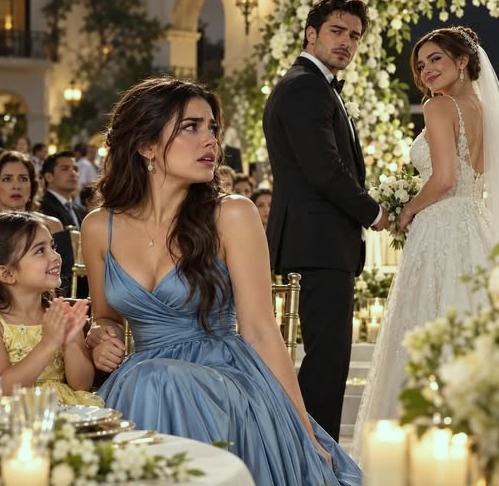
My daughter stood behind me, holding the skirt of my dress. The tiny embroidered flowers brushed my knees whenever she moved.
I lowered my voice. “Start talking.”
Diego swallowed. “A week after Alma was born, I went back to the clinic.”
Marta’s eyes narrowed. “You never came back.”
“I did. After midnight.”
“You asked for the file,” Marta said. “The receptionist told you it was protected.”
“I needed the address.”
“You had my address,” I said.
“I had a letter from you. It said Alma might have a heart problem. I thought if I knew where you lived, I could send money.”
I laughed once, sharply. “You sent nothing.”
“I had the money.”
“Then where was it?”
He looked down at his polished shoes.
Renata stepped closer. “Diego.”
He rubbed both hands over his face. “I borrowed from a man named Calderón. He financed the sound equipment. When I could not pay, he asked for something valuable.”
Esteban’s voice turned hard. “And you gave him access to a child’s medical file?”
“No. I gave him the clinic number. I thought he wanted to verify an insurance claim.”
Marta’s expression changed. “There was no insurance claim.”
“I know that now.”
“Why was Alma’s file requested last Tuesday?” I asked.
Diego looked at me. “Because Calderón found me again.”
The night air pressed against my skin. In the distance, the wedding cake stood untouched beneath its glass dome, six white tiers leaning slightly to one side.
“Why would anyone want my daughter’s file?”
Diego did not answer.
Renata did. “Because Alma’s name was used on the loan documents.”
I stared at her.
She took a folder from her father. “I found this in the contract packet. Diego listed a dependent child on a financial guarantee. He used Alma’s full name and birth date.”
My stomach turned.
The document had my daughter’s name printed beneath Diego’s company seal. Beside it was a signature that looked like mine until I saw the final letter. I always crossed my t with a long downward stroke. This one stopped abruptly.
Forgery.
“He used her identity to secure credit,” Esteban said. “And the lender wants proof that the child exists because the contract includes a life insurance policy.”
My hand went numb.
Diego moved toward me. “I never meant for anything to happen to her.”
“You insured my five-year-old daughter without my permission?”
“I was desperate.”
“You were always desperate when the choice was between responsibility and yourself.”
Alma tugged my hand. “Mommy, what is my name doing on that paper?”
I crouched in front of her. “Someone wrote it there without asking us. That was wrong. But I am here, and I will fix it.”
She studied my face. “Is the man from the altar my dad?”
The question silenced the courtyard more completely than any announcement could have.
I looked at Diego. He had wanted to avoid a child, a debt, a past, and now all three stood in front of him wearing one yellow dress.
“Yes,” I said carefully. “He is your biological father.”
Alma’s mouth parted. “Does he know me?”
“He knows who you are.”
Diego sank onto the edge of a stone planter.
“I know I am late,” he said.
Alma looked at him for a long moment. “Why did you leave?”
He could have lied again. He could have blamed fear, poverty, youth, anything that might make him look less cruel.
Instead he said, “Because I wanted my life to stay easy.”
A sob escaped Renata. She turned away, pressing her knuckles to her lips.
Alma nodded slowly, as if filing the answer somewhere she could understand later. Then she returned to my side.
Diego reached into his pocket and removed a small leather card case. From it he pulled a photograph, creased down the middle. It showed me asleep in the hospital bed, Alma wrapped against my chest.
I recognized it immediately. Marta had taken it for me after the birth.
“How did you get that?” I asked.
“I took it before I left.”
“You stole it.”
“Yes.”
He offered it to me.
I did not take it.
“Keep it,” I said. “You should have one thing that proves the damage was real.”
His hand lowered.
Esteban called the lender from his own phone. He put the call on speaker. A man answered after one ring.
“Calderón?” Esteban asked.
A dry voice replied, “The wedding is over, then.”
Renata’s face went white.
“You were watching?” she asked.
“I have watched every move Diego made since he signed the guarantee.”
Esteban said, “The guarantee is fraudulent.”
“So is the marriage contract, if the groom concealed debt and identity theft. You may want to discuss that with your family lawyer.”
I expected the familiar parade of uniforms, offices, accusations, and locked rooms. Instead Esteban ended the call and turned to me.
“My legal team will challenge every document tonight,” he said. “But Alma’s name must be removed from the loan immediately. I will pay for the filing and the medical records review.”
“I cannot accept charity.”
“It is not charity. Renata was going to use the wedding fund to open the café you both dreamed about.”
Renata looked at me through tear-streaked makeup.
“I should have told you the truth before I sent that invitation,” she said. “I wanted him trapped in front of everyone. I wanted you to see him suffer. I confused revenge with justice.”
“You humiliated me too.”
“I know.”
“Do you?”
She removed a narrow silver bracelet from her wrist. It had belonged to her mother, and I remembered seeing it in photographs from their family celebrations.
“I sold my engagement ring before the guests arrived,” she said. “The money will cover your daughter’s records and the legal review. The rest will go toward the café, if you still want it.”
I stared at the bracelet. “You are offering me your mother’s bracelet?”
“No. I am offering you the thing I can give without pretending the past did not happen.”
That was the first honest gift she had made all night.
I did not embrace her. Forgiveness was not a curtain I could pull across five years. But I took the bracelet and placed it beside the ledger.
“Tomorrow,” I said, “you will come to Querétaro. You will tell Alma exactly why you invited us.”
Renata nodded. “I will.”
“And you will never make another decision about my daughter without asking me.”
“I swear.”
Diego stood.
“I want to see Alma again.”
My daughter looked at him, then at me.
“You may write one letter,” I said. “I will read it first. If it contains excuses, she will never see it.”
He accepted the condition with a small nod.
“What do I call her?” he asked.
Alma answered before I could.
“My name.”
Diego’s eyes filled, but he did not move toward her.
That mattered.
The guests began leaving through the courtyard. The musicians carried their instruments past the cake. Renata’s wedding veil remained on the ground, streaked with wax and crushed petals.
I gathered Alma’s yellow skirt in one hand and the clinic ledger in the other. The ledger was heavier than paper should have been.
At the edge of the courtyard, Alma stopped.
“Mommy?”
“Yes?”
“Can we still make a café?”
I looked at Renata, at the ruined arch, at the man who had once left us beside an unpaid rent notice, and at the name on the forged contract.
“Yes,” I told her. “But the first thing on the menu will be something you choose.”
“Chocolate cake.”
“Of course.”
She considered the matter seriously. “And nobody can leave before eating it.”
Behind us, Diego spoke for the first time without asking for mercy.
“I will write the letter tonight.”
I turned back.
“Write the truth,” I said.
He looked at the photograph in his hand, then at Alma’s yellow flowers.
“I do not know how.”
“Then begin with her name.”
Missed the beginning?






