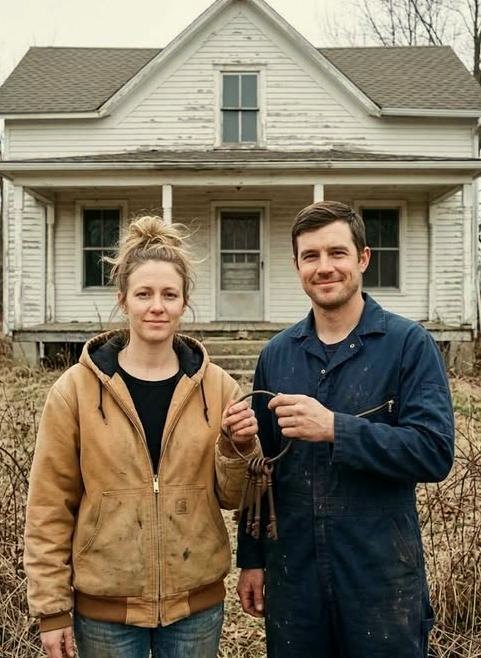
The old woman stopped beneath the bare light bulb, touched the pantry frame, and began crying as if the house had just spoken to her.
I stood behind her in the dusty kitchen, still holding the paper plate she had refused to use. Sunday afternoon light came through the cracked window in narrow gold bars. Somewhere under the floor, a pipe knocked once.
“Opal,” I said softly. “What is it?”
She ran her thumb over a deep scratch in the wood. Her hand trembled so badly that I reached for it.
She pulled away.
“Emily,” she whispered. “Did nobody ever tell you whose house this was?”
“Nate said the county owned it after the taxes went unpaid.”
“Nate was told what Ronald wanted him told.”
The name landed between us like a dropped glass.
Ronald was Nate’s father. My father-in-law. The man who had lifted his coffee cup at Easter and called a card worth twenty thousand dollars a compliment.
I stared at the pantry door. Its white paint had peeled in long curls, exposing dark wood beneath. A rusted hinge squealed when the wind moved through the broken screen.
“Was it yours?” I asked.
Opal closed her eyes.
“Before it was my son’s,” she said. “Before he took it.”
At two o’clock, Nate was replacing a fuse in the back bedroom. His shirt was dark with sweat, and a pencil rested behind his ear. He looked up when I called him.
“What happened?”
“Your grandmother says this house belonged to her.”
The screwdriver slipped from his hand and struck the floorboards.
Opal faced him. “You knew?”
“No.”
“Your father never told you?”
Nate shook his head. The color drained from his face.
Ron had always said the Miller place was an abandoned wreck. He said nobody in the family wanted it. He had even laughed when Nate mentioned the auction notice.
“Buy a house with a porch that eats people?” he had joked.
Now Opal looked at the sagging ceiling as though she could see another kitchen beneath it.
“My Walter built that pantry,” she said. “He put the first shelves in with his own hands. I cooked here for thirty-two years. Ronald learned to walk in this room.”
“Why would he take it?” I asked.
Her mouth tightened.
“Because he said he would care for me. Because I believed my son.”
Nate crouched beside her. “Grandma, what did Dad do?”
Opal reached inside her church coat and pulled out a small brass key tied to a faded red shoelace. The metal was warm from her body.
“I kept this after they changed the locks,” she said. “I thought I had lost it. Then I saw your sale in the newspaper.”
“Changed the locks?” Nate asked.
She looked directly at him.
“Ronald told me the bank needed my signature. I was sick. I signed one paper. He took the house, the land, and every letter Walter left me.”
A chill moved through me, though the afternoon was hot.
“Where are the letters?” I asked.
Opal turned toward the pantry. She lifted the brass key.
“Your grandfather hid the truth where Ronald never thought to look.”
The key entered a tiny brass lock beneath the lowest shelf. It turned with a dry click.
Nate stepped forward. Opal raised her hand.
“Let me open it,” she said.
Her fingers closed around the edge of the panel, and the wood began to move…
PART 2
The panel swung inward with a groan, releasing a breath of cold, trapped air that smelled of cedar, dust, and something faintly medicinal.
Behind it was a narrow cavity in the wall.
Opal reached inside before any of us could stop her. Her fingers found a tin box wrapped in oilcloth. The box was dented at one corner, and a faded railway stamp ran across its lid.
Nate whispered, “What is that?”
“My life,” Opal said.
She carried it to the kitchen table. The table wobbled when she set the box down, so I folded a matchbook beneath one leg. It was the same little blue matchbook I had found in the junk drawer that morning, printed with the name of a diner that had closed before I was born.
Opal noticed it.
“Walter used those,” she said. “He smoked by the back steps until the doctor frightened him into quitting.”
She opened the box.
Inside lay a thick bundle of papers, two photographs, and a folded envelope sealed with dark red wax. The paper had browned along the edges. Nate leaned over the table, but Opal covered the envelope with her palm.
“Not yet,” she said.
“Grandma, if Dad took this place—”
“Your father took more than a place.”
She pulled out the first document. I recognized the county seal before I could read the words. It was a deed, dated thirty-seven years earlier, transferring the Miller property to Ronald Hale.
Nate swallowed. “You said you signed something.”
“I signed permission for him to pay the taxes while I was in the hospital. That is what he told me.”
“Then why is there a deed?”
“Because the signature on it is not mine.”
The kitchen seemed to shrink around us.
I picked up the magnifying glass lying beside the old telephone. A crack split its handle. Beneath it, the signature looked almost convincing, except for the final letter, which curled sharply upward.
Opal’s real signature appeared on the tax receipt beneath it. The two names did not belong to the same hand.
“Why didn’t you report him?” I asked.
Her eyes moved to the photograph of a young man standing on the porch. Ronald was seventeen, thin and smiling, with one arm around his father.
“Because he came to my hospital room and said he would lose everything if I told anyone. He had debts. He had children. He promised the house would stay in the family.”
Nate pushed back from the table.
“He let it go to the county.”
“He let me believe it was safe.”
The front door slammed open before I could answer.
Ron stood on the porch in his Sunday shirt, breathing hard. Judy was behind him, gripping her purse with both hands. Her face had lost all its Easter warmth.
“What are you doing with that?” Ron demanded.
Opal did not turn around.
“Still afraid of a pantry, Ronald?”
His eyes fixed on the papers. “You have no right to drag this into their lives.”
Nate stepped between us. “What did you do?”
Ron’s jaw tightened.
“I did what I had to do.”
“You forged Grandma’s signature?”
Judy flinched. Ron looked at her, and something passed between them—an old warning, silently understood.
Then he pointed toward the deed.
“That paper proves nothing. Your purchase is clean. The county sold the property. You should be grateful.”
“Grateful for what?” I asked. “For buying your mother’s home after you abandoned it?”
His face reddened.
“You think you know everything because you worked two jobs and scraped together forty-one thousand dollars?”
Nate’s voice went quiet. “Why did you give Kim, Jeff, and Stacy twenty thousand dollars each?”
Ron looked at his son.
For one second, he seemed less angry than frightened.
Then Opal lifted the sealed envelope from the box.
“Because this,” she said, “was never meant for Ronald.”
Ron lunged across the table. Nate caught his wrist, and the old chairs skidded over the floorboards.
The red wax seal cracked beneath Ron’s thumb, and a single folded page slid free…
PART 3
The page landed faceup beside the dented tin box.
Opal placed her palm over it before Ron could reach again.
“Sit down,” she said.
He froze.
Not because she shouted. Opal had not raised her voice. She simply spoke with the authority of someone who had spent a lifetime deciding when a stove was hot enough and when a man had gone too far.
Ron lowered himself into the nearest chair. Judy remained by the door, twisting the strap of her purse until the leather creaked.
Opal unfolded the page.
“Walter wrote this three days before he died,” she said. “He left the Miller place to me, with one condition. If I ever needed care, the property was to be sold and divided equally among our four grandchildren.”
Nate stared at her. “All four?”
“All four. You, Kim, Jeff, and Stacy.”
Ron gave a harsh laugh. “That is not a legal will.”
“No,” Opal said. “But it is a letter addressed to Alma Price, the notary who prepared the proper documents.”
She drew out a second paper. At the bottom was a signature, a seal, and a date.
I felt the air leave my lungs.
The document transferred the property into Opal’s name and named the grandchildren as beneficiaries after her death. Beneath it was a note from Alma: “I witnessed Opal sign this. Ronald was not present.”
Nate looked at his father. “You knew about this.”
Ron’s hands began to shake.
“I knew your grandfather was confused.”
“He wasn’t confused,” Opal snapped. “He was dying.”
Judy finally spoke. “Ron said the paperwork had been handled.”
“You knew?” Nate asked her.
She pressed both hands against her stomach. “I knew there was an argument. I didn’t know he forged anything.”
Ron stood so abruptly that the chair struck the wall.
“I did not steal it for myself!” he shouted. “I borrowed against it. The mill was going under. If I lost that business, all of you would have lost everything.”
“You gave the others twenty thousand dollars,” I said. “Where did that money come from?”
He stared at me.
Nate understood first.
“The house,” he whispered.
Ron’s silence answered him.
He had borrowed against Opal’s property, paid three children from the proceeds, and kept telling himself the debt would be cleared before anyone discovered it. When the mill failed, he stopped paying the taxes. The bank withdrew. The county auctioned the place.
The gift envelopes had not been gifts from savings.
They had been money from a home that belonged to all four grandchildren.
Opal looked toward the porch. “Alma is still alive.”
Ron’s face changed.
“She is ninety-one,” he said.
“And she remembers the day you brought me that paper in the hospital.”
A car horn sounded outside. Then another.
Through the broken window, I saw a county vehicle parked beside the weeds. A man in a tan coat stepped out, carrying a leather folder.
Nate turned to me. “Who is that?”
I looked at Ron.
He had gone completely still.
“Your father,” Opal said, “sold the same debt twice.”
Ron’s eyes snapped toward her.
The man in the tan coat climbed the porch steps and raised his hand to knock.
In his other hand was a document bearing our names…
The paper beneath the seal changed everything for us…
I thought the old house held one secret. I was wrong.
The truth waiting in that kitchen would reach every member of the family.
“Leave the kitchen bright enough for every child to see the table.”
No one at the table looked away.
👇 The final part of the story is open now.






