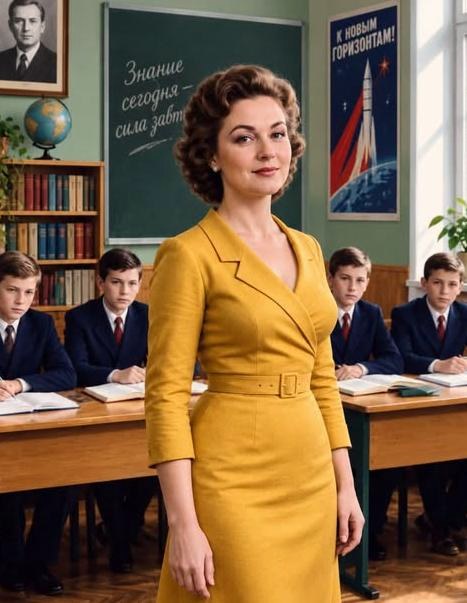
The first boy locked the biology room from the inside, and the second one placed a bloodstained school ledger on my desk.
It was 4:17 on a warm Thursday afternoon in July 1987. Beyond the windows, the birch leaves trembled above Berezovka’s dusty road, and somewhere near the river a tractor coughed itself quiet. I stood beside the demonstration table, still holding a piece of chalk, while Alexei, Dmitri, and Sergei watched me as if I were the student being examined.
“Put the ledger away,” I said.
Alexei smiled. He was the oldest, broad-shouldered and careless, wearing a bright red track jacket despite the heat. “You always say that, Natalya Petrovna. Then you always do what we ask.”
“I have a name.”
“Of course you do.” He tapped the ledger with two fingers. “And we know exactly where to write it.”
I looked at the book. It belonged to the school storehouse. Every bottle of disinfectant, every vial for experiments, every packet of seed was recorded there. The page lying open had been torn from the middle. Several entries were written in my handwriting.
Only I had not written them.
The smell of crushed mint from the afternoon lesson still hung in the room. It mixed with the sharp odor of iodine and the oily scent of the boys’ motorcycles drifting through the open transom. My fingers went cold around the chalk.
“Who gave you that?” I asked.
Dmitri leaned against the cabinet where I kept the microscopes. “Does it matter?”
“It matters if you stole it.”
Sergei laughed under his breath. He was the quietest, with a narrow face and a silver lighter he kept clicking open and shut. “You should worry less about theft and more about signatures.”
They had arrived in Berezovka three weeks earlier, transferred from the regional school after their fathers received new appointments. The principal, Viktor Semyonovich, had personally told me to accept them for extra biology lessons.
“Families like theirs keep schools alive,” he had whispered.
At first, the boys behaved like bored but harmless rich children. They skipped pages, flicked beetles from the windowsill, and complained about the village. Then they began staying after lessons. Three times a week. Always with the principal’s approval.
On Monday, Alexei asked me to open the supply cabinet. On Wednesday, Dmitri made me sign for chemicals I had not received. That afternoon, I found a muddy boot print beneath the basement stairs.
Now the ledger lay between us like a knife.
“I’m going to the principal,” I said.
Alexei caught my wrist before I reached the handle. His fingers were dry and strong. A red pressure mark rose beneath his thumb.
“You are going nowhere.”
“Let go.”
“Ask her what happens when a young teacher accuses the sons of men who can have her dismissed before supper.”
The door shook as someone knocked from the corridor.
“Madam Petrova?” called little Misha Orlov, one of my seventh graders. “Are you there?”
The boys looked at each other.
Alexei released my wrist, but his smile vanished. Dmitri slid the ledger beneath his jacket. Sergei stopped clicking the lighter.
“Tell him to leave,” Alexei whispered.
I stepped toward the door. Misha knocked again, harder.
Then something scraped beneath the floorboards behind the specimen cabinet…
PART 2
The scraping came again, slow and deliberate, like fingernails dragging across the wood.
I stood between the locked door and the cabinet, unable to breathe. Misha was still in the corridor. I could hear his canvas shoes shifting outside.
“Madam Petrova?” he called. “I found something near the river.”
Alexei moved toward him.
“Don’t,” I said.
He turned. “You heard me. Send him away.”
The cabinet trembled. A glass jar of preserved frogs rattled against another. My pulse struck so hard that the room seemed to tilt.
“Go home, Misha,” I called. “I am busy.”
“But you told me to bring you—”
“Go home!”
There was a pause. Then his footsteps ran down the corridor.
Dmitri pulled the ledger from beneath his jacket and dropped it into the sink. “You should have let us handle that.”
“What is under the cabinet?”
Sergei’s lighter clicked once. “Nothing you need to know.”
“That is my classroom.”
“No,” Alexei said. “It is the school’s classroom. And the school belongs to people who understand what you are.”
He reached behind the cabinet and lifted a loose wooden panel. A dark opening appeared in the floor. Cold air rose from it, carrying the smell of damp soil, kerosene, and something metallic.
I stepped back. The heel of my shoe caught on a fallen magnifying glass, and the lens cracked beneath my weight.
“What have you done?”
“Nothing,” Dmitri said too quickly.
That answer frightened me more than any confession.
The boys climbed down one at a time. I followed because Alexei stood beneath the opening, blocking the only path back. The basement was lower than I had known, with brick walls and old shelves stacked with broken desks. At the far end sat a wooden crate. Beside it was a canvas school satchel, ripped open and darkened with blood.
I recognized it.
It belonged to Misha Orlov.
“He was here,” I whispered.
Sergei looked away.
Alexei crouched beside the crate. “He saw us near the pumping station. He followed us. Then he fell.”
“Is he alive?”
“No one said he was dead.”
My knees weakened. “Where is he?”
Dmitri pointed toward the back wall. A narrow door stood beneath a rusted ventilation pipe. Three scratches marked the paint at child height.
I ran to it, but Alexei seized my shoulders.
“Listen carefully. Misha is alive. He will stay alive if you keep doing exactly what we tell you.”
“You kidnapped a child.”
“We protected him from the men who came after him.”
“What men?”
For the first time, uncertainty crossed Sergei’s face. “Our fathers’ men.”
The basement seemed to contract around us.
Alexei explained in broken pieces. Their fathers had been diverting pesticide from the regional warehouses and selling it through the river settlements. The boys had discovered the operation, then joined it. They used the school as a safe place because no one questioned extra lessons with the director’s permission. The chemicals were hidden beneath the biology room and moved at night.
Misha had seen too much.
“You signed the inventory pages,” Alexei said. “If anyone searches the school, the records show you took everything for experiments.”
“I will tell them the truth.”
“Then Misha disappears, and you become the thief.”
A cry came from behind the narrow door.
“Misha?” I shouted.
A weak voice answered, “Teacher?”
I lunged forward. Alexei caught my arm again, but this time I drove my elbow into his ribs. He staggered. I tore the key from Sergei’s hand and shoved it into the lock.
The door opened a few centimeters.
Inside, Misha was curled beneath a wool blanket, his forehead pale, one hand clamped around a torn envelope. He looked at me and whispered, “They don’t know about the woman who keeps the real book…”
Behind me, someone began climbing down the basement steps…
PART 3
The person descending the stairs was Vera Mikhailovna, the school custodian, carrying a brass oil lamp in one hand and a ring of keys in the other.
She stopped when she saw Misha behind the door.
“Move away from the child,” she said.
Alexei straightened, one hand pressed against his ribs. “You should have stayed upstairs.”
Vera set the lamp on a crate. Its flame shook across her lined face. “I stayed upstairs for eleven years. That is how long I watched your fathers empty this village one bottle at a time.”
Dmitri went white. “You knew?”
“I counted.”
She reached beneath her work apron and pulled out a thin black notebook wrapped in oilcloth. The corners were soft from use. When she opened it, every page carried dates, wagon numbers, quantities, and initials.
My initials appeared beside entries I had never made.
“I found this in the boiler room last winter,” Vera said. “Your fathers thought an old woman could not read figures. They were wrong.”
Alexei lunged for the notebook. Vera struck his wrist with the brass lamp handle. He cried out and stumbled against the brick wall.
“You boys were never the masterminds,” she said. “You were bait. Your fathers sent you here because they knew teachers would trust children before they trusted evidence.”
Sergei stared at the notebook. “They told us the chemicals were being sold legally.”
“Then why did they make you carry them at night?”
No one answered.
Misha pushed the door wider. His cheek was bruised, and his school shirt was stiff with dried mud. “I saw Mr. Baranov at the pumping station,” he said. “He was loading the barrels. He saw me.”
Mr. Baranov was the district supply chief and Dmitri’s father.
My stomach turned. “The boys did not hurt Misha?”
“They brought him here,” Vera said. “They were afraid. Afraid of their fathers, afraid of the men with the trucks, afraid of what they had already done.”
Alexei’s face twisted. “We did not plan for him to fall.”
“You locked him in a basement.”
“We had nowhere else!”
His shout struck the walls and came back smaller.
I took the notebook from Vera. Beneath the last page was a folded delivery form bearing Viktor Semyonovich’s signature. The principal had approved the removal of chemical stock under the words “instructional use.” Below it, in red pencil, was a note: Move remaining drums before inspection. Use the teacher’s name.
My hands shook so badly the paper rattled.
“He signed it,” I said.
Vera nodded. “And tonight he means to burn the storehouse.”
A motorcycle engine roared above us. Another answered from the schoolyard.
Sergei looked toward the ceiling. “They came early.”
Alexei grabbed the notebook. I held on. The page tore between us, leaving half the figures in my hand.
From upstairs came the principal’s voice.
“Natalia Petrovna,” Viktor Semyonovich called pleasantly. “Open the basement door. We need to discuss your resignation.”
Misha clutched my sleeve. “The real book is not the only thing I found.”
He unfolded the torn envelope. Inside was a yellowed photograph of three men beside a river pump—and one of them was not any of the officials we knew.
Vera stared at the face and dropped the lamp wick into the oil…
The photograph made Vera drop the lamp wick…
I thought the ledger held the worst secret in that school. I was wrong, and the final discovery changed who was truly trapped.
“My father ordered the shipments.”
The principal’s face collapsed.
👇 The final part of the story is already open.






