The toddler collapsed beside my desk at 3:17 on a Thursday afternoon, and her mother caught her before her head struck the marble floor.
“Mia?” Rosa cried.
The little girl blinked up at us, one hand still gripping the purple building block she had been carrying. Her cheeks had lost their color. The paper crown she had worn that morning slid sideways across her curls.
I was standing behind my desk in the study, reviewing a contract from London. A silver fountain pen rolled off the leather blotter and struck the floor with a sharp click. That tiny sound seemed impossibly loud.
Rosa pressed Mia against her chest.
“Breathe, sweetheart. Look at Mommy.”
“I’m okay,” Mia whispered.
She was two years old. She should not have had to say it like someone reassuring a room full of adults.
I crossed the carpet and knelt beside them.
“How long has this been happening?” I asked.
Rosa’s eyes jumped to mine, then away.
“It was just the running. She gets excited.”
“Mia was sitting when she went pale.”
“She skipped her nap.”
The answer came too quickly. I felt something cold settle beneath my ribs.
Mia reached for the stuffed rabbit tucked under Rosa’s arm. Mr. Buttons had one ear bent permanently forward, and his faded red scarf was held together with three uneven stitches. Rosa gave him to her, and the child hugged him against her chest.
“Can we build?” Mia asked.
“Not right now,” Rosa said.
“But Daniel promised.”
The words hurt in a place I had not expected. For months, her laughter had filled my house and pulled me back into a life I had abandoned after Emily died. Mia had turned my study into a kingdom of blocks, picture books, and impossible purple animals. I had begun measuring my afternoons by the sound of her sneakers in the hallway.
Now those sneakers were motionless.
“I can call the pediatric clinic,” I said.
Rosa stood abruptly.
“No, sir. I’ll take her home.”
“Rosa.”
“She’ll be fine.”
“She fainted.”
Her fingers tightened around the rabbit. “Please don’t make this bigger than it is.”
That sentence followed me through dinner.
At 6:40, I found Rosa in the kitchen washing a glass that was already clean. The copper kettle beside her trembled softly as it heated.
“Go home,” I told her. “Take Mia to a doctor tonight.”
“I don’t have an appointment.”
“Then go to urgent care.”
“I can’t lose another shift.”
“You won’t.”
She turned off the tap. “You don’t understand.”
“Then explain it to me.”
For a moment, the only sound was water dripping from the faucet.
Rosa looked exhausted, not merely worried. There were purple shadows beneath her eyes, and a small adhesive bandage covered the side of her thumb.
“She has good days,” Rosa said quietly. “Today wasn’t one of them.”
“What is wrong with her?”
“I said I’ll handle it.”
She picked up her purse.
I stepped aside, but something on the counter caught my attention. Beneath a folded dish towel lay a white hospital bracelet, the plastic stamped with Mia’s name and a date from three weeks earlier.
Rosa saw me looking.
Her face changed.
“Where did you get that?” I asked.
“Please, Mr. Carter.”
“Why was she in a hospital?”
“It was nothing.”
“People don’t leave hospitals wearing bracelets for nothing.”
Her mouth opened, but no answer came. Then Mia whimpered from the hallway, and Rosa rushed to her.
At 8:05, after they had gone, I called Michael Grant. He found me in the study beneath the brass lamp, holding the hospital bracelet between two fingers.
“You look like you’re about to dismantle a company,” he said.
“I need you to find a pediatric cardiologist.”
Michael’s smile disappeared. “Why?”
“Because a child in my house is sick, and her mother is hiding how sick.”
He studied me. “Does Rosa know you’re making calls?”
“No.”
“Then ask her before you cross that line.”
“I did. She refused.”
Michael picked up the bracelet. His thumb brushed the printed name.
“Daniel, don’t turn guilt into control.”
The words struck harder than they should have.
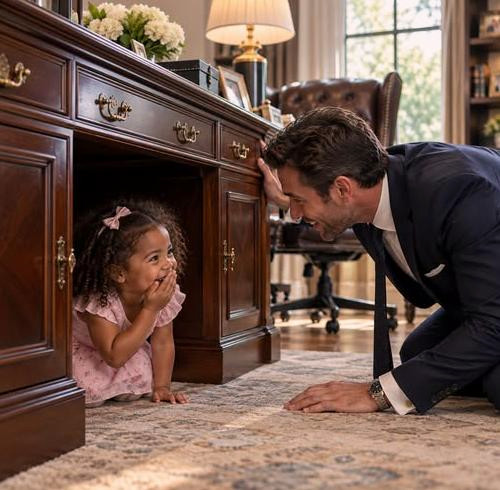
I looked toward the empty doorway, where Mia had once hidden beneath my desk and shouted, “You can’t find me!”
“I’m not trying to control her,” I said. “I’m trying to keep that little girl alive.”
At 9:12, Michael’s phone rang. He listened, wrote down an address, and placed the phone on my desk.
“There’s a pediatric cardiology clinic in Hartford,” he said. “Dr. Anika Patel saw Mia twice this month.”
My pulse began to pound.
“Twice?”
Michael nodded. “And Daniel, the clinic says Rosa canceled tomorrow’s appointment.”
“Why?”
He looked at the bracelet, then at me.
“Because she told them she couldn’t pay.”
I reached for the folder Michael had brought, but before my fingers touched it, the study door opened behind us. Rosa stood there, pale and breathless, with Mia asleep against her shoulder.
“Give me that folder,” she said…
PART 2
“Give me that folder,” Rosa repeated.
It was 9:16 on Thursday night. The study lamp threw a yellow circle across the walnut desk, leaving the shelves behind her in darkness. Mia slept against Rosa’s shoulder, one pink shoelace dangling near the floor.
I kept my hand on the folder.
“You heard us.”
“I heard enough.”
Michael rose from the leather chair. “Rosa, no one is trying to—”
“Please leave.”
His jaw tightened, but he looked at me. I nodded, and he walked past her without another word. The brass handle clicked shut.
Rosa stepped forward.
“That information is private.”
“I know.”
“Then why did you open it?”
“I didn’t. Michael found the clinic after I saw the bracelet.”
Her expression hardened. “You had no right.”
“No,” I said. “But I have a responsibility when a child collapses in my home.”
“She did not collapse.”
“I watched her knees give out.”
Rosa hugged Mia closer. The child’s breath made a faint whistling sound against her mother’s blouse. I heard it clearly. Rosa heard it too and looked down.
“What did the doctor say?” I asked.
“It’s being monitored.”
“That isn’t an answer.”
“It’s the only one I can give you.”
I opened the folder. Inside was a copy of a clinic invoice, a referral form, and a payment estimate clipped to a blue sheet of paper. The number at the bottom stopped me.
“Thirty-eight thousand dollars?”
Rosa snatched the papers from my hand.
“Lower your voice.”
“There’s a procedure.”
“There may be.”
“May be?”
“She needs more tests.”
“Then she needs those tests.”
“With what money?”
Her question cracked across the room.
I looked at the perfect carpet, the expensive books, the bronze clock on the mantel. I had spent more than thirty-eight thousand dollars that month on a private dining table I barely used.
“I’ll pay it.”
Rosa shook her head immediately.
“No.”
“This is not charity.”
“It is exactly charity.”
“It is medical care.”
“It is money from the man who signs my paycheck. That makes it impossible.”
Her voice trembled, but she did not lower her eyes.
I understood then that pride was not the opposite of desperation. Sometimes it was the last wall keeping a person upright.
At 10:03, we sat in the kitchen while Mia slept in the small padded chair beside the pantry. A mug of chamomile tea cooled between Rosa’s hands. The cracked green handle pressed against her thumb.
“Why didn’t you tell me?” I asked.
“Because I needed a job, not pity.”
“You could have taken leave.”
“And then what? Come back to an empty schedule? Find rent money while waiting for a decision?”
“We would have worked something out.”
“You say that because you have always had something to work with.”
The accusation was quiet. That made it worse.
I looked down at my hands. After Emily’s death, everyone had offered help. A driver. A therapist. A business retreat. A house full of employees who made sure I never had to face a dirty plate or an empty room. Rosa had no such cushion.
“How serious is it?” I asked.
She stared at Mia.
“Her heart has a hole in it. A large one. The doctor thinks it is making her lungs work too hard.”
The kitchen seemed to tilt.
“Can it be repaired?”
“Dr. Patel says surgery can help. But Mia is small, and the operation is dangerous.”
“Why cancel the appointment?”
“Because the hospital wanted a deposit before they scheduled anything.”
“Then let me—”
“No.”
The word came out like a slammed drawer.
Mia stirred. Rosa stood, lifted her, and carried her toward the service hallway.
At the doorway, she stopped.
“Please don’t mention this to anyone. Especially not the other staff.”
“I won’t.”
“And please don’t look at me differently tomorrow.”
I had no answer for that.
She left at 10:27. I remained at the kitchen table until the tea turned cold.
The following morning, I drove to Dr. Patel’s clinic instead of going to the office. Rain tapped against the windshield, and the hospital bracelet lay on the passenger seat beside Emily’s old leather notebook. I had taken the notebook from a drawer without knowing why. On the first page, Emily had written a sentence in green ink: Ask what people need before deciding how to save them.
At 8:41, Dr. Patel met me in a consultation room with a model heart on the shelf behind her. A tiny plastic vessel had broken loose from the base and hung at an angle.
“You are Mr. Carter?”
“Yes.”
“Are you Mia’s father?”
“No. I employ her mother.”
“Then I can’t discuss her medical information without Rosa’s consent.”
“I’m not asking you to violate anything. I’m asking what happens when a child misses a cardiac appointment because her mother cannot pay.”
Dr. Patel watched me carefully.
“Sometimes the child gets sicker.”
“Does Mia have time?”
The doctor’s fingers rested on the broken plastic vessel.
“Less than her mother believes.”
My phone rang before I could ask another question. It was Rosa.
“Mr. Carter,” she said, and I heard traffic behind her. “Mia is at the clinic.”
“Is she worse?”
“She turned blue at breakfast.”
The room narrowed around me.
“Where are you?”
“I’m outside the emergency entrance.”
“I’m coming.”
“Don’t.”
“Rosa—”
“Please. If you come, I’ll know you never listened to me.”
The line went silent.
Dr. Patel had heard enough to understand.
“You can’t force her to accept help,” she said.
“I know.”
“But you can make sure she understands every choice.”
At 11:18, Rosa returned to the mansion alone. Her coat was wet, and a strip of medical tape showed above her collar.
“Where is Mia?” I asked.
“In the hospital.”
“What happened?”
“She needs surgery.”
The words landed between us.
I stood.
“When?”
Rosa looked toward the staircase, as though the house itself might overhear.
“Tomorrow morning.”
“Then we’ll arrange everything.”
“No.”
“Rosa.”
“They found another problem.”
She reached into her purse and pulled out a folded consent form. Her hand shook so hard that the paper rattled.
“Dr. Patel said the procedure may not be enough.”
I moved closer.
“What does that mean?”
Rosa unfolded the paper and stared at the bottom line.
“It means they need to know who Mia’s father is before they operate…”
PART 3
“It means they need to know who Mia’s father is before they operate…”
Rosa’s voice broke on the final word.
We were standing in the upstairs linen room at 11:22 on Friday morning. Shelves of folded towels surrounded us, each one embroidered with the Carter crest. The ordinary neatness of the room made the situation feel unreal.
“Why would the hospital need her father?” I asked.
“For medical history. For consent if something happens to me.”
“Where is he?”
“Gone.”
“Gone where?”
“Everywhere.”
She folded the form again, but a second page slipped loose and landed beside a basket of lavender-scented towels. I picked it up before she could stop me.
It was a medical history sheet. Under family conditions, one line had been circled in red: congenital heart disease, paternal side.
I looked at Rosa.
“Her father has the same condition.”
“He had a heart repair when he was six.”
“And you knew Mia might inherit it?”
“I knew there was a risk.”
The hallway clock struck eleven-thirty. The sound traveled through the walls like a warning.
“Why didn’t you tell Dr. Patel?”
“I did.”
“Then what is missing?”
Rosa pressed her palms against her eyes.
“His records. His signature. They need to confirm whether he carries the mutation.”
“Where is he?”
She lowered her hands.
“His name is Caleb Ward.”
I waited.
“He left before Mia was born. He told me a child with my life would ruin his plans. He moved to another state and changed his number.”
“Have you looked for him?”
“Every year.”
“Why hide that from the hospital?”
“Because I was afraid they would delay her. Because I was afraid they would decide I was irresponsible. Because I have spent two years making sure nobody could take my daughter from me.”
Her confession stripped the anger from my chest. I had mistaken silence for stubbornness. It had been terror.
At 12:07, Dr. Patel joined us in the mansion’s breakfast room. Rain streaked the windows, and a bowl of untouched strawberries sat on the table. Rosa sat rigidly in a wooden chair while I stood beside the fireplace.
“Rosa,” the doctor said, “we do not need Caleb’s permission to operate. But his history could change the surgical plan.”
“Can you do it without him?”
“Yes.”
“Then why are we talking about him?”
“Because Mia’s scan shows more strain than we expected. Her heart is compensating, but not well. We need every piece of information available.”
Rosa’s fingers dug into the edge of the chair.
“Can she survive tomorrow?”
Dr. Patel did not soften the answer.
“She has a strong chance. Waiting makes that chance smaller.”
I felt Rosa’s fear move through the room like a second pulse.
“I’ll cover the hospital deposit,” I said.
Rosa turned toward me.
“No.”
“Not as a gift. As an advance against emergency leave.”
“I can’t repay thirty-eight thousand dollars.”
“Then don’t call it a loan.”
Dr. Patel looked between us.
“Mr. Carter, the hospital has an assistance office. We can combine insurance, grants, and a payment plan.”
“I will sign whatever is needed.”
Rosa shook her head. “You don’t get to decide.”
“No,” I said. “You do. But you should not have to choose between your child’s operation and your rent.”
That was when the back door opened.
Peter Lawson, the estate manager, stood there holding a small brown envelope. His gray hair was damp from the rain, and mud marked the edge of his work boots.
“I’m sorry,” he said. “There’s someone at the gate asking for Rosa.”
Rosa went completely still.
“Who?”
Peter looked at the envelope.
“He gave me this and said the name Caleb Ward.”
The room seemed to lose its air.
Rosa rose so quickly that her chair scraped the floor.
“No.”
I took the envelope from Peter. It was not sealed. Inside was a photocopy of an old insurance card, a handwritten address, and a short note.
I read it aloud.
“Rosa, I heard about Mia. I have been trying to find you. Please let me see my daughter before the operation. Caleb.”
Rosa’s face crumpled.
“He can’t come in.”
A man’s voice came from the hallway.
“I’m not here to take her.”
Caleb Ward stepped into the breakfast room. He was thinner than I expected, with a scar running from beneath his left ear to the collar of his jacket. He held both hands where we could see them.
Rosa moved between him and the staircase.
“You left us.”
“I know.”
“You never called.”
“I did. Your number changed.”
“You sent nothing.”
“I was ashamed.”
She laughed once, sharply. “Shame is comfortable when someone else is carrying the baby.”
Caleb looked at the consent form in her hand.
“Let me give Dr. Patel my records. Let me sign whatever Mia needs.”
“You don’t get to walk in because she’s sick.”
“I know.”
His eyes moved to me.
“I’m not asking to be her father today. I’m asking to be useful.”
Dr. Patel took the insurance card from the table.
“Caleb, do you have documentation of your repair?”
He pulled a plastic medical file from his jacket. The corner was softened from being carried too often.
“Yes.”
She opened it, scanned the pages, and stopped.
“What?” Rosa whispered.
Dr. Patel’s expression tightened.
“His records show a rare vascular complication. If Mia has inherited it, tomorrow’s procedure needs a different surgical team.”
“Can you still operate?” I asked.
“Not at this hospital.”
She reached for her phone.
“There is one surgeon in Boston who handles this combination. I need to call him now.”
Her phone began ringing before she finished dialing. She answered, listened, and turned toward me.
“Mr. Carter, the surgeon can take Mia tonight.”
Rosa gripped the table.
“Tonight?”
Dr. Patel’s face went pale.
“And the hospital just called. Their cardiac unit has lost power in the operating wing. They are evacuating the patients…”
The surgeon opened Mia’s file—and everything changed…
I thought the hardest part was paying for the operation. I was wrong. What came next forced all of us to face the truth we had been avoiding.
“Can’t find me?”
The room broke into tears and laughter.
👇 The final part of the story is open






