PART 4
“They are evacuating the patients,” Dr. Patel finished.
For three seconds, nobody moved.
Then Rosa grabbed her purse.
“Where is Mia?”
“Still at Hartford Children’s,” Dr. Patel said. “They’re transferring her by ambulance to Boston, but the receiving team needs a parent present.”
“I’m her mother.”
“Then we go now.”
Caleb stepped forward. “I’ll drive.”
Rosa turned on him.
“You don’t know where anything is.”
“I know how to get to Boston.”
“You haven’t earned the right to sit beside us.”
“No,” he said. “But I can get you there.”
The answer stopped her, not because it repaired anything, but because it was practical. Mia needed practical things: a vehicle, a signature, a medical file, a mother who could keep breathing.
I took my keys from the breakfast table.
“We’ll use my car. Peter, bring the emergency bag from the garage. Michael is calling the hospital administrator.”
Rosa stared at me.
“You have a meeting.”
“Not today.”
The drive to Hartford took twenty-two minutes. Rain hammered the windshield, and the wipers moved so quickly they seemed to erase the road before it appeared. Rosa sat beside me clutching Mr. Buttons. Caleb followed in his car.
Neither of us spoke until she said, “If she dies, I will never forgive you.”
I kept my eyes on the road.
“For what?”
“For helping.”
“I can live with that.”
“No, you can’t. People like you give money and expect gratitude. Then, if the worst happens, you tell yourself you tried.”
She was crying now, but her voice remained hard.
“I’m not trying to feel like a good man,” I said. “I’m trying to get your daughter to Boston.”
The ambulance bay was crowded with nurses, rolling equipment, and families holding plastic bags of belongings. A generator rumbled behind the building. Its exhaust smelled of hot metal and wet pavement.
We found Mia in a transport room beneath a warming blanket. Her face was pale, and thin wires crossed her chest. When she saw me, she lifted one finger.
“Daniel,” she whispered.
I bent beside the bed.
“I’m here.”
“Build tower?”
“After you get better.”
She considered this with the seriousness of a contract.
“Big one.”
“The biggest one.”
Rosa kissed her hair. Caleb stood near the wall, staring as though the machines were a language he had forgotten how to read.
A nurse handed Rosa a packet.
“Sign here for transfer.”
Rosa’s hand shook over the page.
Caleb moved closer.
“Give it to me.”
She looked at him sharply.
“What?”
“Your hand is shaking. Let me hold the clipboard.”
He did not touch the pen. He only steadied the packet against his palm.
Rosa signed.
That small act changed nothing between them. It changed everything about the next hour.
At 1:06 in the morning, the ambulance doors closed. I watched the vehicle pull away with its lights flashing against the rain.
Michael arrived ten minutes later, soaked from the parking lot and carrying a folder.
“The hospital assistance office approved temporary coverage,” he said. “But there’s a problem.”
“Of course there is.”
“The policy is under Rosa’s former employer. It expired when she changed jobs two years ago.”
Rosa pressed both hands to her face.
“I knew it.”
“What?” I asked.
“The bill. The surgery. Everything. That’s why I kept working. I thought if I could stay invisible, nobody would ask questions.”
Michael opened the folder.
“I brought a proposal from the company board. We can create an emergency medical fund for all household and warehouse staff. No special treatment. No repayment. The board approved it unanimously.”
Rosa lowered her hands.
“Because of Mia?”
“Because people get sick,” Michael said. “Mia made us notice.”
I added, “And because Emily spent years saying our companies were only as decent as the way they treated people who had no leverage.”
Rosa looked at me.
“You remember everything she said.”
“I remember the things I ignored.”
At 2:18, we reached Boston. The cardiac team met us beneath a white corridor light. Dr. Lena Ortiz, the surgeon, shook Rosa’s hand and then Caleb’s.
“I have reviewed your daughter’s scans,” she said. “The additional family records were important. We can repair the defect, but the vascular complication means we need a second team on standby.”
“How dangerous?” Rosa asked.
“Dangerous enough that I will not make promises. But treatable.”
Rosa nodded, though her lips had gone white.
Dr. Ortiz looked at me.
“Are you family?”
“No.”
“Then only the parent may authorize treatment.”
“I understand.”
Rosa stared at the consent form.
Caleb stood beside her.
“If you want me gone, I’ll go,” he said. “But if you want me to sign as a witness, I will. If you want me to tell the surgeon everything about my condition, I will. If you want me to spend the rest of my life proving I should have done this before, I will.”
Rosa’s eyes filled.
“You think saying that fixes it?”
“No.”
“Then why say it?”
“Because I have nothing else that isn’t a lie.”
She looked at the scar beneath his ear.
“Were you afraid?”
“Every day.”
“And you left because you were afraid?”
“I left because I was a coward. Fear explains it. It doesn’t excuse it.”
The surgeon waited quietly.
Rosa signed the consent form.
Then she handed the pen to Caleb.
“Tell her what happened when you were six.”
He took the pen, but instead of signing, he sat beside Rosa and began describing every surgery, every medication, every complication he remembered. Dr. Ortiz listened. Rosa listened too. I stood near the vending machines, holding Mr. Buttons because Mia had released him when the nurses took her through the double doors.
At 3:02, the operating room doors closed.
Rosa sat beneath a wall clock with a cracked plastic face. Caleb remained three chairs away. Michael went to arrange the fund paperwork. I called the office and canceled every meeting on my calendar.
No one said, “She’ll be fine.”
We had all learned that hope was not a substitute for truth.
At 5:47, Dr. Ortiz appeared.
Rosa stood so quickly that her chair struck the wall.
“The repair is complete,” the surgeon said. “There were complications, but we managed them.”
Rosa covered her mouth.
“Is she alive?”
“She is alive. She is in intensive care, and the next twelve hours matter.”
Rosa folded against the wall. Caleb reached for her, then stopped before touching her.
I put my hand beneath her elbow.
She allowed me to steady her.
At noon, the nurse let us see Mia through the glass. She looked impossibly small beneath the wires and blankets. A monitor traced green peaks above her bed.
Rosa entered first. She leaned close and whispered, “Mommy is here.”
Mia did not wake.
Caleb stood outside the room, unable to cross the threshold.
Rosa looked back at him.
“You can come in.”
He shook his head.
“I haven’t earned that.”
“No,” Rosa said. “But she shouldn’t have to wait for you to become worthy.”
He entered.
He did not touch Mia. He stood at the foot of the bed and told her, in a broken voice, about the first heart surgery he had survived. He told her that the scar behind his ear was not a monster’s mark, no matter what other children had called it. He told her that he had once been afraid of hospitals too.
Rosa listened with her arms folded.
When he finished, she said, “You will not disappear after this.”
“I won’t.”
“If you want to be in her life, you will do it slowly. You will show up when she is healthy, not only when everyone is terrified.”
“I will.”
“And you will never make me beg for support again.”
Caleb nodded.
“I will learn how.”
It was not forgiveness. It was a set of conditions.
That was more honest than forgiveness.
Mia woke two days later, just before the afternoon shift changed. Her eyes opened halfway, and she turned her head toward the chair beside the bed.
I was there with a stack of foam blocks the hospital gift shop had found in a supply closet. They were soft, washable, and shaped like bright arches.
Mia looked at them.
“Tower?”
My throat tightened.
“Only if the doctor says yes.”
She thought about this, then lifted one weak hand.
“Daniel.”
“Yes?”
“Can’t find me?”
Rosa began to cry. Caleb laughed through his tears. Even the nurse at the doorway pressed a hand to her mouth.
I leaned closer.
“I found you.”
Mia’s fingers closed around the smallest block.
“Again.”
So I placed the first block on the tray table. Rosa placed the second. Caleb, after asking permission, placed the third.
The tower leaned immediately.
Mia watched it with fierce concentration.
“Stay,” she whispered.
It wobbled but held.
Behind the glass, the heart monitor continued its steady green rhythm. Dr. Ortiz later told us Mia would need years of follow-up care, careful medication, and no pretending that survival meant the danger had vanished. The company fund covered the treatment without putting Rosa in debt. Her job remained protected, and Michael made the policy available to every employee who needed it.
Caleb rented a room near the hospital and began attending every appointment he was allowed to attend. Rosa did not move him into their lives. She made him earn each place at the table.
I returned to Connecticut with a stack of medical forms, a canceled acquisition, and a study that no longer felt like a mausoleum. The purple building block Mia had dropped on the day she fainted stayed on my desk beside Emily’s green notebook.
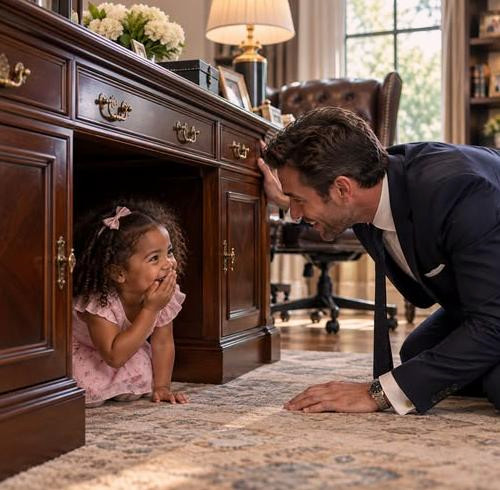
A week later, Mia came home for an afternoon visit. She was still weak, still surrounded by instructions, but she insisted on crawling beneath my desk.
“You can’t find me!” she called.
I lowered myself carefully onto the carpet.
“I know exactly where you are.”
“No!”
Her laughter rose beneath the desk, bright and stubborn.
I reached for the foam block she had carried from the hospital.
“Then give me a clue.”
A small hand pushed the block into mine.
“Build.”
Missed the beginning?






