PART 4
The engine stopped beneath the chapel steps.
For three heartbeats, no one moved.
Then Nora Doyle came through the open corridor with a red scarf tied around her wrist and six men from the river road behind her. They were warehouse workers, mechanics, and boat hands—people who had spent years watching Calder collect money from their wages while pretending the river belonged to him.
Nora saw me on the floor beside Rhett.
“Winnie?”
“I’m all right.”
“You’re bleeding.”
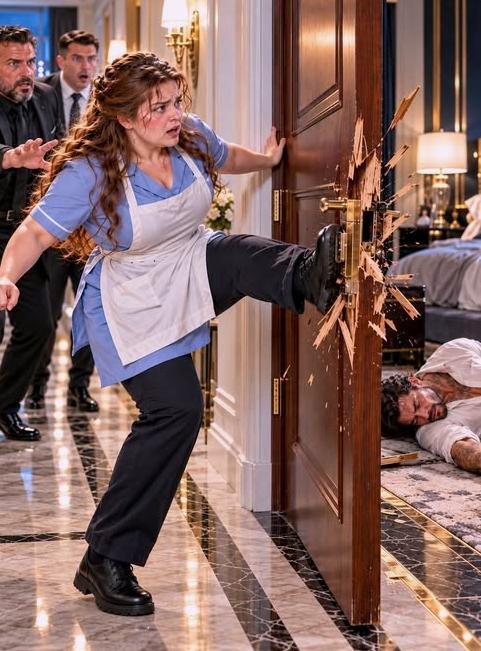
I looked down. A splinter from the broken door had cut my palm. I had not felt it.
Nora crossed the room and pulled me upright. Her fingers smelled of coffee and engine oil, the same smell that had clung to her clothes since she reopened the diner in a temporary storefront.
Calder took one step toward her.
“You should have stayed away.”
Nora’s eyes never left his face.
“You said that seven years ago, too.”
The workers spread through the corridor. They did not shout. They did not need to. Their silence had weight.
Halvorsen lowered his pistol and looked at the signed delivery sheet in Mrs. Bell’s hand.
“Is it true?” he asked Calder.
Calder’s mouth tightened.
“Rhett was weak. The city was changing. Someone had to make decisions.”
“That is not what I asked,” Halvorsen said.
Calder glanced at him. “You were paid to guard this house.”
“And I did.”
“You were paid to obey.”
Halvorsen looked at the floor where Rhett lay choking for breath.
“No. I was paid to keep him alive.”
That was the moment Calder lost the room.
Not because anyone attacked him.
Because every man who had been waiting for permission stopped waiting.
Mateo hurried to Rhett’s side with towels and water. Mrs. Bell knelt beside him and began counting his breaths. Nora took the brass key from my hand.
The scratched letters—NORA—caught the lamplight.
“You kept it,” she whispered.
“I didn’t know what it was.”
“You weren’t supposed to.”
Rhett opened his eyes.
“Under the chapel,” he said. “Go.”
Calder moved toward the staircase.
One of the river workers blocked him with a broad shoulder.
“Not without us.”
The chapel stood at the far end of the estate, a small stone building built by Rhett’s grandfather when the mansion was still surrounded by marshland. At 2:19 a.m., Nora pushed its warped door open, and the smell of damp stone rose around us.
A brass lock waited beneath the altar.
The key fit.
Behind the altar, a narrow section of wall released with a heavy click. Inside was a metal cabinet, sealed with wax and covered in dust. Calder had claimed for years that the chapel was empty. He had been wrong—or Rhett had wanted him to believe he was.
Nora opened the cabinet.
There were ledgers inside. Bank drafts. Property deeds. Copies of contracts signed by Calder’s men. And beneath them, wrapped in oilcloth, was a small notebook with my father’s name on the first page.
I touched it and felt the old diner floor beneath my feet, the night of the fire, the smoke pressing into my lungs while Nora screamed from the pantry.
“What is that?” I asked.
Nora opened it carefully.
Our father had written down every payment Calder demanded before the fire. He had also written the name of the man who delivered the fuel.
It was not Calder.
It was Rhett Marquetti.
The room seemed to narrow around me.
Nora read the line again, her lips parting.
“Rhett ordered it.”
Behind us, someone made a quiet, broken sound.
Rhett had followed with Mateo’s help. His face was gray, but he was standing. Halvorsen held him beneath one arm. Calder remained between them and the chapel entrance, watching the notebook in Nora’s hands.
I turned toward Rhett.
“Did you burn our diner?”
He did not deny it.
Nora’s hand closed around my wrist.
“Winnie, don’t go near him.”
But I was already walking.
Rhett stopped three feet away. His breathing was shallow. The poison had left his face drained and his eyes older than the mansion around us.
“I ordered the fire,” he said.
The words landed harder than the bedroom door.
“Why?” I asked.
“Calder was stealing from me. He wanted the river road. Your father discovered the accounts and refused to sell. I thought a controlled fire would scare him into leaving.”
Nora laughed, but there was no humor in it.
“You called that controlled?”
“I did not know you were inside.”
“You never came to see whether we survived.”
“I sent money.”
“You sent a debt collector.”
Rhett looked at me. “I sent Calder. He changed the order.”
Mrs. Bell stepped forward.
“He added the fuel truck,” she said. “He wanted the whole property. Rhett’s order was reckless. Calder made it murderous.”
Calder’s head snapped toward her.
“You old fool.”
Nora lifted the delivery sheet. “And you signed it.”
“I signed a hundred things.”
“Then you will not mind signing one more.”
She placed a blank transfer form on the chapel altar.
Calder stared at it.
The river workers had brought the form from the estate office. It transferred every warehouse along the river road into a cooperative held by the workers and the families who had paid Calder’s fees. The ledger showed that the properties had already been bought with their money. Calder had only concealed the ownership.
Rhett had the authority to sign.
Calder understood what he was losing.
“Those warehouses are mine.”
“No,” Rhett said. “They were never yours.”
“You need me.”
“I needed you to believe that.”
Calder lunged for the form.
Mateo caught his wrist. Halvorsen stepped in beside him. The workers closed around the underboss until he stood alone beneath the chapel’s cracked wooden cross.
No one called the authorities. Not yet. The ledgers would go to the city’s financial office, and the fire records would go to the insurance board. But the first consequence belonged to the people Calder had robbed.
They took his keys.
They removed his name from the warehouse accounts.
They made him watch as Rhett signed the transfer.
Rhett’s hand shook so badly that the first signature became a crooked black smear. He tried again.
Nora watched every stroke.
When it was finished, she folded the paper and placed it in her coat.
“And the diner?” she asked.
Rhett looked at me.
“It belongs to you,” he said. “The original deed was in the cabinet. Your father paid for it before Calder forced the loan. The debt was invented.”
I took the deed from Nora’s hands.
Seven years of interest. Seven years of threats. Seven years of believing our family had failed because we were careless, poor, and too tired to fight.
The paper was real.
The debt was not.
I turned to Rhett.
“You don’t get forgiveness because you gave us back what you stole.”
“I know.”
“You don’t get to come near Nora’s diner.”
“I know.”
“And you will sign every document needed to clear our name.”
“I will.”
His voice broke on the last word.
I expected satisfaction. I expected the clean rush of victory.
Instead, I felt tired enough to sit on the chapel floor.
Rhett had saved us from Calder only after helping create the fire. Calder had poisoned him because he wanted the empire Rhett had built through fear. Both men had called their choices necessary. Both had expected other people to live with the smoke.
Nora took my injured hand and wrapped it with a strip of cloth torn from her red scarf.
“Come on,” she said. “We have a diner to rebuild properly.”
I looked once at the mansion behind us.
The broken bedroom door still hung crooked on its hinges. The dark stain beneath it had dried into the carpet. Somewhere inside, the brass key had left a bright scratch in the floor where it had slid from Rhett’s hand.
I did not feel like a cleaner anymore.
I felt like a witness who had finally decided where to stand.
At dawn, Nora and I carried the deed through the empty dining room of the old diner. The fire had blackened the ceiling, but one thing remained untouched: my father’s red enamel cash register, its little brass bell still fixed above the drawer.
Nora set the deed beside it.
Then she placed the signed warehouse transfer on top.
“Should we keep the bell?” she asked.
I ran my thumb over the chipped enamel.
“Yes,” I said. “Let it tell everyone who owns the counter.”
Nora pressed the drawer shut, and the bell rang once through the burned-out room.
From the street, the first truck arrived carrying new timber.
The sound echoed through the diner like a promise nobody else had the right to make for us.
Missed the beginning?






