PART 4
I read the message again while the hospital monitor beeped steadily behind the wall.
The locked cabinet in our bedroom.
I had installed it two years earlier for passports, tax documents, and the small collection of family papers my father had left me. Marissa knew the combination. Logan did not.
I looked at her.
“Why does the school counselor know about our cabinet?”
Marissa’s face had gone blank.
“I have no idea.”
Logan pulled at my sleeve. “Dad, I didn’t open it.”
“I know.”
“I only saw her put something inside.”
Marissa turned sharply. “Who?”
“Marissa.”
The sound of her name stopped the room.
Logan’s lips trembled. “Yesterday, after school. She thought I was in the bathroom. She put a folder in the cabinet.”
Marissa’s eyes flashed with panic.
“I was putting away bills.”
“Bills don’t need a locked cabinet?”
“Paul, your daughter is in the hospital.”
“And my son is telling me you hid something.”
“He is confused.”
Logan shook his head. “It had the hospital picture on it.”
“What picture?”
“The one of Mia when she was born.”
I felt a cold pressure behind my ribs.
Mia had been born sixteen months earlier. The delivery had been difficult, and Marissa had spent five days recovering. I had taken a photograph of her holding the baby, exhausted and smiling beneath a knitted yellow cap.
There had been one copy.
Or so I thought.
At 7:02 p.m., I went into Mia’s room. She was awake, her cheeks flushed, one tiny hand gripping Logan’s stuffed rabbit. The red wheel from the toy truck sat in the sealed cup on a counter near the sink.
“Dada,” she murmured.
I touched her forehead.
“I’m here, sweetheart.”
Logan stood in the doorway.
“Can I see her?”
I held out my hand. He approached slowly, as if someone might still send him away. When he leaned over the crib, Mia grabbed the sleeve of his sweatshirt.
He began crying.
“I didn’t let her eat it,” he whispered.
“I know.”
“I tried to get it out.”
“You saved her.”
Behind us, Marissa made a broken sound.
Logan looked at her. “Why did you tell Dad I gave it to her?”
She had no answer ready this time.
That frightened me more than her anger had.
At 7:24, I left the hospital with Logan and drove to his school. The building was mostly dark, but the counselor, Evelyn Price, waited in the front office with a brown folder pressed against her chest.
She was a short woman with silver glasses and a blue scarf covered in tiny white stars. Her hands were trembling.
“You said this was urgent,” I told her.
“It is.”
Logan moved closer to me.
Evelyn looked at him. “You can tell your father yourself.”
He swallowed. “Marissa asked me to sign something.”
“What?”
“She said it was permission for me to stay with her mother. But it said I was dangerous around Mia.”
I turned to Evelyn.
“He showed me the paper yesterday,” she said. “He was afraid to take it home. I asked him why.”
Logan stared at the floor tiles.
“He said Marissa told him Dad would choose the baby if he made trouble.”
My hands curled into fists.
Evelyn opened the folder. Inside were three documents, each bearing my forged signature. One requested temporary guardianship of Logan by Marissa’s mother. Another described him as aggressive and jealous. The third authorized a transfer from his school to a residential behavioral program.
I could barely breathe.
“She was planning to send him away,” I said.
“Tomorrow morning,” Evelyn replied. “The school received a call from Marissa’s mother today asking what time the transport would arrive.”
Logan looked at me. “I thought you knew.”
I crouched in front of him.
“Buddy, I would never sign something like that without talking to you.”
“She said you were tired of me.”
The sentence tore through me.
I pulled him into my arms. His body remained rigid for one second, then collapsed against my chest.
“I was working too much,” I whispered. “But I was never tired of you.”
At 8:11, we returned to the hospital. Marissa was waiting outside Mia’s room. Her wedding ring had left a red mark around her finger because she had been twisting it so hard.
I placed the folder on the chair between us.
She stared at the documents.
“Where did you get those?”
“From Logan’s counselor.”
“You went to the school?”
“She called me.”
Marissa closed her eyes.
“Paul, I was going to fix everything.”
“You forged my signature.”
“I had already spoken to a program.”
“For our son.”
“He needs help.”
“He needs adults who do not lie to him.”
Her face crumpled. “I was drowning.”
“Then you should have told me.”
“I did tell you. You never listened.”
“I listened when you said you were tired. I offered help. You said you had it under control.”
“I didn’t have it under control!” she shouted.
The hallway fell silent.
A nurse glanced toward us, but I did not move.
Marissa pressed both hands to her mouth. “I hated that baby for needing me. I hated Logan because he made me feel like I had failed before I even became his mother.”
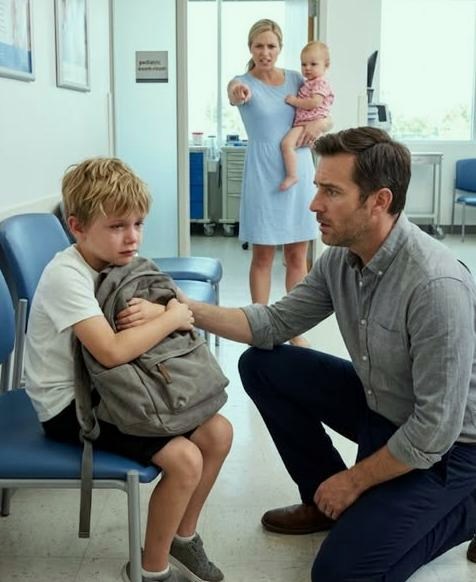
Logan stood behind me, holding the strap of his backpack.
Marissa saw him and began to cry.
“I never wanted Mia hurt,” she said.
“But you left her with a child,” I replied. “And when the child saved her, you made him the villain.”
She sank into the chair.
For a moment, I saw not a monster, but a frightened, resentful woman who had made a series of choices and then tried to bury each one beneath the next. Understanding her did not erase what she had done.
The hospital social worker arrived at 8:46. She spoke privately with me, then with Logan, then with Marissa. The forged documents were copied. The school was notified that no transfer had been authorized. Marissa’s mother called twice and left furious messages when she learned the plan had collapsed.
I did not answer.
The next morning, Mia was discharged with instructions to return if her breathing changed. She rode home in her car seat, clutching Logan’s rabbit. Logan sat beside her, watching every breath.
At the house, I found the bedroom cabinet open.
Inside was the folder Evelyn had mentioned and the yellow-capped photograph from Mia’s birth. Marissa had written on the back in black ink:
HE WILL ALWAYS COME FIRST.
I carried it to the kitchen, where Logan was standing beside the table with his math worksheet.
Question seven was still unfinished.
He looked at me. “Can you help me with fractions?”
I sat beside him.
“Yes.”
Mia began crying in the living room. I started to rise, but Logan caught my sleeve.
“I can stay with her while you explain this one.”
I looked at him carefully.
“You do not have to watch her, buddy.”
“I know.” He glanced toward the living room. “I just want to.”
“Then we do it together.”
I carried the worksheet to the rug. Logan brought the colored blocks from his backpack, and we used them to divide the shapes into halves and quarters while Mia reached for the stuffed rabbit between us.
Marissa was not there. She had gone to stay with her mother while the arrangements were made for counseling and separate housing. I did not know whether our marriage would survive. I knew apologies would not be enough, and I knew Logan would need more than one conversation to believe he was safe.
But when he finally solved question seven, he looked toward the baby and smiled.
“She gets the big piece,” he said.
Mia grabbed it with both hands.
Logan laughed, then pushed the smaller piece across the worksheet toward me.
“Dad, you can have the leftover quarter.”
I looked at the red wheel sealed in the evidence cup on the counter, the tiny object that had nearly taken my daughter’s breath and exposed everything my wife had hidden.
Then Logan leaned against my shoulder and asked, “Do you think I’m still part of this family?”
I put my pencil down.
“You are the reason it is still one.”
From the living room, Mia’s breathing stayed soft and steady.
Logan drew one final line beneath his answer and wrote, in careful block letters: “The whole is still there.”
Missed the beginning?






