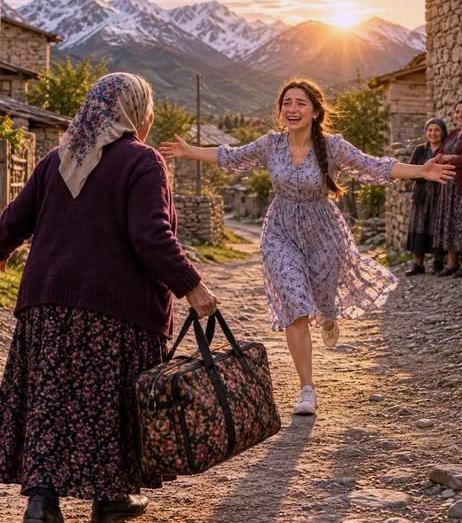
The letter began with “Dear Grandma Valya,” and before I reached the second line, the teacup slipped from my hand and shattered on the kitchen floor.
For twelve years, I had told everyone in the village that I had no daughter. I said it at the post office, beside the well, outside the church, even when drunk old Pavel asked whether my Lisa had ever written from the mountains.
“No daughter,” I would answer.
Then I would go home and take her photograph from beneath the folded sheets.
That morning in early May, I had just returned from the garden. Mud clung to my boots, my lower back burned, and the smell of crushed wormwood followed me into the house. An envelope lay beneath a brick on the porch. The handwriting was uneven, almost childish.
I stared at the address for nearly ten minutes.
My neighbor Galya appeared at the gate with a basket of eggs.
“Valya, are you coming to tea?” she called. “What are you holding?”
“Nothing.”
“Nothing has a name written on it?”
I turned the envelope over. There was no return address, only my name and the village street. My thumb trembled against the paper.
“Open it,” Galya said more softly.
“I know who sent it.”
I did not know. That was the worst of it.
Inside lay a page torn from a school notebook. The first line was written in blue pencil: “Dear Grandma Valya, my name is Amina. I am your granddaughter.”
I sat down so quickly the chair scraped the floor.
Amina wrote that she was eleven. Her little brother Magomed was seven. Their mother was Lisa. Their father was Ruslan. Lisa was in a hospital and needed an operation. Ruslan worked far away. The children were alone with their grandfather. Lisa cried and spoke about me every day.
At the bottom, Amina had added, “Please come, even for one day. We want to see what you look like.”
Galya stopped breathing for a moment.
“Is she alive?” she whispered.
“She is sick.”
“No, I mean Lisa.”
I pressed the page to my chest. The paper smelled faintly of pencil shavings and smoke.
“Alive,” I said. “But she may not stay that way.”
That night, I took out the old photograph. Lisa was seventeen, wearing a white graduation dress and holding daisies. I remembered the day she had stood by the window and told me she loved a man from Dagestan.
“His faith is different,” I had said.
“He is good, Mama.”
“You leave with him, and you stop being my daughter.”
She had cried. Ruslan had stood beside the door, crushing his cap in both hands.
“Think carefully,” he told me.
“I already have.”
Now, twelve years later, I packed that same photograph into a cloth bag. I sold my cow, gave the chickens to Galya, and locked the house.
“You don’t even know what waits there,” Galya said at the gate.
“I know who waits there.”
At dawn, I boarded the bus with one suitcase, my documents, and the letter pressed against my ribs. The road climbed into the mountains, where the clouds hung low enough to touch.
At the final stop, a broad-shouldered man in a dark wool coat stood beside an old silver car. He looked at me, then at the photograph in my hand.
“Valentina Egorovna?” he asked.
“Yes.”
“I am Ruslan’s father. Idris.”
His voice was calm, but his fingers tightened around a small string of prayer beads.
“Is my daughter alive?” I asked.
He looked toward the winding road above the village.
“She is waiting for you. But before you see her, the doctor must tell you something…”
PART 2
“What must the doctor tell me?” I demanded.
Idris did not answer immediately. The beads clicked once between his fingers, a dry little sound inside the mountain wind.
“Get in,” he said. “The hospital is forty minutes away.”
“I did not come forty years through fear to sit quietly now.”
His face tightened.
“Your daughter’s condition is serious.”
“Serious how?”
“Her kidneys are failing.”
The word struck harder than the bus ride, harder than the twelve years I had spent pretending not to remember her voice. I climbed into the car. The seat smelled of pine resin and dust, and a child’s red scarf was tangled around the gear lever.
“Why did nobody tell me?” I asked.
“Lisa told us not to search for you.”
“Why?”
“Because you had made your choice.”
I looked at him sharply.
“I made it in anger.”
“She believed you meant it.”
The hospital stood below a cliff, a pale building with narrow windows. At noon, Idris led me through a corridor where the floor shone with disinfectant. Amina waited on a bench, thin and solemn, holding a knitted green cap. Beside her sat Magomed, swinging his legs and gripping a toy truck with one missing wheel.
Amina rose first.
“You look like Mama,” she said.
I touched her cheek. Her skin was warm, and the small scar above her eyebrow felt like a question beneath my fingertip.
“You look like Lisa.”
“Do you know her?” Magomed asked.
“I am her mother.”
He studied me.
“Then why didn’t you come before?”
No answer I had could survive that child’s eyes.
Lisa lay in a private room beneath a thin blanket. Tubes ran from her arm to a machine that pulsed with patient blue light. She was thinner than the girl in my photograph, but when she opened her eyes, I knew her immediately.
“Mama?”
I gripped the metal rail of the bed.
“You called me that.”
Her lips trembled.
“I called you every day.”
“Then why did you stay silent?”
“Because you told me not to come back.”
“I expected you to disobey me.”
A weak laugh escaped her, then became a cough. I bent toward her, terrified of touching her and more terrified of not touching her.
Ruslan entered carrying a paper bag of medicine. He stopped when he saw me.
For a moment, neither of us moved.
“You came,” he said.
“Your daughter wrote to me.”
“I know.”
“Did you want her to?”
He put the bag on the table. The paper crumpled beneath his hand.
“I wanted to come for you twelve years ago. Lisa would not let me.”
“Why?”
“She said your pride was the only thing you had left.”
I turned to Lisa.
“You protected my pride?”
“I was ashamed,” she whispered. “I thought you were right to hate me.”
“I never hated you.”
“But you said—”
“I said the cruelest thing I knew because I was afraid.”
A doctor arrived at four in the afternoon. Her name was Dr. Samira Karimova, and she carried a yellow folder against her chest.
“Mrs. Egorovna, we ran preliminary tests,” she said. “Your blood type matches Lisa’s.”
My knees weakened.
“Matches for what?”
“A kidney transplant may save her life.”
Lisa pushed herself upright.
“No,” she said.
I stared at the doctor.
“Can I give her mine?”
“Your age and heart condition make the operation dangerous. We need further examinations.”
Ruslan shook his head.
“She has just arrived. You cannot ask this of her.”
I looked at my daughter, at the tubes, the pale lips, the wedding band she still wore on a swollen finger.
“I did not come to watch her die.”
The doctor opened the folder, but before she could speak, an orderly rushed into the room with a telegram in his hand.
“Doctor, this arrived from the regional center,” he said. “They say the donor file was already opened twelve years ago. Under the name of…”
PART 3
“Under the name of whom?” I asked.
The orderly looked at the folder, then at Lisa.
“Valentina Egorovna.”
The room seemed to tilt. Even the machine beside Lisa gave a sudden sharp beep.
I turned toward my daughter.
“You opened a donor file twelve years ago?”
Lisa closed her eyes.
“I did not.”
Dr. Samira removed several papers from the yellow folder. One was an old medical referral, creased down the middle. Another carried a signature in dark ink.
“Your daughter was diagnosed with hereditary kidney disease shortly after Amina was born,” the doctor explained. “The specialists advised her to contact her mother immediately. A family donor had the best chance of compatibility.”
I stared at the signature.
It was mine.
Or it looked like mine.
Below it were the words: “Patient refuses contact with biological mother. Do not disclose condition.”
My hands grew cold.
“I never signed this.”
Lisa began to cry without making a sound.
“Ruslan did,” she said.
He flinched as if she had struck him.
“Lisa—”
“You told them Mama would never come.”
“I told them she had cut us off.”
“You signed for her.”
“I was trying to protect you.”
“From what?” I demanded. “From the chance that I might have saved you?”
Ruslan stepped closer, his face drained of color.
“When Amina was born, Lisa nearly died. Her kidneys were already damaged. Your daughter begged me not to send a letter. She said you had chosen your hatred.”
“I had chosen badly,” I said.
“I sent one anyway.”
My head snapped up.
“Where did it go?”
“To your village.”
“I never received it.”
Idris lowered his gaze.
“Neither did the second,” he said.
“Father,” Ruslan whispered.
The older man’s prayer beads stopped moving.
“I found them in the storage room,” Idris continued. “Both letters came back marked undelivered. I should have told you, Valentina. I was ashamed. I thought a family quarrel was not mine to open.”
Galya’s name rose in my mind like a match flaring in darkness. She had been the one who collected our post when I was away at the market. She had been the one who told me, year after year, “Nothing from the mountains.”
But before I could speak, Dr. Samira placed another paper in front of me.
“The old donor form is not the only issue,” she said. “Your tests show a serious heart valve defect. If we operate immediately, you may not survive the anesthesia.”
Lisa gripped my hand.
“Go home, Mama.”
“No.”
“You cannot trade your life for mine.”
“I am not trading it.”
“You are afraid.”
“Yes,” I said. “But I am more afraid of leaving you with another empty chair.”
The doctor looked between us.
“There is a regional surgical board meeting tomorrow morning. They may approve a paired donation if we find another compatible donor. But we have no time to search.”
At that moment, Ruslan’s phone rang. He listened, said nothing, and slowly lowered it.
“What happened?” I asked.
He looked at Lisa.
“The hospital in Makhachkala has accepted another donor match.”
Relief flashed across her face.
Then Ruslan added, “But the donor is not a stranger. It is someone who has been waiting twelve years to tell you the truth…”
The donor’s name made the entire corridor go silent…
I thought the hardest truth was my daughter’s illness. I was wrong. The final part changed what I believed about all twelve lost years.
“Keep them,” she whispered.
Lisa covered them with her trembling hand.
👇 The final part of the story is already open.






