PART 4
The caller was still speaking when I ended the call.
No one reached for me.
The bedroom smelled of dust, cold tobacco, and the lavender cream Tatyana kept beside the bed. On the floor, my invoices lay mixed with the lending notice. One of them had a corner folded sharply upward, as if even the paper was trying to point at Dima.
“How did they get my signature?” I asked again.
Dima sat against the wall, his knees drawn up. “I copied it.”
Tatyana turned on him. “You forged your wife’s signature?”
“I did not think they would approve it.”
“That is your defense?”
“I needed the money.”
“You needed permission.”
He looked at me. “I used a scan from the lease renewal. And your bank details from the household folder.”
The room went strangely bright. I could hear the refrigerator humming in the kitchen, guarding its single piece of cheese like a witness.
“How much is under my name?”
“Two loans.”
“How much?”
He swallowed. “One hundred and eighty thousand.”
Tatyana gripped the bedpost. “The rest?”
“Credit cards. Private lenders. A loan from Pavel at the garage.”
I felt the anger arrive at last. It did not explode. It settled into me, heavy and clean.
“You told everyone I was spending your money,” I said. “All this time, you were using my identity to borrow money.”
“I was going to pay it back before you found out.”
“Then why did you put a sticker on cheese?”
He covered his face.
The question sounded ridiculous, but it was the truest one in the room. He had not divided our budget to save money. He had divided the household into two sides so he could hide on one of them.
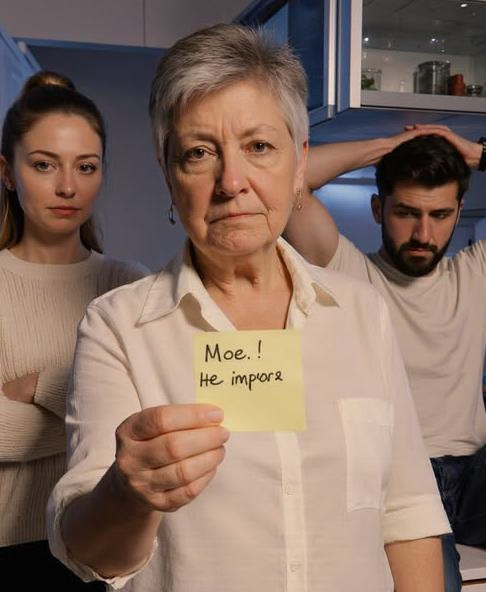
Tatyana walked into the kitchen, picked up the yellow sticker from the refrigerator door, and peeled it away. The paper tore down the middle.
“Look at me,” she told him.
Dima did not.
“You were not protecting your family. You were protecting the version of yourself that mattered more than your family.”
He began to cry then, quietly, without reaching for sympathy. I watched him and remembered the first year of our marriage, when he had burned pancakes and laughed until he had tears in his eyes. I remembered his hands around newborn Sonya. Love did not disappear because someone lied. But it could become unsafe to live inside.
The following morning, I went to the lending office with every document I had. A clerk named Marina compared the application with my identification and frowned.
“This signature is not yours,” she said.
“No.”
“Your account information was also changed after the application.”
“Can you remove the loan?”
“Not immediately. We need a written dispute and an internal investigation.”
I signed the dispute with a pen chained to the counter. The chain rattled every time my hand moved.
I did not call the authorities. Not because what Dima had done was small, but because I knew exactly what it would do to Sonya’s life, our housing, and the fragile pieces of work keeping us afloat. I chose a civil dispute, account freezes, and a financial counselor recommended by Marina. It was not mercy. It was the least destructive path for my daughter.
At home, I changed every password and opened an account in my name alone. I moved my design contracts there. I took photographs of every document. Tatyana sat beside me at the table, writing down dates in a spiral notebook with a red cover.
Dima had nowhere left to hide.
He sold his car first. Then his gaming computer. He called every lender and admitted which debts belonged to him. He did not ask me to cover the payments. He signed a written repayment plan that assigned the forged loans to his income and assets, though the dispute remained open until the company finished its review.
For three nights, he slept on the sofa. I stayed with Sonya at Vera’s apartment, where the child kept asking whether her father was sick.
“He made a very bad decision,” I told her.
“Is he still my dad?”
“Yes.”
“Can bad people still be dads?”
I held her hand. “People can do terrible things without becoming only one terrible thing. But they still have to repair what they broke.”
A week later, Dima came to Vera’s building. He stood in the lobby holding a cardboard box. Inside were Sonya’s books, her purple rabbit, and the little red rain boots she had outgrown.
“I will not come upstairs,” he said. “I only wanted to return these.”
I looked at him through the glass partition.
“Why didn’t you bring them before?”
“Because I thought bringing gifts would make me look like a father.”
“And now?”
“Now I know I have to act like one when no one is watching.”
He handed me the box.
“Are you asking me to forgive you?”
“No.”
That answer hurt in a way I had not expected.
“I am asking you to let me pay for what I did without pretending payment earns me another chance.”
Behind me, Sonya called my name. Her voice carried down the stairwell.
I looked at the box, then at Dima.
“You can see her tomorrow,” I said. “At the park. One hour. No promises beyond that.”
He nodded.
“Thank you.”
“Do not thank me. Show up.”
He did.
The meeting was awkward. Sonya talked about a paper bird she had made at school. Dima listened and asked questions instead of interrupting. When she offered him the bird, he held it as carefully as if it were made of glass.
Three weeks later, the lending company removed the first fraudulent account from my name. The second required more paperwork. Dima kept working temporary shifts at a warehouse during the day and delivering food in the evenings. He came home only to collect clothes, and each time he left money on the table for Sonya’s expenses without attaching a note or asking for praise.
Tatyana changed too. She stopped saying that a man must carry everything alone. She started telling Dima that asking for help before disaster was not humiliation.
One Saturday, she came to my apartment with the red spiral notebook. Her hands were shaking.
“I have something to tell you,” she said.
“I know about the loans.”
“Not that.”
She opened the notebook to a page covered in dates. At the bottom was a name I did not recognize.
“Before Dima borrowed from the lenders, he went to someone else,” she said. “A man called Viktor. He was his former manager.”
“What about him?”
“Viktor offered Dima his old job back. Dima refused because the salary was lower. Then Viktor asked him to bring a list of your clients. Dima did.”
My stomach tightened.
“Why?”
“He promised to sell the list and clear part of the debt.”
The old anger returned, sharper than before. Dima had not only used my name. He had taken the work I had built at two in the morning while Sonya slept beside me.
I called Dima.
He arrived forty minutes later, breathing hard, without a jacket despite the cold hallway.
“Did you give Viktor my client list?”
He closed his eyes.
“Yes.”
“Did he sell it?”
“I do not know.”
“You do not know?”
“He said he needed time. I got scared and stopped answering him.”
“Bring me every message, every payment, every name.”
“I will.”
“And if one client is contacted using my work, I will protect my business, whatever it costs you.”
“I understand.”
“No. You understand fear. You do not understand consequences yet.”
He looked at the table where my invoices used to sit beside his yellow stickers.
“I will learn,” he said.
The next morning, he brought the evidence. Viktor had not sold the list, but he had used it to approach two clients. I sent formal notices, changed my contracts, and recovered both accounts. Dima gave me the remaining messages and agreed to make a statement to the lending company about the forged applications.
It cost him his warehouse job when his manager learned about the debt collection calls. It cost him friends who had believed his story. It cost me the marriage I thought I was saving when I swallowed every insult and kept paying every bill.
We separated without a dramatic farewell. There was no grand speech, no promise that love could repair everything.
There was only a custody calendar on the refrigerator, written beneath the place where the sticker had been.
On the first Sunday Sonya visited Dima’s rented room, she came back carrying a paper bag.
“What is that?” I asked.
“Dad bought groceries,” she said proudly. “He let me choose the cereal.”
Inside were apples, milk, bread, and one small block of cheese.
A yellow sticker covered it.
I froze.
Then I saw the writing. It was not Dima’s.
FOR SONYA, it said. SHARED.
She had written it herself with a felt-tip marker.
I touched the sticker, and Sonya pulled the cheese from the bag.
“Dad says the refrigerator has rules now,” she announced. “No one eats alone.”
From the hallway, Tatyana called, “And tell him the jam belongs to everybody!”
Sonya laughed, holding the crooked yellow label between both hands.
“Mom,” she said, “where should we put it?”
Missed the beginning?






