PART 4
I read the message twice.
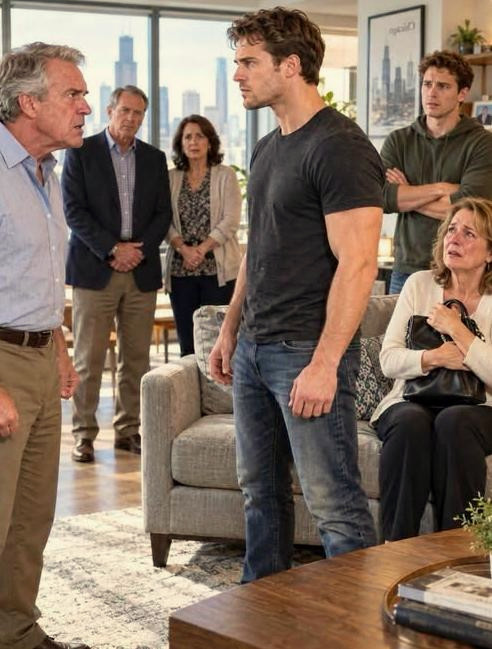
My mother stood across the office with her hands folded over her purse. Her face had the waxy color of someone who had been holding a secret too long.
My father noticed my expression.
“What did she send you?”
“Ask her.”
Mom’s fingers tightened around the purse strap.
Dad took one step toward her. “What did you send him?”
She looked at him, and something inside her finally moved from fear to exhaustion.
“The original agreement,” she said.
His jaw tightened.
“What agreement?”
“The one you made with your brother.”
The office seemed to shrink around us.
I had not heard my uncle’s name in years. My father’s younger brother, Daniel, had died before I finished college. He had left the family after a bitter argument, and Dad always described him as unstable and jealous.
Mom opened her purse and removed a flat black notebook wrapped in a grocery receipt. The pages were swollen from humidity. A small brass clasp held them shut.
Dad reached for it.
She pulled it away.
“No.”
The word landed harder than a shout.
I took the notebook. On the first page, in Daniel’s handwriting, was a list of transfers made from my grandfather’s estate. The money had not gone to me, although everyone had told me the estate had been divided equally between the three children.
My father had taken his share, Daniel’s share, and the portion intended for me.
He had used it to make the down payment on the house.
I looked up slowly.
“You helped buy my house with my inheritance.”
Dad’s nostrils flared. “You were a child.”
“I was twenty-three.”
“You would have wasted it.”
“You told me there was nothing left.”
“There was nothing left after I built the business.”
Leonard gave a bitter laugh. “The business was already failing when you bought that property.”
My father turned toward him. “You have no idea what I sacrificed.”
“I know exactly what you sacrificed,” Leonard said. “Other people.”
Mom sank into the chair beside the desk. Her wedding ring scraped against the wooden armrest.
“I found the notebook in Daniel’s storage unit after he died,” she said. “Your father told me if I opened it, he would make sure I lost everything. He said he had already arranged the papers so that no one would believe me.”
“Why keep it?” I asked.
“Because it was the only proof that I wasn’t imagining what happened.”
My father’s face had gone gray.
The phone in my hand rang again. This time it was the buyer’s attorney.
I put the call on speaker.
“We received the notebook scans and Leonard Pike’s statement,” the attorney said. “The emergency claim is fraudulent. The lender has withdrawn its filing, and the title company will insure the transfer.”
My father gripped the back of a chair.
“You can’t do this to me,” he said.
I looked at him. “You did it to yourself when you signed my name.”
The sale closed two days later in a small conference room at Mara’s office. The buyer, a woman named Elise, brought architectural drawings for the greenhouse. She had listened to the entire story without interrupting.
When the last signature was complete, she slid the final page toward me.
“You know,” she said, “the greenhouse could become a workshop for people leaving abusive homes. I’m planning to offer free classes there.”
I thought of my mother’s trembling hands, Daniel’s notebook, and the house that had carried everybody’s lies.
“Then use the money from the sale,” I said. “I want to fund the first year.”
Mara stared at me. “All of it?”
“After the mortgage and the taxes, yes.”
My parents were waiting outside. Dad had expected me to pay his debt or surrender the proceeds. Mom had expected nothing except another punishment for speaking.
I gave her the black notebook.
“Keep it,” I said. “You found it. You decide what happens to it.”
She began to cry.
Dad stepped between us.
“You’re destroying this family over a house.”
“No,” I said. “The house was the only thing that kept your story standing.”
He looked toward the street, where a moving truck waited beside the curb. His leather case sat on the pavement. The handle had snapped, spilling passports, receipts, and a handful of foreign coins onto the concrete.
For years, he had wanted the house because it made him look successful. Without it, he had to face the debts, the false signatures, the empty accounts, and the son he had treated like an unpaid caretaker.
Mom walked past him.
“Where are you going?” he asked.
“To Daniel’s sister,” she replied. “She said I could stay until I understand what you did with my retirement money.”
He grabbed her wrist.
I moved before I thought.
“Let go.”
Dad looked at my hand, then at my face.
The old command was there, waiting for me to obey. But his fingers loosened.
Mom stepped away.
The lender later demanded repayment, but the debt was his, not mine. Leonard provided the records. Mara provided the title history. My father’s business collapsed quietly under the weight of its own promises, and the apartment he had flaunted during family gatherings was sold before the summer ended.
There was no dramatic courtroom scene. No triumphant announcement. Just envelopes arriving, accounts closing, and people refusing to sign anything for him anymore.
My mother returned the money she could prove she had taken from Daniel’s share. She also gave a statement to the title company. It was not an apology, but it was the first honest thing she had done in years.
As for me, I moved into a small apartment above a bicycle repair shop. The walls were thin, the stairs crooked, and the radiator made a banging sound every morning.
I slept better there.
Mara sent me a photograph when the greenhouse restoration began. The old panes had been removed, and sunlight poured through the empty frame. In the center, Elise had placed a wooden workbench made from beams salvaged from the house.
On the front edge, she had engraved a dedication.
Not to me.
To Daniel.
I visited the property on the day the first workshop opened. My father’s old brass compass was in my coat pocket. I had kept it because it was the one object he had given me without expecting repayment.
Elise met me beside the greenhouse.
“Ready?” she asked.
Inside, six women were learning how to repair broken window frames. My mother stood among them, holding a paintbrush. She looked older, but lighter.
She saw the compass in my hand.
“Your father gave you that?”
“No,” I said. “He left it behind.”
I set it on the workbench beside Daniel’s dedication.
The needle spun once, twice, then settled toward the greenhouse door where the women were working.
My mother touched the engraved name with one paint-stained finger.
“Do you hate him?” she asked.
I watched a woman tighten a pane into place while another held the frame steady.
“I hate what he chose,” I said. “I’m still deciding what to do with the rest.”
Mom nodded. She did not ask me to forgive him.
That mattered.
Outside, a delivery truck unloaded fresh lumber. The driver shouted for someone to clear a path, and Elise laughed as three people rushed forward to help.
The house was gone.
The debt was no longer mine.
And the place my father had called proof of my failure now carried Daniel’s name above a room where strangers were learning how to build something that could hold.
Before I left, Elise picked up the compass and placed it beside the first repaired window.
“Keep it here,” she said. “It seems to know where people need to go.”
Missed the beginning?






