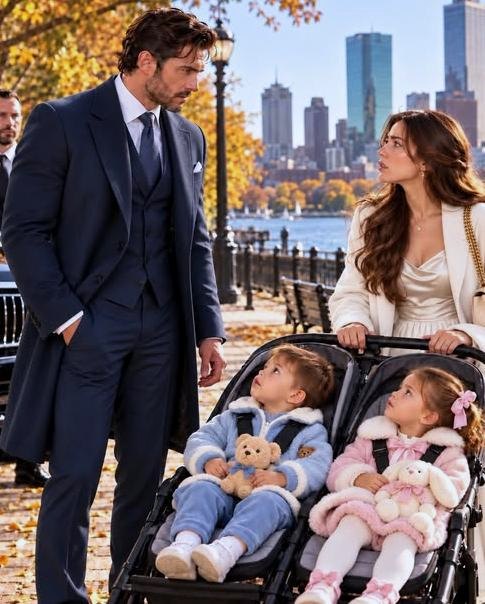
The first thing I saw that morning was my ex-wife pushing a stroller with two children who had my face.
For three years, I had trained myself not to ask where Evelina Koval lived. In my world, curiosity was a weakness people learned to exploit. I controlled one of Kyiv’s most sealed and feared criminal networks, and even men who hated me lowered their voices when they said my surname.
Then Marco Rudenko came into my office at 9:17 on a wet Thursday morning, dropped a photograph beside my untouched coffee, and forgot to breathe.
“Boss,” he said. “Evelina has twins.”
I stared at the photograph.
She was walking along a Lviv embankment beneath a row of dripping chestnut trees. Her beige coat hung loosely from her shoulders. In one hand, she carried a paper bag from a bakery. In the other, she pushed a double stroller.
The bakery logo was tiny, but I recognized it. We used to buy cherry dumplings there after midnight walks, back when Evelina still believed I could become someone who came home before dawn.
“How old?” I asked.
“Two and a half.”
My fingers tightened around the photograph.
The girl had my eyes. Not similar eyes. Mine. The same dark shape, the same slight crease beneath the left brow. The boy had my nose and the small notch in his chin that my mother used to call the Moroz mark.
“When were they born?”
Marco looked toward the closed office door.
“Six months after your divorce.”
The room seemed to tilt.
I remembered Evelina vomiting each morning. I had called it stress. I remembered her falling asleep with one hand pressed against her stomach. I had called it exhaustion. I remembered her standing outside the bathroom with a white envelope crushed in her palm.
“Arsen, we need to talk.”
“I’m working.”
“It’s important.”
“Everything becomes important when you interrupt me.”
She had lowered her hand.
I had never asked what was inside the envelope.
At noon, Marco returned with a second photograph. Evelina stood outside a children’s clinic. A tall man held the boy against his chest. His expression was too alert for a father enjoying a family afternoon. Beneath his jacket, the hard outline of a holster showed clearly.
“His name is Nikita Savchuk,” Marco said. “Former investigator. He worked cases connected to your family.”
“Is he her husband?”
“On paper. The marriage was registered three months ago.”
“Three months?”
Marco nodded. “Not two years ago. Three months.”
My phone rang before I could ask why.
Evelina’s number was still saved beneath a name I had refused to delete. I pressed call.
One ring.
Two.
A man answered.
“Hello?”
“I need Evelina Koval.”
“Who is asking?”
“Arsen Moroz. Her former husband.”
The pause that followed was quiet enough for me to hear rain ticking against the window.
“Former husband?” the man said.
“Yes.”
“You misunderstood more than you know, Moroz.”
“What does that mean?”
He ended the call.
I called again. The phone went straight to a recorded message.
A minute later, an unknown number sent me a photograph of the twins asleep beneath a knitted blanket. Each child wore a narrow copper bracelet engraved with a name: Daniil and Mira.
Then the message arrived.
If you are coming for the children, come alone. If Victoria is with you, I disappear again.
My mother’s name made my stomach clench.
I looked at Marco. “Find out everything.”
“Already trying.”
“What are you not telling me?”
He placed a thin brown folder on my desk. The corner was bent, and a dark smear marked its cover like a fingerprint.
“Boss,” he said quietly, “you need to see where Evelina has been living.”
I reached for the folder, but before my hand touched it, someone knocked twice on the locked door…
PART 2
The knock came again, slower this time.
Marco moved first. He drew his weapon and positioned himself beside the bookcase. I slid the photograph of the twins beneath a ledger and watched the brass handle turn.
“Who is it?” I called.
“Your mother’s driver,” a woman answered. “She wants you home.”
Of course she did.
Victoria Moroz never asked where I was because she already knew. She simply reminded me that she had known first.
“Tell her I’m busy.”
“She said you should not leave Kyiv.”
The threat was dressed as advice, which was my mother’s favorite kind.
Marco opened the door just enough to take the envelope the woman held out. A red wax seal pressed the paper shut. My mother had used that seal since I was a boy, stamping contracts, birthday cards, and once, memorably, the notice dismissing a man who had betrayed her.
I broke it with my thumb.
Inside was one sentence in Victoria’s precise handwriting: Do not confuse blood with permission.
Below it lay a small brass key.
“What does it open?” Marco asked.
I knew before he finished speaking. It belonged to the private records room in my mother’s house, a room I had been forbidden to enter since childhood.
At 12:40, we left through the underground garage. Rain had turned the concrete ramp into a dark mirror. Before I climbed into the car, I saw a black sedan parked beside the service gate.
Its windows were tinted.
The engine was warm.
“Someone followed us,” Marco said.
“Let them.”
He frowned. “That is not our usual plan.”
“Neither are children I never knew existed.”
We drove west. For almost four hours, Marco said nothing. The photograph lay on my knee, its edges already softened from my grip. Every time I looked at Mira’s face, a new memory returned: Evelina choosing yellow curtains, Evelina laughing at my terrible cooking, Evelina standing in the hospital corridor on the night my mother had sent three men to collect me for an emergency meeting.
I had left Evelina alone that night.
At 5:18, we reached Lviv and stopped outside a narrow yellow building behind a closed pharmacy. Nikita Savchuk was waiting beneath an iron awning. He wore a charcoal coat, and rainwater ran from his hair onto his collar.
“You came alone?” he asked.
“Marco is family.”
“Nobody who works for Arsen Moroz is harmless.”
“Then you should have kept my children out of the picture.”
His jaw tightened.
“They are not a picture. They are two children your mother has been trying to find for thirty-one months.”
The words struck harder than an accusation.
“Where is Evelina?”
“Inside. But she will not speak to you if you arrive as a king.”
“I am not here as a king.”
“Then leave your men, your temper, and your mother’s name outside.”
Marco stepped forward. “Careful.”
Nikita’s hand moved near the holster beneath his coat.
I lifted my palm. “Take me upstairs.”
The apartment smelled of boiled apples and antiseptic. A red wooden train lay beneath the radiator. From the back room came the soft, uneven breathing of sleeping children.
Evelina stood in the kitchen doorway.
She was thinner than I remembered, but her eyes were exactly the same. For one second, neither of us moved.
Then she looked at my hands.
“You came armed?”
“No.”
“Marco did.”
“He came because I asked him to keep me alive.”
Her laugh was small and bitter. “You always did confuse survival with love.”
I deserved that. It still felt like a blade.
“Why didn’t you tell me?” I asked.
“Tell you what? That your mother had men waiting outside my doctor’s office? That someone searched our bedroom while you were away? That the envelope I carried contained a pregnancy report and a warning written in your mother’s hand?”
My blood turned cold.
“Why didn’t you show me?”
“I tried.”
The kitchen clock clicked above us.
Evelina reached into a drawer and pulled out a folded document. Its paper was yellowed along the edge, and a brown thread from an old file was caught in the crease.
“You signed this three years ago,” she said. “You just never read the second page.”
I took it from her.
Before I could unfold it, the lights went out downstairs. Nikita turned toward the hall.
A child began to cry.
Then three heavy knocks struck the apartment door, and a voice behind it said, “Mrs. Moroz, open up. We know the twins are inside…”
PART 3
Nikita pushed Evelina behind him and drew his weapon. I moved toward the children’s room, but Evelina caught my sleeve.
“Not yet,” she whispered. “If they see you, they will know exactly where to aim.”
The hallway outside filled with footsteps.
Marco slipped through the kitchen window onto the fire escape and disappeared into the rain. A second later, metal scraped against the front lock. Nikita kicked the door before it opened, and the man outside stumbled backward.
“Back stairs,” Nikita ordered.
We carried the twins through the apartment while Evelina pressed Mira against her shoulder and I held Daniil. He was warm, heavy, and completely unaware that the adults around him were carrying three years of fear through a dark building.
In the courtyard, we reached a delivery van hidden beneath a torn canvas sheet. Only when the vehicle began moving did the children settle. Daniil’s fingers closed around the copper bracelet on his wrist.
At 7:02, we stopped inside an abandoned textile warehouse near the railway tracks. Rain hammered the roof. A single work lamp swung above a table where Evelina placed the folded document.
“I want the truth,” I said.
“You want the version that lets you hate someone else.”
“Give me the version that happened.”
She unfolded the paper.
It was our divorce agreement. I recognized my signature at the bottom of the first page. The second page carried a clause I had never seen: Evelina surrendered all claims against the Moroz organization and agreed to leave Kyiv permanently. In exchange, I would provide financial protection for her and any children born during the marriage.
The payment line had been crossed out.
Beside it was a second signature, written in black ink.
Victoria Moroz.
“That clause was added after you signed,” Evelina said. “Your mother told me that if I went to you, she would make your death look like a betrayal by one of your own men.”
I looked at the signature until the letters blurred.
“Why did you believe her?”
“Because she sent me a photograph of you sleeping beside a man whose throat had been cut. She said the next photograph would be you.”
Nikita placed a sealed medical envelope on the table.
“She also paid a private clinic to alter the pregnancy records,” he said. “The twins’ names were removed from every system connected to Kyiv.”
“Who helped her?” I asked.
A thin older man stepped from behind a stack of fabric crates. I knew him immediately. Pavel Hryn, my mother’s former accountant, had vanished six months before my divorce.
His hands shook as he placed a ledger on the table.
“I kept copies,” Pavel said. “Your mother ordered the protection payments stopped the day Evelina left. She expected the children to become leverage later.”
Evelina’s face tightened. “Why speak now?”
“Because she killed my son when he refused to move the money.”
The warehouse seemed to contract around us.
Pavel opened the ledger. Every payment had been recorded: bribes, surveillance, forged medical reports, and the monthly transfers made to Nikita after he resigned from the investigation bureau.
I looked at Nikita. “You were working for her?”
“For the first month,” he said. “Then I learned what she had done. I spent the next two years keeping her people away from Evelina.”
“Why marry her?”
“To give the children legal protection. My name was cleaner than yours.”
Evelina slid the old document toward me.
“I did not hide your children because I hated you,” she said. “I hid them because loving you had made me visible to a woman who wanted to own everything you loved.”
I could not answer. Daniil stirred against my chest, and his small hand caught the lapel of my coat.
Then Marco entered through the warehouse doors, soaked and pale.
“Boss,” he said, “Victoria is not waiting in Kyiv.”
I stood. “Where is she?”
He looked at the ledger.
“She has gone to the children’s clinic in Lviv. She took the original birth records with her.”
A phone began ringing on the table.
The number belonged to my mother.
Evelina stared at it, and the color drained from her face.
When I answered, Victoria said, “Bring me my grandchildren, Arsen. Or the city learns what you have built.”
Then another voice came through the line, small and frightened.
“Daddy?”
It was Mira.
The call ended, and the warehouse lights went out…
My mother took the twins beneath the clinic—and then the ledger appeared…
I thought finding the children was the end of my nightmare. I was wrong. The final truth forced me to choose what kind of father I would become.
“Are you taking us home?” Mira asked.
Her small question broke the last wall inside me.
👇 The ending is open now






