PART 4
The Aurora money had already moved.
I pressed the phone against my ear.
“Where?” I asked.
“Into an account connected to the foundation,” the voice said. “Not the company. Yours.”
The caller was Elena Montes, my father’s older sister and the former treasurer of Montes Capital. She had left the board two years earlier after a disagreement with Mauricio. I had assumed she left because of her health.
I had been wrong.
“Come upstairs,” I said.
“I’m already in the lobby.”
The line ended.
Mauricio reached for the envelope. I moved it out of his reach.
“What money?” he demanded.
“Elena says Aurora funds were routed through my foundation.”
His face tightened. “She is confused.”
“She has balanced every account this family has owned since before you met me.”
Renata stared at him. “You told me the money came from a reserve account.”
“It did.”
“Then why is it in her foundation?”
Mauricio turned on her. “Because the acquisition required a temporary holding structure.”
“Temporary?” Renata’s voice cracked. “You told me that account belonged to us.”
The room fell quiet around that word.
Us.
I looked at her carefully. Beneath the perfect makeup and expensive watch was a woman who had believed she was being chosen. That did not excuse what she had done in my marriage, but it changed the shape of the betrayal.
Elena entered carrying a leather ledger with a broken brass clasp. She was seventy-one, small, and walked with a silver cane whose handle had been worn smooth by years of use.
Mauricio stepped toward her.
“Aunt Elena, you should not involve yourself.”
She tapped the cane once against the floor.
“Your father said the same thing when he wanted to borrow money from my department.”
No one spoke.
Elena placed the ledger before me. “Eduardo knew you trusted people too easily when you loved them. He never called it a flaw. He called it a responsibility that required protection.”
I opened the ledger. Every Aurora transfer was listed by date, amount, and destination. The first payment had been made three days before Mauricio’s public proposal to Renata. The final transfer had cleared that morning.
At the bottom of the last page, Elena had written a note in red ink: Funds preserved under emergency fiduciary hold.
“You stopped it?” I asked.
“I stopped the final release. The money is still yours, but only if we prove the transaction was unauthorized.”
Mariana looked at Adriana. “We can prove it.”
Adriana removed one final sheet from her archive box. It was a signed instruction from Mauricio to the bank, ordering the transfer through the foundation because “Valeria’s name will avoid scrutiny.”
The handwriting was unmistakable.
Mauricio stared at the page as if it had betrayed him.
I expected rage. What I felt was stranger: grief with nowhere left to go.
He had not merely found another woman. He had studied my name, my father’s safeguards, my charitable work, and my trust, then used each one as a tool.
“Why?” I asked him.
His shoulders lowered.
Renata watched him, waiting for an answer that might preserve something between them.
Mauricio looked at the ring on her finger.
“Because the company was never really mine,” he said. “Every room, every decision, every success carried Eduardo’s name. I was the man married to the owner.”
“You were my husband,” I said.
“I was always afraid you would remember the difference.”
The confession did not soften me. It explained him, and explanation was not absolution.
Renata removed the ring and placed it on the table.
“You promised me a future,” she said.
“I meant it.”
“No. You meant to build one with stolen bricks.”
She walked to the board secretary and handed over her resignation as general director. Then she turned to me.
“I knew he was married,” she said. “I did not know he was using your shares. I am not asking you to forgive me.”
“I won’t,” I replied. “But I will make sure you receive the compensation you legally earned before he tied your bonus to the transfer.”
Her eyes filled, though she kept her chin raised. “Why?”
“Because I am not going to let him decide what kind of person I become.”
The words surprised me as soon as they left my mouth.
For ten years, I had signed foundation checks, attended company dinners, and allowed Mauricio to explain my own inheritance to me. I thought strength meant remaining gracious while someone else occupied my place.
It did not.
Strength was knowing exactly which signature belonged to me.
By noon, the board had removed Mauricio from operational control. The Aurora acquisition was canceled. The transferred funds were secured under the emergency hold, and the company’s auditors began tracing every payment connected to the shell trust.
No dramatic arrest followed. There was no courtroom spectacle to make the betrayal feel tidy. There were only documents, canceled authorities, returned money, and the cold arithmetic of consequences.
Mauricio asked to speak with me alone in the archive room.
I allowed it because I wanted to see whether he had anything left that was not strategy.
He stood beside the shelves where my father’s old ledgers were kept.
“I loved you,” he said.
“I believe you did.”
His eyes lifted.
“That should matter.”
“It matters. It just doesn’t repair what you used that love to do.”
He swallowed. “I can repay everything.”
“You will repay what the contracts require.”
“And us?”
I looked at the brass clasp on Elena’s ledger, bent from years of being opened and closed.
“There is no ‘us’ left that can carry the weight of this.”
He nodded toward the doorway. “Are you giving me nothing?”
“I’m giving you the truth without disguising it.”
He left the archive room with his wedding ring still on his hand. I did not ask him to remove it.
Renata’s resignation was accepted that afternoon. She agreed to cooperate with the audit and returned every document related to Aurora. Adriana’s son kept his medical coverage through the foundation, not as a favor from me, but because the board approved a general employee protection policy that no executive could use as leverage again.
Elena stayed beside me while I signed the new governance rules.
“No proxy can survive a hidden conflict,” I read aloud.
“No executive can approve a transaction involving a related party,” Elena added.
“And every controlling shareholder must receive the attachments personally.”
She smiled faintly. “Your father would have underlined that twice.”
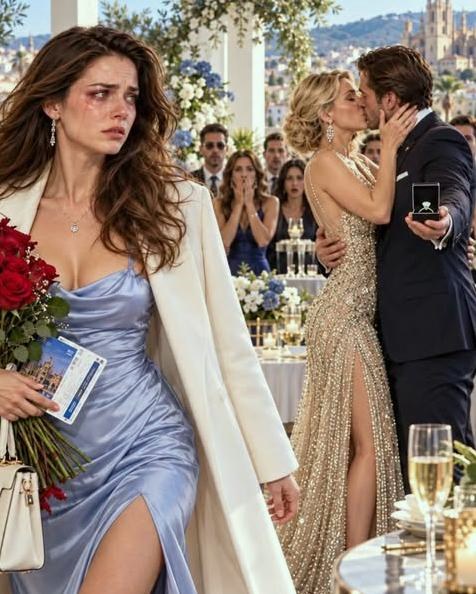
The roses were still at the company reception desk. I had forgotten them there after all.
At 6:20, the receptionist brought the bouquet upstairs. Most of the petals had begun to curl, but one rose remained open in the center, bright against the others.
I carried it into the boardroom and placed it beside the canceled Aurora documents.
Mariana looked at me. “Do you want to keep the Paris tickets?”
I took them from my handbag. The paper was creased where my fingers had crushed it in the parking garage.
“For a while,” I said.
“Why?”
I turned the tickets over. On the back, I wrote the name of the foundation’s first new project: a scholarship for employees’ children who wanted to study engineering.
“Because Paris was supposed to save my marriage,” I said. “It can do something more useful.”
A month later, the first scholarship recipient stood in the same lobby where Mauricio had lifted Renata’s ring. She was a mechanic’s daughter named Lucía, clutching a letter of acceptance and trying not to cry in front of her father.
I handed her the envelope myself.
“Your tuition is covered,” I said.
She looked past me at the silver banner, still folded in a storage box after the celebration that had destroyed my marriage.
“Does this company really belong to you?” she asked.
I glanced toward the boardroom, where my father’s original proxy now rested beneath glass beside the new rules.
“It belongs to everyone who refuses to let fear make their decisions,” I said.
Lucía frowned, trying to understand.
So I gave her the simpler answer.
“It belongs to the work.”
She smiled and hugged the scholarship letter to her chest.
Behind her, Elena closed the ledger with the bent brass clasp. The sound traveled through the lobby, firm and final, while the ruined silver banner waited to be thrown away.
I watched Lucía walk toward the elevators with her father, carrying the future Mauricio had tried to steal.
Then I picked up the single surviving rose and signed my name beneath the first scholarship approval: Valeria Montes, controlling shareholder.
The ink dried exactly where his forged signature had been.
Missed the beginning?






