PART 4
I kept the phone against my ear while the porch seemed to contract around us.
“Who is there?” I asked.
The clinic nurse took a breath that trembled through the line.
“I don’t know his name. He showed an old authorization signed by Elias. He asked for the baby’s bloodwork, the discharge papers, everything.”
“Did you give him anything?”
“No. I locked the records room.”
“Call the emergency desk. Tell them I’m coming.”
Caleb stepped toward me. “You’re not going anywhere.”
I covered the phone. “Someone is trying to get Nora’s medical file.”
His expression hardened. “Then we need to move.”
Jonah shook his head. “Not to the clinic. That’s where he expects you.”
Elias was still on one knee, pale and sweating. He pointed toward the house.
“The storm cellar,” he said.
I stared at him. “What?”
“The second entrance is behind the pantry. Your mother used it.”
Caleb frowned. “You never told me that.”
“I never told anyone everything.”
That was the final piece of the man I had worshiped and the man who had failed me. Elias had spent my entire childhood protecting me with locked drawers, missing names, and carefully edited memories. He had also protected his own fear.
Jonah helped him stand.
We carried Nora inside.
The house smelled of cedar, old coffee, and the lavender soap Elias always bought in bulk. Every object felt suddenly dangerous. The blue ceramic bowl from my mother’s kitchen. The brass compass hanging against Elias’s shirt. The framed photograph of my parents that had always seemed comforting.
Now I wondered what had been cropped from the edges.
“Where is the entrance?” Caleb asked.
“Behind the pantry shelves,” Elias said.
“You built this house around a hiding place?”
“I built it after Elena died.”
Caleb looked at him with open fury. “You knew she was being watched and still let us grow up in the same town?”
“I kept you apart.”
“You kept us ignorant.”
The argument stopped when tires crunched outside.
Jonah killed the kitchen light.
A man walked past the window carrying a leather medical case. He wore a tan coat and held a key ring that flashed beneath the porch lamp.
I recognized him.
Dr. Adrian Voss had signed my mother’s death certificate. He had also been the physician who examined me after the crash and told Elias I had no surviving relatives.
My mouth went dry.
“He’s the one,” I whispered.
Elias nodded. “He worked for your mother’s father. He arranged the crash because Elena was going to tell the authorities about the port.”
Voss tried the front door.
The lock turned.
Caleb grabbed my arm. “Cellar. Now.”
We slipped behind the pantry as the front door opened. Elias reached into a drawer and pulled out a small iron key. His hands were so weak that it took three attempts to fit it into the hidden lock.
The shelves shifted.
A narrow stairway appeared.
From the hallway came Voss’s calm voice.
“Elias, I know you’re here. Give me the child and this ends quietly.”
I held Nora against my chest. Her tiny fingers curled around the brass bell on her blanket.
Caleb moved in front of us.
Voss entered the kitchen. “You should have handed over the records years ago.”
“You killed Elena,” Elias said.
Voss smiled. “Elena died because she chose sentiment over survival. You made the same mistake with her daughter.”
Jonah stepped from behind the refrigerator and struck Voss’s wrist with the heavy wooden handle of a carving knife. The medical case fell open, spilling syringes across the floor.
Voss lunged. Caleb tackled him into the table.
The table split beneath their weight.
I ran down the stairs with Nora. At the bottom was a concrete room lined with shelves. On one wall hung dozens of envelopes, each labeled with a date. On another stood an old metal filing cabinet.
Elias descended behind me, one hand pressed to his chest.
“Open the cabinet,” he said.
“Why?”
“Because the truth your mother left is not in the folder.”
I pulled the drawer. It stuck, then released with a shriek.
Inside lay a small wooden box. Its lid was carved with a swallow, the same bird Elias had carved into Nora’s cradle.
My hands shook as I lifted it.
Inside was a photograph of my mother holding a baby boy. Beside her stood a young doctor with the same calm smile Voss had worn upstairs.
On the back, my mother had written: He knows where Caleb is. If anything happens to me, the proof is beneath the hospital chapel.
I looked at Elias.
“You had this all along.”
“I was afraid to use it.”
“Because of me?”
“Because I thought keeping you alive was the same as giving you a life.”
Above us, something crashed. Caleb shouted my name.
I shoved the photograph into my pocket and climbed the stairs.
Voss was pinned beneath a broken chair. Jonah had one knee against his shoulder. Caleb stood bleeding from the mouth, but he was still between Voss and me.
The clinic nurse was on the phone with emergency services now, and the line was open on the counter. She had heard everything.
Voss looked at me. “You think a photograph will save you?”
“No,” I said. “The chapel will.”
His face changed.
That was the proof I needed. Not the photograph. His reaction.
He had known exactly where the missing evidence was.
Elias walked toward him, trembling. “You promised Elena you would leave the children alone.”
Voss laughed beneath Jonah’s grip. “She had one child. The girl was an inconvenience.”
Caleb flinched as though struck again.
I knelt beside him. “You heard him.”
“I heard.”
“You don’t get to disappear after this.”
“I know.”
It was not a grand apology. It did not repair the months of fear or the life we had unknowingly stepped into together. But he looked at Nora without reaching for her, as if he understood that wanting to be her father’s brother did not give him the right to touch her.
The emergency crew arrived minutes later. Voss was taken away, and the clinic secured Nora’s medical file. The chapel evidence was recovered that evening: ledgers, payment records, and a signed order from the man who had arranged my parents’ deaths. Voss had kept copies because he believed every secret was a possession.
He lost the records, the clinic, and the protection of the people who had trusted his respectable name. He never got Nora.
Elias spent several days under observation, and when he came home, he handed me the brass compass.
“I wore this because Elena gave it to me the night she asked me to hide Caleb,” he said. “The needle stopped pointing north after the crash.”
I turned it over. Beneath the cracked glass, the needle trembled toward the east.
“Why east?” I asked.
“Your mother’s chapel was east of the highway. She always said that was where she wanted to be buried.”
We went there together with Caleb, Jonah, and Nora asleep in her carrier. No one pretended we were a normal family. We were not.
At the chapel wall, a mason removed the loose stone and found the tin box Elena had hidden thirty-one years earlier. Inside were letters to me, one for every birthday she expected to miss.
I read the first one aloud while Caleb stood beside me.
My darling Mara, if you ever meet the boy I had to give away, do not punish him for being born into my fear. Ask him what he remembers. Tell him I loved you both before I knew how to protect either of you.
Caleb turned away, pressing his palm against his mouth.
Elias sat heavily on the chapel step.
“I should have given you these,” he said.
“Yes,” I answered. “You should have.”
He nodded. He didn’t defend himself.
That mattered, though it did not erase anything.
Caleb came back to the house the next morning. He brought a small paper bag and placed it on the table.
Inside was a photograph of him as a child, standing beside a birthday cake. On the cake was a wooden swallow, crudely carved and missing one wing.
“I made it,” he said. “Jonah kept it.”
I looked at the swallow, then at the bird on Nora’s cradle.
Elias lowered his eyes.
“My mother carved the first one,” Caleb said. “She told me it meant someone was coming home.”
The room tightened around the words.
I did not call him brother. Not yet.
But I placed Nora’s hand in his, and he let her tiny fingers close around his thumb.
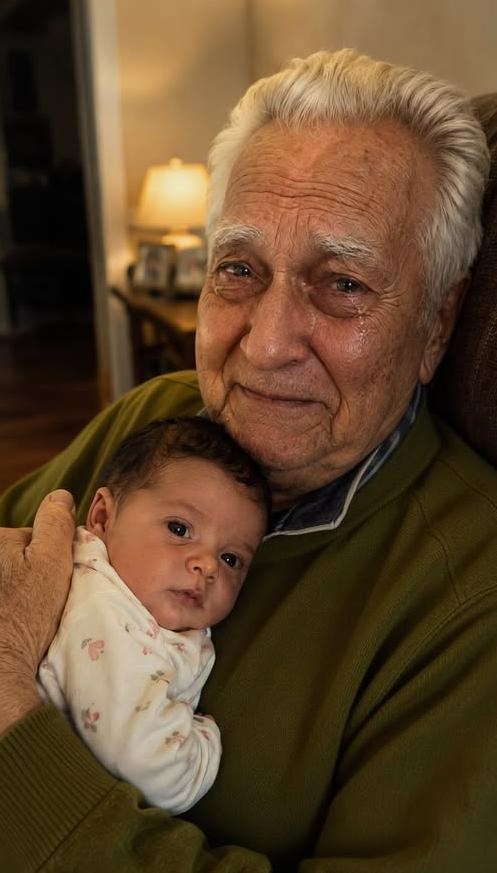
Her blue eye opened first. Then the dark one.
Caleb began to cry silently.
I picked up the cracked compass and held it beside the child’s face. The needle trembled, turned, and pointed toward the wooden swallow on the cradle.
Caleb whispered, “She looks like us.”
I looked at my daughter, at the brother my mother had buried in a secret, and at the grandfather who had mistaken silence for safety.
Then I answered, “She gets to know every name.”
Missed the beginning?






