PART 4
The name was my father’s.
For one terrible second, I thought Dad had been lying about everything.
Then he looked at the paper and said, “That signature isn’t mine either.”
Nobody spoke.
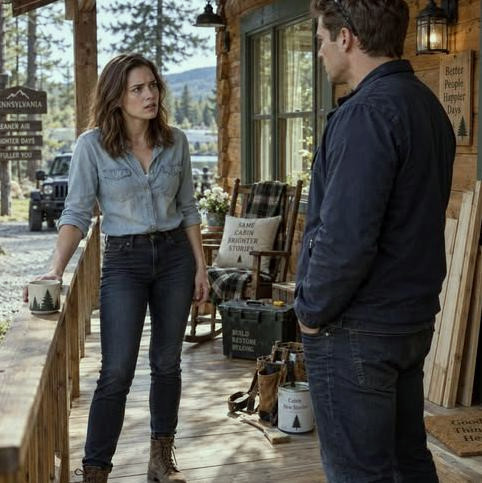
The porch boards creaked beneath our feet. A loose metal hook tapped against the cabin wall in the wind, once, twice, three times.
I turned to Beckett. “Who is behind Rowan Ridge Adventures?”
He shook his head too quickly.
“I don’t know.”
Tate held out his phone. “The filing lists a registered agent. Someone named Lydia Vale.”
Mom’s face changed.
Dad noticed. “Who is Lydia Vale?”
Mom pressed the leather case against her stomach. “The developer who approached your father.”
The memory came back to me: Dad mentioning four hundred eighty thousand dollars, then refusing to explain why the sale had mattered so much. Grandpa had believed the lower acreage was worth protecting. I had assumed the developer had disappeared after Grandpa’s refusal.
She had not disappeared.
“Call her,” I said.
Mom looked at me. “Maren—”
“Call her.”
Dad took out his phone. His fingers hovered above the screen.
“I haven’t spoken to her in three years,” he said.
“Then she’ll be surprised.”
He called.
A woman answered on the second ring.
“Richard,” she said. “I was beginning to think you had changed your mind.”
Dad’s face emptied of color.
Beckett backed toward the steps.
I took the phone from Dad and put it on speaker.
“This is Maren Rowan. Why did you file a transfer request against my property?”
There was a pause.
“So Everett finally told you,” Lydia said.
“He told me enough.”
“I didn’t file anything against you. I filed what your father and brother delivered.”
Dad gripped the porch railing. “We delivered nothing.”
“You delivered a signed purchase option and a corporate authorization. Both were witnessed by a notary in Harrisburg.”
I looked at Beckett.
He was staring at the gravel.
Lydia continued. “Richard, you promised the property would be available by autumn. The purchase price was reduced because you said the title issue was being resolved inside the family.”
Dad’s voice cracked. “I never signed a purchase option.”
“Then someone used your name twice.”
The wind moved through the apple trees. I could hear the creek below the hill.
“Send us copies,” I said.
“I already sent them to the recorder. But I can email them to you.”
“Do that.”
When the call ended, Beckett said, “I can explain.”
“No,” Dad said. “You can tell the truth.”
Beckett’s eyes flashed. “You want the truth? You started this. You told me Everett’s deed was a family arrangement, not a real transfer. You told me Maren would eventually sell because she couldn’t afford the taxes.”
Dad flinched.
I turned toward him. “Did you say that?”
“I thought you might need to sell someday,” he whispered.
“That isn’t an answer.”
“Yes,” he said. “I said it.”
The worst part was not that he had believed I would fail. It was that he had built his plans around it.
Beckett pulled a folded envelope from his jacket. “Lydia offered us a commission if the sale went through.”
“Us?” I asked.
He looked at Dad.
Dad closed his eyes. “She offered me a consulting position.”
The cabin seemed to tilt beneath me.
Mom slapped him across the face.
The sound was small, but it traveled across the entire yard.
“You let them use her labor,” she said. “You stood here while she rebuilt every room.”
Dad touched his cheek. “I thought she would be proud if the land became valuable.”
“I was proud before you put a price on it,” I said.
Tate stepped forward. “We need our money back.”
Beckett laughed without humor. “I don’t have it.”
“I do,” Dad said.
Everyone looked at him.
Dad reached into his wallet and removed a bank card. “I’ll cover the deposits today.”
“Dad,” Beckett said.
“No. You will repay me.”
“With what?”
“Your truck. Your apartment lease transfer. The equipment. Everything you bought with their money.”
Beckett stared at him. “You’d sell my life?”
“You sold your sister’s home.”
The words landed harder than the slap.
I expected satisfaction. Instead I felt exhausted. The cabin, which had once been the simplest thing in my life, had become a ledger of other people’s secrets.
Lydia’s email arrived ten minutes later. The purchase option carried my father’s forged signature, but the witness line belonged to a notary whose stamp had been used after her commission expired. The corporate authorization listed Beckett as managing member of Rowan Ridge Adventures.
The filing was invalid.
But it was also proof of deliberate fraud.
Tate read the pages over my shoulder. “You should report this.”
I looked at Beckett.
He had gone white. Not from shame, I realized. From fear of losing everything he had built on borrowed names.
“I will if he doesn’t make this right,” I said.
Dad nodded. “He will.”
“No,” I said. “He won’t make the decision for me.”
I took the contract folder from Tate and spread every page across the porch table. The summer agreement. The trail-access promise. The creek-rights payment. The forged purchase option.
Then I wrote three words across the top of a blank sheet: RETURN EVERYTHING.
“Here is what happens,” I said. “Tate, Nolan, and Pierce get every dollar back. Dad pays first, because he helped create the lie. Beckett sells the equipment and repays him. The company ends today.”
Beckett started to protest.
I raised my hand.
“You don’t get to operate out of this cabin, use the trails, or speak for this property. Not for a day.”
“And the developer?” Tate asked.
“I’ll send her the recorded deed and the invalid filings. She can explain herself to the county.”
Dad looked at me. “What about us?”
That was the question I had been avoiding.
I could have told him to leave. I could have handed him the envelope Grandpa had trusted him to deliver and asked why he had waited until the cabin was valuable enough to exploit.
Instead, I said, “You can help repair what you damaged.”
His eyes lifted.
“Not by giving advice,” I continued. “Not by calling it family property. You will sit with Tate and write every repayment agreement. You will tell Mom exactly what Lydia offered you. And you will sign a statement acknowledging that I have owned this land since the day Grandpa recorded the deed.”
Dad swallowed. “I will.”
Mom stepped beside me. “So will I.”
Beckett looked at the cedar posts, the porch he had dismissed, and the cabin he had already sold three different ways.
“What do you want from me?” he asked.
I answered honestly. “For once, I want you to stop trying to turn everything into something you can use.”
He lowered his gaze. “I don’t know how to fix it.”
“Start with the first signature.”
That afternoon, we drove to the county recorder’s office. Not as a parade of accusations, and not because I wanted revenge. We went because every false document had to be attached to the correct record, and every man who had paid Beckett deserved proof that the land had never been available.
The clerk compared the signatures, examined the expired notary stamp, and placed the purchase option in a separate file.
When she returned my certified deed, I held it against my chest. The paper was thin, but it carried the weight of twenty-seven months, Grandpa’s judgment, and every night I had worked alone.
Outside, Tate asked whether I would still allow them to hike through the property.
“After the repayments are complete,” I said. “You can ask me directly.”
He nodded. “Fair.”
Nolan gave me the metal water bottle he had been gripping all morning. A small dent marked its side.
“For the trouble,” he said.
I almost refused, then accepted it. Not as payment. As a reminder that strangers had believed a lie because my family made it look official.
By sunset, Beckett had listed his truck and equipment for sale. Dad had transferred the first repayment. Mom sat at the oak desk, copying Grandpa’s letter word for word because she said the original belonged with my deed.
Beckett stood outside the porch steps.
“Can I come back tomorrow?” he asked.
“For what?”
“To help replace the railing.”
I looked at the cedar posts he had once treated like proof that my work was his to command.
“Tomorrow at eight,” I said. “Bring a measuring tape. And don’t bring a business plan.”
He gave a tired nod.
The next morning, he arrived before the sun reached the orchard. He carried no folder, no contract, and no promise about what the property could become.
Only a length of cedar and a box of screws.
He set them beside the porch and waited for instructions.
I handed him Grandpa’s old level, its brass edge worn smooth by years of use.
“Hold it there,” I said.
Beckett pressed the tool against the railing. The bubble drifted toward the center and stopped.
For once, he did not ask what the land was worth.
He asked, “Is that straight?”
I looked at the level, then at the porch Grandpa had taught me to repair.
“Keep holding it,” I said.
Missed the beginning?






