PART 4
The message from Lucía ended with three words that made my fingers go numb: They are coming now.
A vehicle door slammed outside the loading entrance.
Then another.
Ricardo looked toward the glass doors.
“Who did you call?” he demanded.
I held the phone against my chest.
“No one.”
“Diana, give it to me.”
He took one step forward.
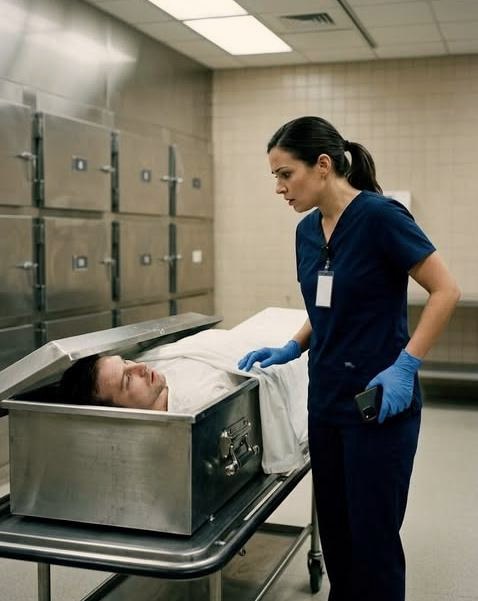
Gustavo tried to rise, but pain folded him back onto the coffin. Mateo caught his shoulder.
“Stay down,” Mateo said.
The morgue door shook under a hard knock.
Esteban whispered, “We have to leave.”
Ricardo turned on him.
“You said the records were gone.”
“I said I had secured the office.”
“You said the wife was harmless.”
The words hung in the bright, freezing room.
I felt something inside me settle.
Not calm.
Clarity.
For months, Ricardo had trained me to doubt my memory. He corrected the amount of money I spent. He interrupted my sentences. He explained that work was beneath the dignity of our marriage, then complained that I contributed nothing.
But he had just called me harmless in front of everyone.
He had forgotten that harmless people were often allowed to stand close to the evidence.
The door opened before anyone could move.
A woman in a hospital administrator’s coat entered with two security guards. Behind her stood Aunt Lucía, leaning on a polished wooden cane, her swollen ankles wrapped in white bandages.
“Aunt,” I whispered.
She gave me an exhausted smile.
“You took long enough to read the envelope.”
Ricardo stared at her.
“You can barely walk.”
“I can still remember numbers.”
Lucía had worked for twenty-seven years in hospital records before arthritis forced her to retire. She had recognized the altered death report when a former colleague showed her the intake list. She had also noticed that one of the bank accounts connected to Ricardo used her medical payment number as a cover.
She had not been helpless.
She had been watching.
The administrator faced Esteban.
“Your cremation authorization is invalid. The physician’s signature was entered before the examination, and the transfer number belongs to a different patient.”
Esteban’s face tightened.
“Those are administrative errors.”
“Then you will explain them to the hospital board.”
The guards moved between him and the exit.
Ricardo pointed at Gustavo.
“He is unstable. He is making accusations because he wants revenge.”
Gustavo looked at him from the coffin.
“Open your folder.”
Ricardo’s hand closed around it.
“What?”
“Open it,” Gustavo repeated. “Show Diana the release form.”
Ricardo’s eyes flicked toward me.
That tiny movement told me there was something inside meant for me.
I walked over and took the folder from his hand.
He grabbed my wrist.
“Do not.”
His fingers dug into my skin, just as they had when he had stopped me from accepting the daycare director’s reference letter.
I looked down at his hand.
“Let go.”
He did not.
Mateo stepped closer.
“Mr. Morales.”
Ricardo released me, but his expression had changed from anger to pleading.
Inside the folder lay a release authorization, three account summaries, and a printed confession prepared in my name. It stated that I had stolen company funds to pay family debts and had arranged Gustavo’s poisoning after he threatened to expose me.
My signature appeared at the bottom.
It was not my signature.
It was a careful copy of the signature on my marriage certificate.
For one second, I could not breathe.
Then Lucía placed her cane against the floor.
“Look at the ink,” she said.
She pointed to the page.
“The signature was copied from a scanned document. The pressure is identical across every curve. A living hand never writes that way.”
The administrator took the paper.
“Where did you get this?”
“Ricardo’s office,” I said. “He keeps copies of everything.”
Ricardo shook his head.
“Diana, listen to me. I was trying to protect us.”
“From what?”
“From prison. From losing the house. From Gustavo exposing all of us.”
“All of us?”
His eyes filled with panic.
“You were my wife. Your account made the transfers look ordinary. I thought I could move the money back before anyone noticed.”
Gustavo let out a bitter breath.
“You moved twelve million pesos.”
Ricardo turned toward him.
“And you signed the contracts.”
“I signed legitimate contracts. You created the hidden payments.”
“Because the board forced me to!”
The room went still.
Esteban’s head turned slowly.
“What did you say?”
Ricardo seemed to realize too late that he had spoken aloud.
Gustavo pushed himself upright despite the pain.
“Who forced you?”
Ricardo stared at the folder.
“The chairman. He told us Gustavo was going to replace him. He said if Gustavo spoke, everyone would lose everything.”
Esteban whispered, “You were not supposed to say that.”
The administrator looked at the guards.
“Take both of them to the boardroom. No one leaves until the authorities arrive.”
I expected triumph.
Instead, I felt tired enough to collapse.
Gustavo reached for my hand.
“I am sorry,” he said. “I used your name to make you the safest person to trust. I should have warned you sooner.”
“You were unconscious in a coffin.”
“Before that.”
I looked at the bruises on his wrist.
“Why did you trust me at all?”
“Because when everyone else saw a dead man, you checked for a pulse.”
The sentence broke something open in me.
Not grief.
The part of me that had accepted Ricardo’s description of my character.
Lucía touched my shoulder.
“Your bank account is still frozen,” she said. “And the house may be tied to the company transfers.”
I nodded.
“I know.”
“You may lose it.”
“I know that too.”
Ricardo heard us. He turned back from the doorway, his face strained.
“Diana, if you help them, they will take everything.”
I looked at the copied confession in my hand.
“You already tried.”
He glanced at the notebook tucked inside my coat pocket, the one where he had recorded every tortilla and bus fare. I pulled it out and placed it on the counter beside the false confession.
“Keep your ledger,” I said. “I kept mine.”
The administrator collected both documents.
By seven in the morning, Gustavo had been transferred to intensive care. The poisoning had damaged his kidneys, but he was expected to survive. Mateo gave a statement about the syringe and the altered paperwork. The funeral director admitted he had been paid to deliver an empty identification tag if anyone questioned the cremation.
Dr. Salgado was found hiding in a storage room with the unused death certificate.
Esteban’s own messages revealed that the chairman had ordered the cover-up, but Esteban had added the false accounts because he believed he could take control of the company afterward. Ricardo had been both accomplice and pawn, greedy enough to participate and frightened enough to obey.
None of that returned the months I had spent begging for money to buy medicine.
None of it erased the day he destroyed my work at the daycare.
But it gave the truth a shape I could finally hold.
Three days later, I sat beside Gustavo’s hospital bed. A small brass key rested in his palm, the one recovered from the red tray. The maintenance locker had contained the original ledger, a list of account numbers, and a handwritten note naming every person involved.
Gustavo offered me the key.
“You should keep it.”
“I do not want another secret.”
“It is not a secret anymore.”
I closed his fingers around it.
“Then use it to open the locker yourself.”
He studied me.
“And what will you do?”
I looked at the employment form Lucía had brought from the hospital administration. They had offered me a permanent position in records and patient services. Not because I had saved a famous businessman, but because I had noticed a date no one else bothered to question.
“I am going back to work,” I said.
Gustavo smiled faintly.
“Your husband will hate that.”
“My husband is no longer deciding what I am allowed to become.”
At noon, Lucía arrived with medicine in a paper bag and a fresh Metro card tucked into the pocket of her coat. She placed the card in my hand, then pointed toward the hospital register.
“Write down the time,” she said.
I picked up the pen.
“Why?”
“Because someone always changes the story later.”
So I wrote it carefully: 12:06 p.m. Gustavo Valdés alive. Diana Morales present.
The ink dried beneath my name while, down the corridor, a stretcher began to roll toward the morgue.
This time, I was the one holding the register.
And when the wheels squeaked, I did not look away.
Missed the beginning?






