PART 4
The call ended before Emmett could speak.
For several seconds, nobody moved beneath the humming fluorescent light.
Then Margot whispered, “Grandpa, are they going to take my money?”
I crouched in front of her.
“No one is taking anything from you.”
Claire covered her face with both hands.
Emmett stood over the open box, staring at the account number as though it were a wound.
“Who has a key?” he asked.
Nora looked down at the brass leaf hanging from her necklace.
“I do.”
Emmett turned toward her.
“Why?”
“Because Claire gave it to me.”
Claire’s head jerked up. “Nora—”
“She told me to use it at the bank on Monday,” Nora continued. “She said I was only collecting documents. I didn’t know what they were for until I saw Phoebe’s name.”
“You were helping her?” Emmett asked.
“I was trying to stop her.”
Nora reached into her purse and took out a folded envelope. Its corners were bent from being handled too often.
“I copied everything before I came here. The trust request. The debt notices. The messages from the lender. And a letter Claire wrote to the boarding school.”
Emmett took the envelope but did not open it.
“What did the letter say?”
Nora looked at Margot.
“That the child would be removed from the home within thirty days of the wedding.”
Claire stumbled backward until her shoulder hit the wall.
“I had not decided,” she said.
“You had a deadline,” Emmett replied.
“I was trying to give us a chance.”
“You called sending my daughter away a chance?”
“I wanted a child of our own!” Claire shouted. “I wanted one room in that house where I wasn’t walking through Phoebe’s shadow. Every photograph had her face in it. Every conversation ended with Margot. Even your grief had a place at the table, and I didn’t.”
Her voice cracked.
“I thought if Margot went away, you might finally see me.”
Emmett looked toward the reception hall, where their wedding cake still stood beneath its sugar flowers.
“I saw you,” he said. “You were the person deciding whether a little girl deserved to stand beside her father.”
Claire slid down the wall and sat on the floor. White satin pooled around her knees.
Margot watched her without expression.
I wanted to feel triumph. I did not. I felt tired, and older than I had felt that morning.
The debt collector called again.
Emmett answered on speaker.
“Mr. Hale,” the man said, “your wife assured us the child’s trust would cover the balance.”
“It will not,” Emmett said.
“Then your house is at risk.”
“My house is not collateral for a debt I never agreed to.”
“Your wife signed the documents.”
“Without authority.”
There was a pause.
Then the man said, “She also told us you would not report the fraud because it would expose your family.”
Claire closed her eyes.
Emmett’s gaze moved to Margot, then to the letter from Phoebe.
“I am not hiding this,” he said. “Send every document to my accountant. And do not contact my daughter again.”
He ended the call.
That was the moment Claire understood that the money was gone to her forever—not because someone had taken it, but because Emmett had stopped protecting her from the truth.
She reached for him.
“Please. I can repay it.”
“With what?”
“I’ll sell my car. My jewelry. I’ll work.”
“You can do those things because they are yours,” he said. “But you cannot use Margot to purchase forgiveness.”
Claire looked at me.
“Arthur, you hate me.”
“I hate what you told her.”
Her eyes moved to the child behind my shoulder.
“Can I say goodbye?”
Margot’s face tightened.
“No,” she said.
It was barely audible, but Claire heard it.
Margot stepped forward, holding the silver locket in her palm.
“You said I wasn’t family.”
Claire began to cry again.
“I was wrong.”
“Daddy said I could be in the pictures.”
“He did.”
“And Mommy wrote that I should never have to earn my place.”
Claire looked at Emmett. “You knew about that letter?”
“I didn’t,” he said. “Arthur didn’t either.”
Margot closed her fingers around the locket.
“Then I’m going to stand in the picture.”
She walked away from Claire and took her father’s hand.
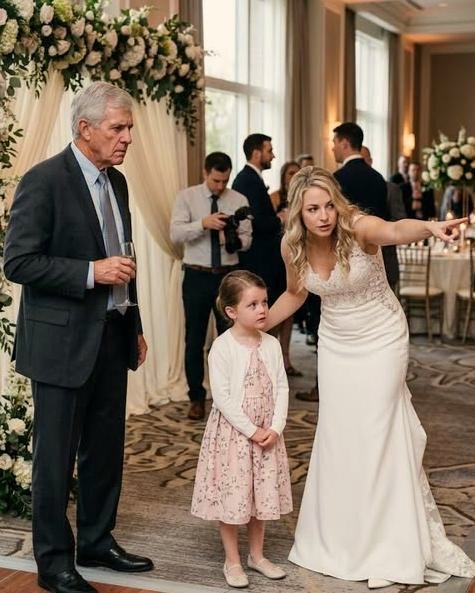
The photographer had remained near the reception hall, holding his camera against his chest. Emmett led Margot back toward the cake, but stopped beside me.
“Come with us,” he said.
I looked at the empty chair where Phoebe should have been sitting.
“I’m already with you.”
The photographer raised his camera.
“Ready?”
Emmett knelt beside Margot. I stood on her other side. Nora joined us, still wearing the brass key around her neck.
The shutter clicked.
Claire remained in the corridor, her wedding dress marked with dust from the floor. She had wanted a picture without Margot. Instead, the only photograph that survived that day showed exactly who had chosen the child.
By midnight, Emmett had cancelled the reception, frozen every account Claire could reach, and moved the trust documents into the hands of an independent financial guardian. He did not call the police that night. He gave Claire one week to surrender the forged papers, disclose every debt, and leave the house without touching Margot’s inheritance.
She signed the agreement at dawn in the hotel business room, wearing borrowed clothes because she had refused to return to the bridal suite.
Before she left, she placed her wedding ring on the table.
“I thought money would make me safe,” she said.
Emmett did not answer.
I did.
“Money was never the thing you were missing.”
She looked at Margot, who sat beside the window coloring the back of a wedding menu.
“What was I missing?” Claire asked.
Margot did not look up.
“Permission to be kind.”
Claire pressed her lips together and walked away with nothing except the clothes Nora had brought her.
The debt collector received the documents. The lender withdrew the claim against Emmett’s house after learning the trust had been protected from the beginning. The forged transfer was surrendered, and Claire’s own accounts were sold to repay what she had taken. She kept no part of the trust, no part of Phoebe’s money, and no place in the family photographs.
But the damage was not erased by paperwork.
For weeks, Margot asked whether she was still important.
Each time, Emmett answered before I could.
“You are my daughter. Nobody can vote you out of this family.”
At the Rosewood Hall, the photographer sent us the finished images. In the first, Margot stood between her father and me, her pink dress bright beneath the chandeliers. In the second, she held Phoebe’s silver locket up to the camera, as if showing her mother exactly where she belonged.
Emmett framed that photograph and placed it above the mantel.
Not in a drawer.
Not behind the newer pictures.
Above the mantel, where every visitor had to see it.
Months later, while sorting through the papers Nora had preserved, I found one final note from Phoebe tucked inside the red notebook. It was only three lines, written in the hurried slant I remembered from grocery lists and birthday cards.
If Margot ever doubts she is loved, tell her to look for the people who make room beside them.
I read it to her at the kitchen table.
She considered the words while carefully fastening the silver locket around her neck.
“Grandpa,” she said, “do you think Mommy was in the picture?”
I looked at the framed photograph above us.
Margot stood in the middle. Emmett’s hand rested on her shoulder. Mine rested on the other.
And between the three of us, reflected in the polished glass of the frame, Phoebe’s locket caught the morning light.
“Yes,” I told her. “She was exactly where she wanted to be.”
Missed the beginning?






