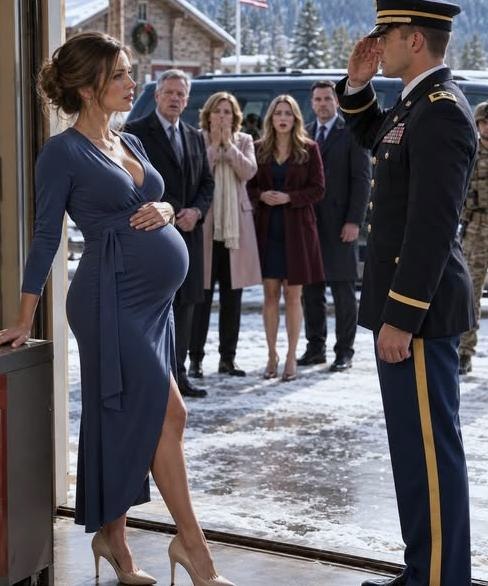
My sister was still pointing toward the freezing garage when three military vehicles rolled into my parents’ driveway and every voice in the house died.
It was 5:02 on Thanksgiving morning when Harper called me from the hallway. I had been standing barefoot on the kitchen tile, one hand around a chipped mug, the other resting beneath the curve of my five-month pregnancy. David’s old Army shirt hung from my shoulders. The cotton smelled faintly of cedar and the soap he used before every deployment.
“Mom and Dad made a decision,” Harper said. “Julian needs your room.”
I stared at her. “He needs my room?”
“He needs privacy for his work.”
From behind the newspaper, my father lowered his glasses. The clock above him clicked once, loudly.
“You’ll sleep in the garage,” he said. “It’s temporary.”
I glanced at the frost whitening the windows. “The garage has no heat.”
My mother folded a dish towel with careful, useless precision. “There are blankets in the blue storage bin.”
The words landed harder than shouting would have. David’s funeral had been held six days earlier. Six days. The casket had been sealed, the flag folded, and a uniformed officer had handed me a triangle of fabric while I tried not to collapse in front of strangers.
My father had hugged me afterward and said, “Come home. We’ll take care of you.”
Now he tapped the newspaper against the table.
“Your grief is ruining Thanksgiving,” he said. “People are coming.”
I looked at Harper’s husband. Julian stood beside her in a cream sweater that probably cost more than my monthly food budget. He was holding my bedroom key between two fingers, swinging it like a coin.
“I need the room for the investors,” he said. “The garage is perfectly usable.”
“Your investors are coming at seven in the morning?” I asked.
His smile tightened. “Don’t make this difficult.”
Harper touched my arm, but not gently. Her diamond bracelet pressed into my skin.
“You can’t expect everyone to arrange their lives around your sadness forever.”
I looked down at David’s shirt. At the faded name tape sewn above my heart. At the tiny brown thread he had once repaired with a field needle while telling me our baby would grow up believing he could fix anything.
I wanted to scream. Instead, I carried one cardboard box through the back door.
The garage smelled of gasoline, wet cardboard, and the peppermint mice repellent my father scattered along the walls. A camping cot stood beneath a bare bulb. My breath clouded in front of me.
“Put your things along the left side,” Mother called. “Julian needs room for his car.”
I set the box down.
“Okay,” I whispered.
They mistook the word for surrender.
None of them knew that David and I had never been consultants, clerks, or harmless military administrators. For twelve years, we had served as senior Army intelligence officers. Our assignments were classified. Even our families received carefully edited stories.
They also did not know that my emergency leave ended at midnight.
At 5:17, while Harper placed a vase of roses in my old bedroom, the first engine growled outside. Then another. Then a third.
Julian walked to the window. His smile vanished before he turned around.
Dark vehicles stopped in a precise line across the driveway. A woman in a black field coat stepped out, crossed the frozen lawn, and entered the garage without looking at anyone.
She stopped in front of me.
Then she raised her hand and gave me a sharp military salute.
Behind her, my father dropped the newspaper.
The woman lowered her hand and reached inside her coat for a sealed folder…
PART 2
The folder was black, unmarked, and locked with a narrow brass clasp. I knew that clasp. David had used the same kind on mission packets he carried beneath his armor.
The woman held it out to me.
“Captain Bennett,” she said quietly. “We need to leave within ten minutes.”
Harper appeared in the garage doorway, clutching the frame. “Captain?”
My father came behind her. His face had lost its color.
“What is this?” he demanded. “Who are you?”
The woman turned toward him. “Major Elena Ruiz, United States Army.”
Julian stepped forward. “This is private property.”
Ruiz looked at him once. “Then you should be grateful we asked before entering.”
I took the folder. The metal clasp was cold against my palm, and beneath it I felt the hard outline of a second object. David had always hidden important things in pairs: the truth and the means to prove it.
“Why are you here?” I asked.
Ruiz’s eyes dropped briefly to my stomach. “Because your emergency leave ended last night. Because your husband’s final assignment was compromised. And because someone has been searching this house for the access key he left with you.”
Mother gripped the doorframe. “She doesn’t have anything.”
That answer came too quickly.
I looked at her. “What do you mean, I don’t have anything?”
“Your father means you’re grieving,” she corrected.
“No,” Ruiz said. “She means the key.”
The garage bulb swung overhead, throwing shadows across the boxes. My heart began to beat in the old measured rhythm David had taught me before our first joint operation: observe, breathe, decide.
Julian laughed, but the sound was thin. “This is absurd. My wife’s sister is pregnant and unstable. You can’t drag her away because of some military misunderstanding.”
Ruiz reached into her coat again and removed a photograph. She placed it on the hood of my father’s truck.
It showed David outside a warehouse in Bucharest three weeks before his funeral. He was alive. He was wearing a dark wool cap and holding a red metal lunch tin.
My knees nearly gave way.
“That photograph was taken two days before he died,” Ruiz said. “The tin was recovered from the crash site. The access key was not.”
I touched the photograph with one finger. The image blurred.
“Why wasn’t I shown this?”
“Because the people who arranged his funeral were trying to identify who knew what.”
Harper shook her head. “You’re saying David’s death wasn’t an accident?”
“I’m saying the official report is incomplete.”
My father stepped into the garage. His shoes crushed a strip of frost near the threshold.
“Everyone out,” he said. “This is a family matter.”
Ruiz’s expression hardened. “It stopped being a family matter when your son-in-law’s secure documents began appearing in financial transactions connected to Julian Cross.”
Julian’s hand jerked. Only once. But I saw it.
Harper turned toward him. “Julian?”
He raised both palms. “This is ridiculous. I manage investments. People send me documents all the time.”
“Not documents bearing military seals,” Ruiz replied.
My father moved between us. “You have no right to accuse anyone in my home.”
The sentence struck me strangely. Not Julian’s home. Not Harper’s home. His home.
I looked at the folder in my hand. “What did David leave me?”
Ruiz did not answer immediately.
Instead, she glanced toward the kitchen.
“There is one person inside who knows where he hid the original evidence. She has been too frightened to speak.”
Mother’s face tightened. “There’s no one here.”
A chair scraped across the kitchen floor.
An old woman emerged slowly from behind the pantry door. It was Mrs. Alvarez, the neighbor who had brought casseroles after David’s funeral. Her fingers were wrapped around a small brass key, and tears were shining on her cheeks.
“I’m sorry,” she whispered. “He told me to wait until the soldiers came.”
Julian took one step toward her.
Ruiz blocked him.
Mrs. Alvarez held the key out to me. “Your husband said the person who hurt him would come looking for the red tin.”
Then the house lights went out.
Somewhere inside the darkness, a lock clicked open…
PART 3
The darkness lasted three heartbeats.
Then Ruiz switched on a narrow lamp attached to her vest, and the garage filled with a hard white circle of light. Julian stood beside the kitchen door, one hand buried inside his sweater.
“Take your hand out,” Ruiz ordered.
“I’m reaching for my phone.”
“Slowly.”
He obeyed. A silver key fell from his fingers and struck the tile.
Mrs. Alvarez made a frightened sound. “That’s the key he showed me.”
I looked at Julian. “You already had one.”
He swallowed. “I found it.”
“Where?”
He did not answer.
My father bent to pick it up, but Ruiz caught his wrist before he could touch the metal. Her grip was calm and absolute.
“Let the captain decide what happens to evidence,” she said.
No one moved.
Mrs. Alvarez stepped into the lamp’s glow. Her blue cardigan was fastened with a wooden clothes peg because one button had broken. She looked suddenly smaller than I remembered, but her voice steadied.
“David came to me the night before he left,” she said. “He was bleeding from his forehead. He asked me to witness a document.”
My breath stopped. “What document?”
“He said it would protect you and the baby if he did not return. He signed it at my dining table. Then he placed a copy in the red tin and told me to hide the tin beneath the loose brick behind your father’s furnace.”
Father’s face twisted. “You broke into my furnace room?”
“I followed David’s instructions,” she said. “Unlike you, I kept my promise.”
Julian’s eyes flashed. “This is a senile woman inventing stories.”
Mrs. Alvarez turned toward him. “You came to my house two nights after the funeral. You asked whether David had left anything. When I refused, you threatened to have my grandson deported.”
Harper stared at her husband. “You did what?”
Julian’s mask cracked. “She misunderstood.”
“No,” Mrs. Alvarez said. “You used the exact same words you used at the funeral. You said Mara would be easier to control once everyone convinced her she was helpless.”
My mother began to cry silently.
I looked at her. “Did you know?”
She pressed both hands to her mouth.
Father answered for her. “We knew Julian had a proposal. That is all.”
“What proposal?”
Julian backed toward the wall. “Your family owed money. I offered to refinance the house. Harper and I would take over the mortgage, and you would receive a small settlement.”
“This is David’s house.”
“David was dead,” he snapped. “You were pregnant, grieving, and incapable of managing anything. It was practical.”
The room seemed to tilt.
Ruiz opened the folder and removed three pages. The first carried David’s signature. The second contained a transfer record from Julian’s investment company to an account in my father’s name. The third was a statement from a foreign contractor who had paid Julian for the location of David’s extraction route.
Julian stared at the pages.
Harper whispered, “You sold his route?”
“I didn’t know they would kill him.”
The confession hung in the cold air.
My father sank onto a storage crate. Mother covered her face. Harper took off her diamond bracelet and set it on the workbench as though it had suddenly become unbearable to wear.
I read David’s signed document. It transferred the house, his service benefits, and control of his classified estate to me—not because he expected to die, but because he knew someone close to us had been watching.
At the bottom, beneath his signature, he had written one sentence in his cramped handwriting: Trust Mara’s judgment, even when grief makes her doubt it.
Ruiz folded the papers. “We leave now. The people who paid Julian know the key is here.”
A vehicle door slammed outside.
Then a second voice called from the driveway, using David’s old operational code name.
Ruiz’s face changed.
She looked at me and said, “That voice should be impossible.”
The garage door began to rise…
The man outside the garage carried something impossible…
I thought the military team had come to take me away. I never imagined who would be standing behind them, or what his return would expose.
“Julian, you always did hate waiting.”
The room seemed to lose its air.
👇 The final part of the story is now open.






