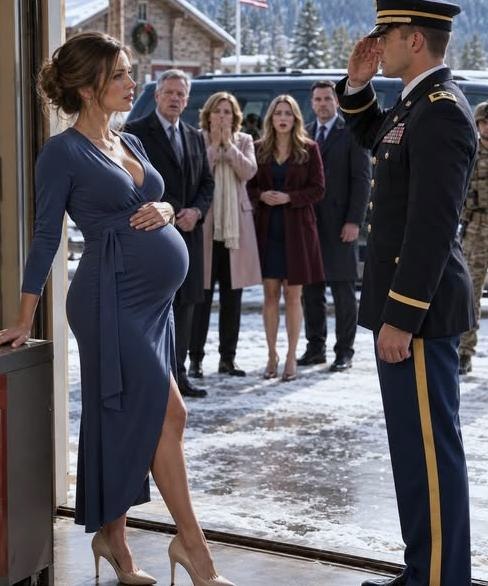
PART 4
The garage door climbed halfway, scraping against its track with a shriek that went through my teeth.
Cold air poured beneath it.
Everyone turned toward the widening gap.
A man stood beyond the driveway lights, wearing a dark coat and holding both hands where we could see them. His face was partly hidden by the collar, but his posture was unmistakable: shoulders squared, weight balanced, head angled toward every possible exit.
My body recognized him before my mind allowed the name.
“David?”
He lifted his face.
It was him.
Not a ghost. Not a photograph. Not a memory wearing a stranger’s body.
David stood in the frost with a scar across his temple and a red metal lunch tin tucked beneath one arm.
Harper screamed.
Mother stumbled backward into the shelves. My father gripped the edge of the workbench as if the concrete had turned to water.
Julian did not move at all.
David looked past me and fixed his eyes on him.
“Julian,” he said. “You always did hate waiting.”
I crossed the garage before anyone could stop me. Ruiz reached for my shoulder, but I pulled free.
David met me beneath the half-raised door.
I struck his chest with both hands.
Once.
Twice.
The third time, my fingers caught in his coat and refused to let go.
“You were dead,” I said.
“I know.”
“You let me bury you.”
“I know.”
“You let them tell me our child would grow up without you.”
His eyes broke then. Not dramatically. Just enough for me to see the cost of the answer before he gave it.
“If I contacted you, they would have followed me to you.”
I wanted to hate him for being alive. I wanted to collapse against him. I wanted the six months of waiting, funeral flowers, official condolences, and sleepless nights returned to me in one piece.
Instead, I whispered, “Tell me why.”
David looked toward the house.
“Because the convoy carrying my team was betrayed from inside the financial network supporting the mission. We staged the crash after extracting two surviving officers. My identity had to disappear while we traced the buyer.”
Julian laughed under his breath.
David turned to him. “You were not the buyer. You were the door.”
Ruiz stepped beside us. “The contractor you sold information to worked for the same consortium that has been moving money through Julian’s accounts.”
Julian’s face tightened. “I only gave them a travel schedule.”
“You gave them the route, the vehicle change, and the name of the safe hospital,” David said. “You gave them enough to put my team in a grave.”
Harper stared at her husband. “Why would you do that?”
Julian looked at her as if she were asking an inconvenient business question.
“Because I was drowning,” he said. “The investment fund collapsed. I owed people who don’t forgive debts. David had access to contracts worth millions, and his family had a house with enough equity to buy me time.”
“You used my sister,” Harper said.
“I used an opportunity.”
That sentence destroyed whatever remained between them.
Harper walked to the workbench and picked up the signed transfer document. Her hands shook so badly the pages rustled.
“You told us Mara was unstable,” she said. “You told Dad the mortgage could be taken before she understood what was happening.”
“I was protecting us.”
“No,” she answered. “You were protecting the man you wanted to become.”
My father lowered his head. “Mara, I’m sorry.”
The apology sounded small against the garage walls.
I turned to him. “You knew about the payment.”
He nodded.
“How much?”
“Twenty thousand.”
Mother began to sob. “We thought you would leave after Thanksgiving. We thought Julian would settle everything.”
“You put me in an unheated garage while carrying his money.”
Father’s mouth trembled. “I thought your grief made you impossible to reason with.”
“No. You thought grief made me easy to remove.”
David’s hand found the back of mine. His palm was scarred, warm, and real.
Outside, two soldiers moved toward the road. A third stood beside a vehicle with a tablet in hand.
Ruiz took the red tin from David. “The evidence inside goes to the command review team. The accounts will be frozen before anyone can move the remaining money.”
Julian lunged for the tin.
David caught his wrist.
The movement was swift, almost gentle. Julian hit the side of the vehicle and groaned.
“Don’t,” I said.
David looked at me.
I shook my head. “Let him stand there and understand what he lost.”
Julian’s eyes moved across the driveway: the vehicles, the soldiers, Harper’s wedding ring sliding from her finger, my father sitting among the boxes he had ordered me to carry.
He had wanted the house, the money, and the illusion that he could turn desperate people into obedient pieces.
Now the house was legally mine, the evidence was beyond his reach, and the woman whose name had opened every door for him was walking away.
Harper stopped beside me.
“I am not going with him,” she said.
I looked at her bracelet on the workbench. “Where will you go?”
“Somewhere I can hear myself think.”
It was not forgiveness. It was not a family repaired by a single revelation. But it was the first honest decision anyone in that garage had made.
My mother reached for me.
I let her fingers touch my sleeve, then gently moved away.
“I can’t carry your guilt and my child,” I said. “You’ll have to carry your own.”
She nodded through tears.
David opened the passenger door of the nearest vehicle, but I did not climb in immediately. I went back to the workbench and picked up the small brass key Mrs. Alvarez had given me.
She stood near the furnace-room entrance, still trembling.
“You kept him alive long enough to come home,” I told her.
She shook her head. “He kept his promise to you.”
David looked at the key in my hand.
“Do you remember what it opens?” he asked.
I did.
The old cedar trunk in our bedroom. The one we had been told contained only deployment uniforms and tax papers.
I turned toward the room Harper had taken from me that morning.
Julian followed my gaze, and fear crossed his face.
“What else is in there?” he asked.
David’s expression softened with something almost like relief.
“The names of everyone who thought your family would break before the truth arrived.”
Ruiz closed the vehicle door behind us. The engine began to rumble, filling the driveway with heat and diesel fumes.
I placed one hand over my stomach.
The baby moved beneath my palm.
David saw it and pressed two fingers gently against the same place. For a moment, the garage, the funeral, the lies, and the long black months narrowed to that tiny movement between us.
Then he looked at the house.
“Are you ready?”
I looked at the cardboard box still sitting on the concrete floor, David’s old Army shirt folded on top of it. The faded name tape was crooked now, its thread coming loose after years of washing.
I lifted the shirt and carried it with me.
Behind us, Julian was still staring at the cedar trunk.
The brass key rested in my hand like a small, bright verdict.
David took my arm as we walked toward the waiting vehicle, and from inside the house came the first sound of the trunk being opened.
Missed the beginning?






