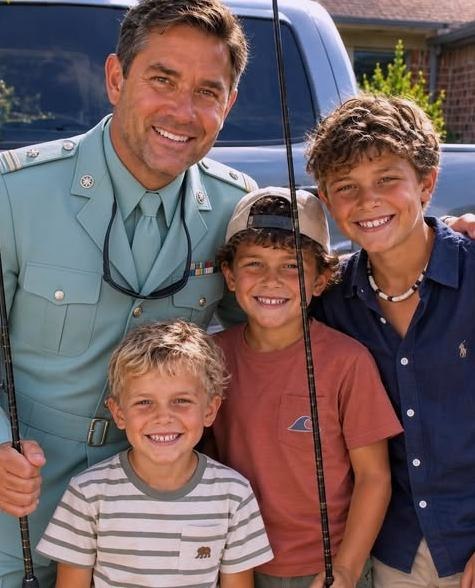
The first thing Abigail said after finding her father’s phone was not hello, but, “Mom, Dad lied about the lake.”
She stood in the kitchen beneath the yellow light, gripping the phone so tightly that her knuckles had turned white. Dust clung to the black case. One corner was chipped, and a thin crescent of dried mud still filled the speaker grille.
I knew that phone.
Lucas had carried it everywhere—into the garage, onto the boat, even to the bathroom when he was checking the weather before our fishing weekends. Three days before he vanished with our sons, he had told me he had lost it near the lake.
“I watched him throw it in the glove compartment,” I whispered.
Abigail swallowed. “He didn’t lose it.”
The kitchen clock clicked toward midnight. Behind her, the cardboard boxes filled with clothes, fishing hats, and three pairs of tiny rubber boots waited to be donated to the church. I had avoided opening those boxes for six years. Abigail had insisted that we could not keep living among ghosts.
Then she found the phone inside a cracked tackle box.
“Why would Dad say the lake was a lie?” I asked.
“He didn’t say it exactly.” She unlocked the screen with a four-digit code—the birthday of our youngest son, Noah. “There’s a video. It was recorded the day before they disappeared.”
My fingers went cold.
Lucas had taken our three boys fishing every summer. Caleb was fourteen, Daniel was ten, and Noah had just turned seven. They packed the coolers themselves, argued over who would sit beside the window, and competed to catch the first fish.
That last morning, I stood in the driveway at 7:12, holding a blue enamel mug Lucas had bought at a roadside store. The boys loaded rods into the truck while Lucas checked the trailer hitch twice.
“Back Sunday before dinner,” he promised.
“You said that last year,” I told him.
“And I came back with three sunburned criminals.”
Caleb laughed. Daniel threw a rolled-up towel at him. Noah climbed into the truck wearing a red cap with a plastic fish sewn above the brim.
I took a picture.
I still had it printed on my refrigerator. Four smiling faces. A row of fishing rods. Morning sunlight on the windshield.
On Sunday night, the driveway stayed empty.
By Monday morning, I had called Lucas thirty-seven times. By Tuesday, search teams were dragging the lake with hooks and sonar. The truck was found beside the eastern dock with the empty boat trailer attached. Hours later, the boat itself appeared on the far shore, split along one side.
No bodies were recovered.
The authorities called it an accident. Lucas had taken the boat out in worsening weather, they said. The current could have carried all four of them into the deeper channel.
But Lucas checked weather reports ten times before driving across town. He never let the truck’s fuel gauge drop below half. He had fished that lake for three years.
And he never took our boys onto the water without life jackets.
Six years passed, but the question remained lodged beneath my ribs.
Why had he gone out at all?
Abigail placed the phone on the table. “I watched the beginning. I stopped when I heard him say Uncle Zachary’s name.”
My husband’s younger brother had been beside us through everything. He brought casseroles after the disappearance, repaired the girls’ bicycles, and repeated the same sentence whenever I questioned the investigation.
“You have to stop living in that weekend, Evelyn.”
Now Abigail pushed the phone toward me.
“Mom,” she said, “I think Uncle Zachary knew what happened.”
The old device vibrated once, though no call had come through. The screen showed a single file dated Friday evening, the night before Lucas left.
I pressed play.
Lucas appeared in the dim light of our garage. His face looked tense, and behind him hung the red life jacket Noah had forgotten to pack. Lucas glanced toward the door, lowered his voice, and said, “If Zachary comes here tomorrow, do not let him take the boys because…”
PART 2
“Because what?” Abigail demanded, leaning so close to the phone that her hair brushed the screen.
The video froze on Lucas’s face.
A spinning symbol appeared, then vanished. The battery indicator blinked red. I tapped the screen again, but the file returned to the beginning.
“Play it,” I said.
“I am trying.”
“Try harder, Abigail.”
The sharpness in my voice hurt us both. She pulled back, and guilt struck me immediately. For six years, every object connected to Lucas had felt like a loaded weapon. Now I had aimed one at my daughter.
She breathed in, selected the file, and dragged the progress bar forward. This time the video continued.
Lucas stood in the garage beside the workbench. A brass compass hung from a nail behind his shoulder, the one our boys had given him for Father’s Day. His hands were shaking.
“If Zachary comes here tomorrow, do not let him take the boys because he knows about the account,” Lucas said. “He knows I found it.”
The image jumped.
“What account?” I whispered.
On the phone, Lucas turned his head as if someone had moved outside the garage.
“He has been moving money through the marina. I thought it was a bookkeeping mistake. It isn’t. I found payments from our company to a shell supplier, then transfers into an account under his name. He has been stealing for almost two years.”
Abigail covered her mouth.
I could barely breathe. Lucas and Zachary had owned a small boat-repair business together. It had been Lucas’s dream since he was twenty. Zachary handled invoices and suppliers. Lucas trusted him because they were brothers.
The video flickered again.
“If I go to the bank, he will know. If I go to the police, he will know. I am taking the boys to the lake because I need to meet someone there before Saturday morning. Someone who can prove what he did.”
Abigail paused the screen.
“Someone who can prove it?”
“Who was he meeting?”
“I don’t know.”
Neither of us noticed the back door open until a voice said, “You should have left that phone buried.”
I turned.
Zachary stood beneath the porch light, rain shining on his shoulders. He had let himself in with the spare key Lucas once gave him. In his hand was a small paper bag from the grocery store, but his fingers had crushed the bread inside it.
Abigail moved in front of the phone.
“How long have you been standing there?” she asked.
“Long enough.”
I rose so quickly my chair struck the cabinet. “Why are you here?”
“I brought soup.”
“Put it down.”
His eyes went to the phone. “Evelyn, give me that.”
“No.”
“You don’t understand what you’re watching.”
“Then explain it.”
Zachary’s jaw tightened. “Lucas was sick. He was frightened. He believed everyone was stealing from him.”
“He named you.”
“He named an account.”
“You knew about this video.”
“I knew Lucas was making accusations.”
Abigail lifted the phone. “Why did he say you were coming to the house tomorrow?”
Zachary took one step forward. I saw a pale scar crossing his right thumb, a mark from the boat propeller years earlier. His hand trembled beside it.
“Because he asked me to meet him,” he said.
“That isn’t what he said,” I replied.
“Turn it off.”
“Did you go to the lake?” Abigail asked.
For a moment, the room held only the refrigerator’s low hum.
Then Zachary said, “I got there after the boat was gone.”
The sentence fell too quickly, too cleanly, like something memorized.
“Who told you the boat was gone?” I asked.
His face changed.
He looked at the screen, then at Abigail, then at me. “You need to stop digging. There are things worse than not knowing.”
“Worse than losing my husband and three sons?”
He flinched.
Abigail’s phone suddenly chimed. She had received a message from an unknown number. The message contained only a photograph: a rusted metal key lying on a wooden table.
Beneath it were seven words.
Ask the woman who worked at Dock Nine…
Zachary saw the message and dropped the grocery bag. A jar of soup shattered across the floor.
PART 3
“Who is the woman at Dock Nine?” I asked.
Zachary stared at the broken jar. Tomato broth spread between the floorboards, bright beneath the kitchen light.
“I don’t know,” he said.
Abigail turned the phone toward him. “Then why did you look terrified?”
“I didn’t.”
“You did.”
He reached for his coat. I stepped between him and the hallway.
“Sit down.”
“Evelyn, move.”
“Not until you tell me who she is.”
His eyes hardened. “You’ve spent six years letting grief turn you against everyone who tried to help you.”
“No. I spent six years believing you because I had no proof.”
That stopped him.
At 8:40 the next morning, Abigail and I drove to the old marina. The place had changed owners twice, but Dock Nine still leaned into the water beside a rusted fuel pump. A woman named Marlene Voss was waiting in a bait shop at the end of the pier.
She was sixty-seven, with silver hair pinned by a wooden clothes peg. The key from the photograph hung on a cord around her neck.
“You knew my husband,” I said.
“I knew what he tried to do.”
“Why did you wait six years?”
Marlene looked at Abigail. “Because Zachary came to my house the night your family disappeared. He put that key on my table and told me that if I spoke, your daughters would be next.”
My knees weakened. Abigail caught my elbow.
“Why didn’t you tell anyone?” I whispered.
“Because he knew where my grandchildren went to school. And because I was afraid.”
Marlene led us into a storage room smelling of rope, mildew, and diesel. From beneath a stack of life jackets, she pulled a ledger wrapped in oilcloth.
“This was the marina’s fuel log,” she said. “Your husband asked me to keep it because he discovered someone had been buying fuel with company money.”
She opened the ledger to a page marked with a torn receipt.
Friday, 10:18 p.m. Fuel issued to Zachary Mercer. Twenty-eight gallons. Dock Nine.
I shook my head. “Zachary said he arrived after the boat was gone.”
“He lied.”
Marlene turned another page. “He came before Lucas. He brought a second trailer. He was arguing with your husband when I saw them.”
“What did they say?” Abigail asked.
“Lucas told him he was going to the bank Monday morning. Zachary said he would lose everything. Lucas said, ‘You already chose that.’ Then the boys came down the dock.”
I gripped the edge of the table.
Marlene’s voice cracked. “The weather was turning. Lucas tried to leave. Zachary pulled the safety pin from the steering linkage before they boarded. I saw him do it.”
“Why didn’t you stop him?”
“Because I thought he was disabling the boat for a few minutes. I did not know he had cut the emergency line.”
The room tilted.
“Did you see them after that?” I asked.
Marlene closed her eyes. “I heard the boys shouting from the far side of the lake. The boat struck the rocks near Blackwater Channel. Lucas got Caleb and Daniel into the overturned hull. Noah was wearing the red cap. I saw him on the surface.”
“Were they alive?”
“Yes.”
The word tore through me.
Marlene pushed the ledger toward me. “Zachary came back alone. He asked if I had called anyone. Then he took Lucas’s truck and left it at the eastern dock to make the accident look simple.”
Abigail began to cry silently.
I could hear Lucas’s voice from the video: someone who can prove what he did.
Marlene reached into a metal cabinet and removed one more item—a folded bank document bearing Lucas’s signature and Zachary’s account number.
“He left this with me,” she said. “He told me that if he did not return by Monday, I was to give it to his wife.”
Before I could touch it, my phone rang.
The caller identification showed the hospital in the next county.
A man asked for Evelyn Mercer. Then he said, “We found a boy at the old bus station. He has a red cap, and he keeps saying your name.”
I pressed the phone to my ear.
“Which boy?”
The man hesitated.
“His name is Noah.”
Behind me, Abigail screamed.
And at that exact moment, Zachary called from an unknown number, whispering one sentence that made the blood leave my hands…
“Evelyn, if Noah is alive, then Lucas never told you where he hid Caleb and Daniel.”
The boy in the red cap knew where his brothers were…
I thought the phone would reveal how my family died. Instead, it uncovered a living son and a truth that made every unanswered year hurt differently.
“Dad said you would come.”
My knees gave way beneath me.
👇 The final part of the story is open






