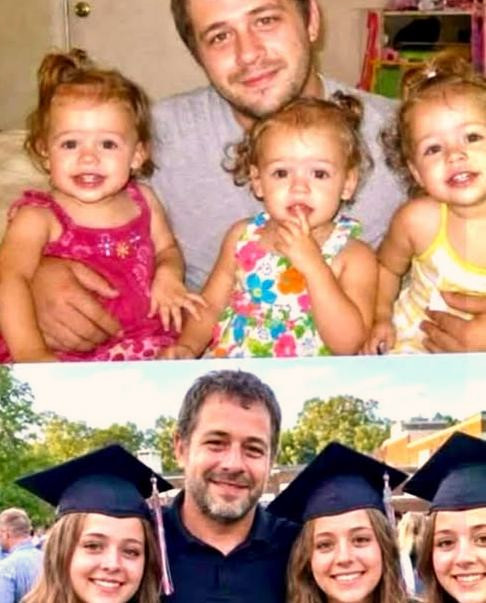
The first thing June said into the graduation microphone was that their father had not abandoned them—and the second thing was my name.
I was sitting at the edge of the eighth row, gripping a cheap camera I had bought for thirty-eight dollars. A small copper house dangled from its wrist strap. I had carried that charm for twenty-two years, ever since the morning three infant car seats appeared outside my apartment door.
“Your hands are shaking again, Noah,” Mrs. Reed whispered beside me.
“It’s hot in here.”
That was a lie. My heart was pounding so hard that the camera trembled in my palm.
On the stage, Ava crossed first. Her lips shook, but she smiled. Claire followed, spotted me, and lifted her hand exactly as she had at eight years old when she was afraid of getting lost in a grocery store. June came last.
She did not smile.
I noticed immediately.
For twenty-two years, I had learned every expression on their faces. Ava cried when she was angry. Claire joked when she was frightened. June went quiet when she had already made a decision.
“They’re so different,” Mrs. Reed murmured.
“They always held on to one another,” I said.
The dean called their names, and the auditorium erupted. I filmed through the blur in my eyes, ignoring my aching knees and the cracks in my fingers from two decades of stocking shelves at the hardware store. A smear of mustard still stained my shirt collar.
I had spent my last savings on their graduation dresses. I had skipped lunch to pay the final balance on Ava’s student account. I had even polished the copper house with a dish towel before leaving that morning.
I thought the hardest moment would be watching them walk away from the stage.
I was wrong.
The dean had already stepped toward the curtain when he returned to the microphone.
“Before we close,” he said, “the graduates have prepared a few words.”
The sisters came back to the center of the stage. June carried a folded sheet tied with a narrow brown ribbon.
“That wasn’t planned,” Mrs. Reed whispered.
“Then they’re probably about to surprise me.”
I tried to smile, but June looked directly at me, and my face refused to cooperate.
“Our father couldn’t be here today,” she said.
A murmur moved through the hall.
Their father was Daniel. He had left the three girls outside my door when they were six months old, eleven days after their mother died. On the back of a gas station receipt, he had written five words: I’m sorry, Noah. I can’t.
I had never known whether Daniel was alive. The girls had never known either.
“But he left something behind,” June continued.
Ava reached for the paper. Claire turned toward me.
“We found this in the locked cabinet beneath the stairs,” she said.
My fingers tightened around the camera. The copper charm pressed into my skin.
“What is it?” someone called from the audience.
June unfolded the page carefully. Its edges were yellow, and one corner was darkened as if it had once been held near a flame.
She read the first line silently. Then she lifted her eyes.
“Uncle Noah,” she said, no longer using the microphone, “you should hear this before everyone else.”
I stood. My knees turned soft.
June’s finger moved slowly toward the first sentence, and every person in that room leaned forward with her…
PART 2
“Noah,” June read, “if the girls ever find this letter, tell them I did not leave because I stopped loving them.”
The auditorium seemed to shrink around me.
Ava lowered her eyes. Claire’s hand closed around the edge of her gown. Somewhere behind me, a chair scraped the floor, but no one turned to see who had moved.
June continued.
“I left because Victor found out about Mara’s account. He said he would take the children, sell the building, and make sure none of them ever learned what their mother left behind.”
I felt the blood drain from my face.
Victor.
Their maternal grandfather had been dead for fifteen years, but his name still lived in the locked drawer of my desk. He had owned half the town’s warehouses and had once stood outside my apartment shouting that three babies could not be raised on a shopkeeper’s wages.
The letter went on.
“I signed the property into Noah’s care. He believes he is only protecting them. He does not know the money is theirs. Do not tell him until they turn twenty-two.”
Ava stopped breathing for a moment.
Claire turned toward me. “You knew about money?”
I could barely hear her.
“No.”
June folded the page against her chest. “That’s not what the rest says.”
She pulled a second sheet from inside the first. I had never seen it before. The paper made a dry, papery sound that traveled through the silent auditorium.
“June,” I said, “wait.”
“You told us our father disappeared.”
“He did.”
“You told us he left only a receipt.”
“That was all I had.”
“Then why does this say you signed for three hundred thousand dollars?”
The question struck harder than any accusation shouted across a room.
Mrs. Reed stood beside me. “Noah, what is she talking about?”
I stared at the signature printed near the bottom of the page. It looked like mine. The long crooked stroke through the N. The little break in the last letter. Even the date was familiar: October 14, 2002, three months after I had taken the girls to live with me.
But I had never signed that document.
“I didn’t take their money,” I said.
June laughed once, without humor. “We didn’t say you took it.”
“You brought me onto a stage in front of hundreds of people.”
“We brought the truth.”
The dean approached, pale and sweating beneath his academic robe. “Perhaps this should be discussed privately.”
“No,” June said. “He has had twenty-two years privately.”
The words landed like stones.
I remembered the first winter with the girls, when I slept on the floor beside their cribs because Ava had pneumonia. I remembered Claire biting through a thermometer. I remembered June asking, at age seven, whether her father had hated her.
I had told her no.
I had told her I simply didn’t know.
Now the page in her hand claimed I had known enough to sign for money.
Ava stepped closer to the microphone. “We found the papers two weeks ago. There was a bank statement too.”
My stomach turned.
“Where is it?” I asked.
“Not here.”
“Who showed you these?”
June’s expression changed. The anger remained, but fear moved underneath it.
“A man came to our apartment last night,” she said. “He knew details only our family could know.”
“What man?”
“He said his name was Daniel.”
The copper house slipped from my fingers and struck the wooden floor.
The sound was tiny.
It still seemed to shake the entire hall.
June bent to pick it up, but before she could, the auditorium doors opened. A tall man stood in the entrance, one hand pressed against the frame. His hair was white at the temples. A scar ran from his ear to his jaw.
He looked at the three young women on the stage.
Then he looked at me.
“Noah,” he said, his voice breaking, “you were never supposed to see that page.”
He took one step forward, and behind him a woman in a navy coat raised a thick folder toward the dean…
PART 3
The woman in the navy coat crossed the auditorium with the careful pace of someone carrying something breakable.
“Everyone needs to leave,” the dean said.
“No,” June replied. “Not until he tells us who that is.”
The man by the doors swallowed. His eyes never left the three sisters.
“My name is Daniel Vale,” he said.
Ava made a small sound. Claire gripped the podium so hard her knuckles whitened.
I moved toward him, but Mrs. Reed caught my sleeve.
“Don’t,” she whispered. “Not yet.”
Daniel looked older than any man I had imagined during those twenty-two years. He had a narrow face, a sunken cheek, and a scar that disappeared beneath his collar. But his left hand still curled inward when he was frightened. I remembered that from childhood, from the way he used to hide his thumb inside his fist whenever our father shouted.
“Where have you been?” June demanded.
“Everywhere I could go without being found.”
“You left us with a receipt.”
“I left you with Noah because he was the only person Victor could not buy.”
I felt the floor tilt beneath me.
The woman in the navy coat set the folder on the first seat. “My name is Helen Mercer. I worked at North County Bank in 2002.”
She took out a magnifying glass and placed it beside the papers.
“That signature is not Noah’s,” she said.
June stared at her. “It looks exactly like his.”
“Because it was copied from the guardianship form. The document was created by Victor Vale’s attorney, Graham Pike. The three hundred thousand dollars was not paid to Noah. It was transferred from Mara’s account into a holding account controlled by Victor.”
Daniel closed his eyes.
“The paper you found is a forgery,” Helen continued. “But the real document is here.”
She opened the folder and removed a single page sealed in plastic. At the bottom was Mara’s signature, followed by mine.
I knew that signature. I had seen it on birthday cards, grocery lists, and the back of photographs. Mara had written like she was always hurrying to catch up with her own thoughts.
The real document named me guardian and trustee of the girls’ inheritance. It also contained one instruction in her handwriting: Keep the money away from Victor until my daughters are old enough to defend themselves.
“I never knew about this,” I said.
Daniel stepped into the aisle. “Because I took the first envelope to you and Victor followed me. He told me Mara’s account would disappear if I went to the authorities. Then he showed me a letter saying the girls would be taken from you if I came back.”
“You vanished for twenty-two years,” I said.
“I spent the first year trying to get proof. Victor found me twice. The second time, he broke my jaw.”
Claire began to cry. Ava reached for her hand.
“Why return now?” June asked.
Daniel looked at Helen. She nodded.
“Because Graham Pike died,” Helen said. “Before he died, he sent us the original ledger and confessed that Victor had forged the transfer. The account was never closed. It has been earning interest.”
June’s anger faltered. “How much?”
“Enough to pay every debt your uncle carried for you,” Helen answered, “and enough to rebuild the community clinic your mother founded.”
All three sisters turned toward me.
I wanted to explain the unpaid bills, the secondhand textbooks, the nights I repaired the same winter coat instead of replacing it. I wanted to tell them that I had never touched a cent that belonged to them.
Instead, I said, “I’m sorry I didn’t know what to tell you.”
Daniel took another step. “Noah, there is one more thing.”
The folder contained a final envelope, marked with Mara’s handwriting. Helen touched it but did not open it.
“She instructed us to deliver this only when the girls graduated together,” she said.
June looked at me.
Then the dean’s phone began ringing in his pocket. He answered, listened, and slowly turned toward Daniel.
“Someone has just filed a claim against the account,” he said. “The claimant says he is the legal guardian of the graduates.”
Daniel’s face changed.
“Victor?” I asked.
Helen shook her head.
“The claim was filed this morning,” she said. “By someone who has been using Mara’s name for twenty-two years…”
Then the name on the claim made Daniel go pale…
I thought the letter had already exposed everything. I was wrong. The final truth forced all of us to choose what the past would become.
“Both of you. Come with us.”
Daniel lowered his head, then followed.
👇 The ending of Noah’s story is open now.






