PART 4
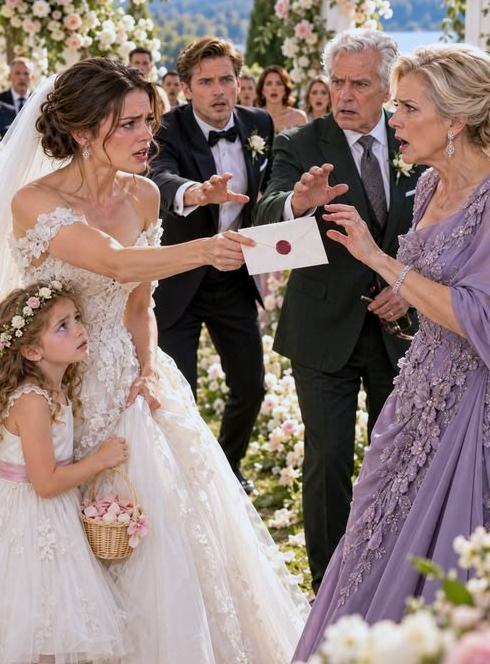
The barn manager held the envelope between us as though it might explode.
Celia reached for it.
I took it first.
Her fingers closed around empty air.
“Give me that,” she said.
“What is it?” Grant asked.
She turned on him. “A private family matter.”
“No,” I said. “You stopped having private family matters when you brought strangers into my wedding and claimed my daughter in front of my guests.”
The paper seal bore my name. Not my current signature. The old one, the hurried version I had used on school forms before Maisie was born.
I broke it with my thumbnail.
Inside was a notarized document claiming that I had appointed Celia as Maisie’s temporary caregiver in the event of my incapacity. It said my mother had been providing regular childcare and that Maisie knew her as a trusted grandparent.
There was a signature at the bottom.
Mine.
The notary stamp was real.
The signature was not.
Nicole stepped closer. “Claire, you never signed that.”
“No.”
Celia’s voice sharpened. “It was only a precaution.”
“A precaution for what?”
“For the possibility that you would make another impulsive decision.”
I looked at the document again. “You planned to take her.”
“I planned to protect her.”
“From me?”
“From your instability.”
Daniel moved beside me. He did not touch my arm. He knew I hated being held in place when I was angry.
“Tell them where you got the signature,” he said.
Celia glared at him. “You have no place in this.”
“I have every place in this.”
The guests had stopped pretending not to listen. A child near the gift table was being quietly led inside by an aunt. The florist stood frozen beside a bucket of roses, one hand still wrapped around a pair of shears.
Grant took the document from me.
He read it once.
Then again.
“Celia,” he said, “this says you have been providing care since 2020.”
“She needed family.”
“She had Claire.”
“You abandoned us,” I said.
The words hit him harder than I expected. His shoulders lowered.
“Yes,” he replied. “I did.”
Celia stared at him. “You are not going to turn against me because Claire is having a tantrum.”
Grant looked at the forged signature. “Did you use the signature from the school enrollment form?”
She hesitated.
That hesitation answered him.
He pulled a folded packet from inside his jacket. The papers were clipped together with a brass fastener shaped like a tiny crescent moon. He had always used those clips for bills, receipts, and maintenance instructions.
“I found the original bank records last night,” he said. “And the old account authorization.”
Celia’s face changed.
Grant held up the first page. “You forged my signature to move the adoption deposit into your account.”
“I was going to put it back.”
“You spent it.”
“I paid household bills.”
“You bought the new kitchen cabinets.”
Her silence spread through the lawn.
I remembered those cabinets. In the photographs my mother sent to relatives, they gleamed behind her like proof that our family was prospering. I had once thought she had used the money to help me.
Grant continued, each sentence quieter than the one before. “You also forged Claire’s signature on this guardianship paper. You told me it was a consent form for family counseling.”
Celia shook her head. “You don’t understand what she was like.”
“I understand exactly what you told me.”
He looked at me.
“I remember the night you were put outside,” he said. “I remember holding the storm door. I remember thinking your mother knew what she was doing.”
My chest tightened.
“Why didn’t you stop her?”
He swallowed. “Because I was afraid of losing my marriage. I told myself you would come back when you were ready. I told myself the baby would be better off with people who had money.”
“You let her make me believe Ben had sold us.”
“I know.”
“No, you don’t.”
Daniel stepped forward. “She spent four years believing I had taken money to abandon her. I spent four years believing she had ended the pregnancy and hated me.”
Grant looked at him. “I’m sorry.”
Daniel’s expression did not soften. “Sorry is not a bridge.”
“No,” Grant said. “But I can bring the boards.”
He handed me the original bank records.
“I will sign a statement explaining everything,” he said. “I will give you the account history, the messages, and the documents your mother kept. If you want no contact with me after that, I will accept it.”
Celia grabbed his sleeve. “You would expose me at our daughter’s wedding?”
“Our daughter’s wedding?” I repeated.
She released him.
The phrase had sounded so natural from her mouth. That was the part that frightened me most. She still believed blood gave her ownership.
Marlene closed the old ledger.
“I can also provide the agency file,” she said. “The original records show Claire never consented to adoption. They show the deposit was returned only after I demanded an explanation.”
I turned to her. “When was it returned?”
“Three weeks ago.”
“Why?”
She looked at Celia. “Because she called my office asking whether the file still existed. She wanted a certified copy to support her claim that Claire had voluntarily abandoned the child.”
A cold line moved down my spine.
Celia had not come to my wedding for reconciliation.
She had come prepared.
She had expected me to panic, expected the guests to see her as a grandmother denied, and expected that forged paper to make me look dangerous if I resisted.
“What did you plan to do after the ceremony?” I asked.
Celia’s eyes flicked toward the barn, where Maisie waited with Nicole.
“Take her for lunch.”
“You brought a legal document to take my daughter for lunch?”
“She would have come willingly if you had not poisoned her against us.”
I walked to the side entrance.
Maisie stood beside Nicole holding a basket of flower petals. Her ribbon had come loose, and one yellow flower was tucked behind her ear.
“Mommy?”
I crouched in front of her.
“Grandma wants to take you somewhere,” I said. “Do you want to go with her?”
Maisie looked past me at Celia.
The older woman softened her face and opened her arms.
“Come here, sweetheart. I’m your grandmother.”
Maisie moved closer to me instead.
“Is she the lady who made you cry?”
No one spoke.
Celia’s face twisted. “Claire, what have you told her?”
“The truth,” I said. “That you are someone from my past who does not get to decide where she goes.”
Maisie reached for my hand.
I took it.
Then I turned to Grant. “You may come to the ceremony if you leave that document and every original record with Marlene. Not because you are forgiven. Because you finally brought proof instead of excuses.”
He nodded.
Celia stared at me as if I had become a stranger.
Perhaps I had.
For seven years, I had measured every decision against the fear that my mother might be right about me: too young, too emotional, too reckless to protect my child.
But I had raised Maisie in a room above a laundromat, worked through sickness, studied after midnight, traced fraudulent accounts for a living, and found the man my parents had erased from our lives.
I was not reckless.
I had simply been surrounded by people who benefited whenever I doubted myself.
Celia reached for the forged guardianship paper.
Marlene placed her hand over it.
“No,” she said. “You don’t get to carry this away.”
My mother looked at Grant.
“Say something.”
He did.
“Give Claire the records.”
“And then?”
“Then you leave.”
Celia’s mouth trembled. “After everything I did for this family?”
Grant’s eyes lowered to the bank statement. “That is exactly why.”
She walked away across the grass, still wearing the cream suit she had chosen to look harmless. At the edge of the parking area, she stopped beside her car but did not open the door.
She turned once.
“Claire, you’ll regret humiliating me.”
I looked at Maisie’s loose yellow ribbon and tied it carefully around her waist.
“No,” I said. “I regret believing you.”
Celia drove away.
Grant stayed near the gift table while Marlene copied every page. He did not ask to hug me. He did not ask whether I could forgive him. He signed the statement with a pen that scratched loudly against the paper, then placed it beside the forged receipt.
Daniel watched him.
When the documents were finished, Daniel picked up the old receipt and turned it over.
On the back, almost invisible beneath the faded ink, was a pencil mark: a phone number and two words written in his mother’s handwriting—Call if found.
He stared at it.
“What is that?” I asked.
“Connie’s number,” he said. “My mother wrote it before I left for the Army. She told me to call if anything ever happened.”
He looked at me, then at Maisie.
“I should have looked harder.”
“So should I,” I said.
Maisie tugged his sleeve.
“Are you coming to the wedding?”
Daniel bent until they were eye to eye.
“If your mother says I can.”
Maisie considered this seriously.
“You can sit by me. I saved the flower basket.”
He smiled, and the scar above his eyebrow lifted with it.
Inside the barn, the guitarist began again. This time he played the whole song.
Grant took a seat in the last row. He kept his hands open on his knees, with nothing hidden inside them.
Marlene placed the agency ledger in my hands before the ceremony began. It was heavier than it looked.
I gave it to Nicole for safekeeping, then walked toward the arbor with Maisie on one side and Daniel on the other.
The crooked ribbon brushed against my dress as she carried the basket.
At the first row, she stopped, looked up at me, and whispered, “Mommy, that lady didn’t get to take me.”
“No,” I whispered back.
Maisie glanced at Daniel.
“Because he found us.”
Daniel squeezed her hand.
And this time, when the music carried our names across the barn, nobody had the power to change who belonged beside us.
Missed the beginning?






