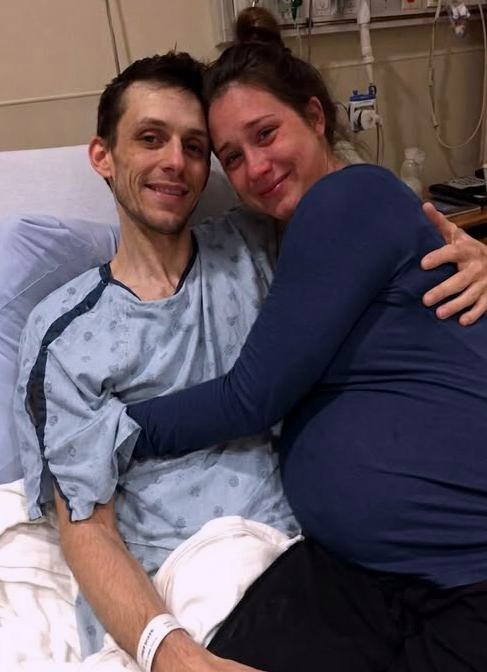
The hospital elevator doors were closing when Dr. Elias Morgan thrust his hand between them and shouted my name as if I were running from a fire.
I was still holding the pen I had used to sign Mark’s final donation forms. My fingers were numb. A tiny brown smear of his blood stained the cuff of my cream cardigan where I had pressed his hand against my cheek before they took him away.
“Claire, wait,” Dr. Morgan gasped.
The elevator shuddered, then opened again.
Behind him, the corridor glowed with the hard white light of the intensive care unit. Nurses moved quickly around him, their rubber soles whispering across the floor. Somewhere behind those doors, machines were still displaying the numbers that no longer belonged to my husband.
I looked at the doctor’s empty hands. “What is it?”
He glanced over his shoulder.
That frightened me more than his voice.
“Not here,” he said. “Please come back to my office.”
“Mark is dead.” The words scraped my throat. “If this is about paperwork, I can’t do any more paperwork.”
“It isn’t paperwork.”
A metal tray rattled as a nurse pushed it past us. The sound went through my skull like a dropped glass.
I had spent the last six months learning the language of death. Tumor. Failure. Decline. Three months, perhaps less. We had repeated those words until they became furniture in our home, always present, impossible to move around.
But Mark had still kissed my stomach every night.
Our daughter had kicked beneath his palm while he whispered to her about the ocean, even though we lived three hours from the nearest coast.
“If my organs are usable,” he had told me on our porch, his thumb circling the gold buckle of his old watch, “I want them donated.”
“Don’t talk like that while she’s moving.”
“Especially while she’s moving.”
Now the watch was in my pocket. I had taken it from his bedside table because I could not leave the hospital with nothing that had touched him.
Dr. Morgan led me into his office at 6:42 in the evening. Rain ticked against the narrow window. On his desk sat a sealed envelope beneath a glass paperweight shaped like a sailboat.
My breath stopped.
“Mark gave me that three weeks ago,” he said.
I stared at the envelope. My name was written across it in Mark’s unmistakable handwriting, the letters leaning forward as if even they were in a hurry.
“What does it say?”
“I don’t know all of it.”
“You don’t know?”
“He asked me to keep it sealed until he died. He was very specific.”
I laughed once, sharply. It sounded nothing like me. “He made you promise to hide something from his pregnant wife?”
“He said you would try to protect him from the truth.”
My hand went to my belly, though our daughter had been born three weeks earlier and was sleeping in my sister’s arms downstairs. I had forgotten, for one dizzy second, that I was no longer carrying her.
Dr. Morgan lowered his eyes.
“Mark also asked me to tell you that the donation must proceed exactly as signed.”
“It will.”
“And he asked me to give you this before anyone else saw it.”
“Anyone else?”
The doctor did not answer.
Rain slid down the glass in crooked lines. I could hear the faint beep of a monitor through the wall, steady and indifferent.
I reached for the envelope.
Dr. Morgan caught my wrist—not hard, but urgently.
“Claire, once you read the first page, you may not be able to stop what happens next.”
I looked at his pale face. “My husband is dead. What could possibly happen next?”
His grip loosened.
The envelope lay between us like a door neither of us wanted to open.
Then someone knocked twice on the office door.
Dr. Morgan turned toward it, and a man’s voice came from the hallway.
“Doctor? Has she received the packet yet?”
Dr. Morgan’s face changed.
I pulled the envelope toward me as the handle began to turn…
PART 2
The door opened before Dr. Morgan could answer.
A tall man in a charcoal coat stood in the doorway, rain glittering on his shoulders. I recognized him immediately. Victor Hale was the hospital’s chief transplant coordinator, the man who had sat beside me two hours earlier and explained, in a gentle voice, how Mark’s organs might give someone else a chance to live.
His eyes dropped to the envelope.
Then he smiled.
“Mrs. Bennett,” he said, “I’m sorry for your loss.”
Dr. Morgan moved between us. “Victor, this is not the time.”
“Actually, it is.” Victor’s hand rested on the silver handle of his umbrella. “There are allocation documents that require immediate attention.”
I tightened my fingers around Mark’s letter. “Why did you ask whether I had received it?”
His smile remained, but the warmth disappeared from it.
“I didn’t.”
“You just did.”
“Doctor, you must have misunderstood.”
Dr. Morgan shut the door.
For several seconds, the room contained only the rain and my own breathing.
“What is going on?” I asked.
The doctor returned to his chair but did not sit. “Mark worked with the transplant department before his illness. He reviewed donor logistics and emergency transfers.”
“I know he worked here.”
“Did he ever tell you about the audit?”
I shook my head.
A thin red line appeared where the corner of the envelope pressed into my palm. I welcomed the sting. It gave me something physical to concentrate on.
“What audit?”
Dr. Morgan looked toward the closed door. “For the past year, Mark believed someone was altering priority reports. He thought certain patients were being moved ahead of children who had waited longer.”
I felt the floor tilt.
“Are you saying organs were stolen?”
“I’m saying Mark found irregularities.”
“Why didn’t he tell me?”
“Because he believed the person responsible could make your life very difficult.”
My baby was downstairs with my sister. Mark was dead. Suddenly every corridor seemed filled with people who knew something I didn’t.
I slid my thumb beneath the envelope flap.
Dr. Morgan caught my eye. “He asked me to give you the contents only after his organs had been accepted for donation.”
“Why?”
“Because he wanted the hospital to be unable to withdraw them.”
A coldness spread from my chest to my hands.
“You’re telling me my husband used his own death to force the hospital to listen?”
“He knew his donation would bring attention.”
I opened the envelope.
Inside was a handwritten letter, two folded pages, and a small brass key attached to a strip of black thread. The key bore a number stamped into its bow: 417.
The letter began with my name.
Claire,
If you are reading this, I failed to tell you the truth while I was alive. I am sorry. I was afraid that if you knew what I had found, you would spend my remaining days fighting people who had already decided I was dying.
My vision blurred. I pressed the paper flat against the desk.
“What did he find?” I whispered.
Dr. Morgan’s voice dropped. “Read the second page.”
The first page contained names, dates, and numbers. Several had been circled in Mark’s blue ink. One name appeared again and again: Victor Hale.
Beneath it was the name of a child, Miriam Cole, age nine.
I looked up. “Who is she?”
“A girl with end-stage heart failure,” Dr. Morgan said. “She has been waiting for a transplant for eleven months.”
“And Mark’s heart?”
“His heart is damaged beyond use.”
The words struck me harder than I expected. Mark had wanted to give everything he could, and even death had refused to take his heart.
“But his kidneys and liver may be suitable,” the doctor continued. “Miriam’s file is connected to the audit.”
I turned the page.
Mark had written that Miriam’s priority score had been lowered twice, each time without a physician’s authorization. He had also written that Victor had tried to move a wealthy adult patient ahead of her.
At the bottom, Mark had underlined one sentence:
The proof is not in this envelope. It is where they will never think to look.
My eyes fell to the brass key.
“Locker 417?”
Dr. Morgan nodded. “The old records room. Mark asked me to keep the key until you came.”
“Then why didn’t you take the documents yourself?”
“Because Mark wanted you to decide what to do with them.”
The office door rattled.
Victor’s voice came through the wood, calm and polished.
“Doctor, the retrieval team is ready. If Mrs. Bennett has concerns, we can address them after the organs are transferred.”
I folded the letter against my chest.
“What happens if I refuse?”
Dr. Morgan’s jaw tightened. “Your husband’s donation could be delayed.”
“And if I agree?”
“Then Miriam may lose her chance.”
The handle began to turn again.
Dr. Morgan took the key from my hand and closed my fingers around it.
“Locker 417 is downstairs,” he whispered. “But we have less than ten minutes before Victor signs the release.”
I looked at Mark’s handwriting one last time.
Then I heard Victor say, “Open the door.”
And Dr. Morgan reached for the light switch…
PART 3
The office went dark.
Dr. Morgan opened the door only after I had slipped behind the tall filing cabinet. Victor entered with two nurses and a clipboard tucked beneath his arm.
“Where is Mrs. Bennett?” he asked.
“Taking a moment in the chapel,” Dr. Morgan replied.
Victor’s gaze swept the room. “She left the envelope.”
“No.”
It was the first time I had heard the doctor lie.
Victor placed the clipboard on the desk. “The retrieval team cannot wait indefinitely. We have an adult recipient in critical condition.”
“What happened to Miriam Cole?”
Victor’s expression hardened. “Her status is being reviewed.”
“By whom?”
“By people qualified to make that decision.”
Behind the cabinet, I could hear my pulse in my ears. The brass key dug into my palm.
Dr. Morgan stepped closer to the desk. “You lowered her priority twice.”
“I corrected an error.”
“You altered a physician’s report.”
Victor laughed under his breath. “Be careful.”
One of the nurses glanced at him. “What is this about?”
Victor turned on her. “Leave.”
She did not move.
That hesitation gave Dr. Morgan the opening he needed. He pulled a folded sheet from inside his coat and placed it beside the clipboard.
“Mark gave me this,” he said. “His signed statement.”
Victor stared at the page.
The color drained from his face.
I stepped from behind the cabinet. “He gave it to me.”
Victor spun around.
For a moment, nobody spoke. The brass key hung between my fingers, catching the thin strip of light beneath the blinds.
“You shouldn’t have that,” Victor said.
The words escaped him before he could stop them.
Dr. Morgan looked at the nurses. “You heard him.”
Victor recovered quickly. “She is grieving. She doesn’t understand what she has.”
“I understand that my husband wrote your name beside every altered report.”
“That proves nothing.”
“Then you won’t object to opening locker 417.”
His eyes flickered toward the door.
That was the answer.
Downstairs, the old records room smelled of dust, disinfectant, and damp cardboard. The clock above the security desk showed 7:03. Dr. Morgan walked beside me while the two nurses followed, each carrying a folder they had taken from Victor’s office.
Locker 417 stood at the end of a rusted metal row. My hand shook so badly that I missed the keyhole twice.
“Let me,” Dr. Morgan said.
“No.” I forced the key in. “Mark wanted me to open it.”
The lock clicked.
Inside was a black ledger, six printed donor reports, and a small envelope addressed to Dr. Morgan. The ledger contained altered dates, patient numbers, and transfers. The reports showed that Miriam Cole had been eligible for a pediatric priority category, but her score had been changed after Victor received a private donation from the family of another patient.
Victor had not merely made a mistake.
He had sold time.
Dr. Morgan read the pages with his lips pressed into a thin line. One nurse began to cry quietly.
Victor arrived at the doorway, breathing hard.
“Close the locker,” he ordered.
I held up the final report. “You signed this.”
“I signed hundreds of forms.”
“You signed the change that moved Miriam down.”
“It was medically justified.”
“Then why did Mark write that you threatened him?”
Victor went still.
Dr. Morgan opened Mark’s second letter. “He wrote that you told him his pregnant wife would regret making enemies at the hospital.”
My knees nearly failed me. Mark had known. He had carried that fear alone while pretending to be annoyed by my questions, while buttoning his shirts with fingers too weak to close the cuffs.
Victor’s mouth tightened. “He was sick and confused.”
“Then you won’t mind if the board reads his statement,” I said.
He lunged for the ledger.
The nurse blocked him. “Don’t touch her.”
Victor stopped, his hand suspended inches from the black cover.
Dr. Morgan took out his phone. “The board chair is on her way.”
Victor looked at me. “If you release those records, your husband’s donation will be suspended. Every transplant connected to this review will be frozen.”
It was the threat Mark had feared.
I thought of his hand resting on my belly. I thought of Miriam’s name written beside a red star.
“Then we don’t release them blindly,” I said. “We give them to the board, the transplant ethics committee, and Miriam’s doctors together.”
A pager shrilled in the corridor.
Dr. Morgan read the message, and his face changed.
“What?” I asked.
He looked at the donation report in my hand.
“Mark’s kidney has been matched.”
“To Miriam?”
“No.”
He swallowed.
“To a private recipient whose identity was entered into the system twelve minutes ago.”
Victor’s eyes dropped to the floor.
Then the nurse beside him whispered, “That recipient is Victor Hale’s brother.”
Dr. Morgan looked at me.
“The surgical team is already preparing to retrieve the organ…”
Mark’s last request reached far beyond his death…
I thought grief was the only thing waiting after that envelope opened. I was wrong. What Mark uncovered placed one child’s life against a system built to protect the powerful.
“Your husband left more than an organ.”
I finally understood why he had been afraid.
👇 The final part of the story is now open.






