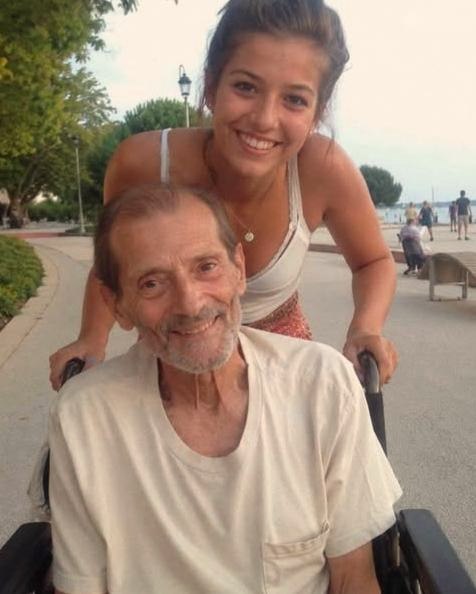
The lawyer placed a small wooden box in my hands the morning after Nathan’s funeral, and his nephew locked the office door behind me.
It was 9:12 on a gray Tuesday at Bellwether Hospice. Rain tapped against the tall windows, and the box smelled faintly of cedar and something medicinal, like the cabinet beside Nathan’s bed. My fingers tightened around its brass clasp.
“Why did you lock that?” I asked.
Victor Hale leaned against the door. He was Nathan’s nephew, though I had seen him only twice during the six weeks I cared for Nathan. He wore a black suit that fit too perfectly and polished shoes that made no sound on the carpet.
“Because you’re about to hear something that changes what you think you were doing here,” he said.
The lawyer, Martin Keene, set a leather folder on the table. His face was pale, but his voice remained careful.
“Elena, Nathan chose this hospice because he knew you volunteered here.”
My throat closed. “He knew me before I met him?”
“He had been looking for you for twenty years.”
Victor gave a short laugh. “Looking for a daughter who didn’t exist? That’s one version.”
The brass clasp pressed into my palm. I remembered Nathan’s hand covering mine in the garden, his skin paper-thin, his thumb trembling as he said, “Just call me Dad while I’m still here.”
I had believed it was an old man’s final wish. A kindness. Nothing more.
For six weeks, I pushed his wheelchair beneath the sycamores, carried coffee from the diner on Fourth Street, and drove him to the ocean at sunset. Every time someone asked who I was, Nathan answered with the same soft pride.
“This is my daughter.”
I had smiled because the words filled a hollow place my mother had left behind. She died two years earlier without ever naming my father. On her death certificate, the space for his name was blank.
Now Martin opened the folder.
“There are records here,” he said. “Some are medical. Some are financial. One concerns your birth.”
Victor stepped away from the door. “You should leave, Elena. Take the box and go. Nathan was sick. Sick people make sentimental arrangements.”
“Then why are you frightened?” I asked.
His jaw tightened. A silver cuff link caught the light as he folded his arms.
“I’m not frightened.”
“You came to a hospice before breakfast to watch a stranger receive a box.”
Martin looked at him. “Victor, I suggest you stop speaking.”
Victor’s eyes shifted to the box. That tiny movement frightened me more than his anger.
At 10:03, Martin led me into the small chapel where Nathan’s memorial flowers still stood in cloudy glass vases. The lilies had begun to brown at the edges. He placed the box on the altar between us.
“Nathan gave me strict instructions,” he said. “I was to tell you only after the funeral. He believed you had to choose freely before you knew who he was.”
“Who was he?”
Martin’s hand hovered over the clasp.
“Your father.”
The room tilted. I caught the edge of the altar, scraping my knuckle against the wood.
“No,” I whispered. “My mother said he left before I was born.”
“She said many things.”
Outside, a cart rattled down the hallway. Somewhere, a nurse called for a doctor. The ordinary sounds made the moment feel impossible.
Victor pushed open the chapel door.
“You’re being manipulated,” he said. “Nathan wanted an heir, and you happened to be convenient.”
“Did he know my name?”
Victor stared at me.
Martin reached toward the box. “There is one thing you must understand before you open this. Nathan did not merely find you. He arranged for you to find him.”
The lawyer lifted the brass clasp, and from inside the box came the sharp click of a hidden mechanism beginning to release…
PART 2
The lid sprang open before Martin could touch it, and a narrow steel compartment slid forward from beneath the velvet lining.
Inside lay a folded birth certificate, three envelopes tied with a strip of brown ribbon, and a tarnished brass diner token stamped with the words Harbor Grill, 1987. Beneath them rested a photograph of my mother standing beside a young man I recognized immediately, although I had never seen the picture before.
Nathan.
He was twenty-nine, dark-haired, broad-shouldered, and smiling at my mother as if the world had made room for only the two of them. My mother’s left hand rested over her stomach.
I stopped breathing.
Victor snatched the photograph from the box.
“Give me that.”
Martin caught his wrist. “You will not touch another item.”
Victor’s face changed. The smooth confidence vanished, replaced by something raw and furious.
“Do you know what that man did?” he asked me. “He abandoned her. He disappeared when she needed him.”
“Did you know him before he died?”
“I knew what he was.”
“That isn’t an answer.”
The chapel clock clicked toward 10:20. I could hear rainwater rushing through the gutters outside. My knuckle had started bleeding, and a bright drop fell onto the photograph’s corner.
Martin took it from Victor and turned it over. On the back, in my mother’s handwriting, were four words: He promised he would come.
I sat down hard on the nearest chair.
“My mother kept this for thirty-eight years.”
“She kept more than that,” Martin said.
He unfolded the birth certificate. The father’s name had been covered by a strip of white correction paper, but beneath it, the original ink showed through: Nathaniel Hale.
I stared until the letters blurred.
“Why did he never contact me?”
Martin glanced at Victor.
“That is what Nathan wanted you to discover yourself.”
“Stop protecting him.”
“I’m not protecting anyone.”
Victor paced beside the altar. His shoes crushed a fallen lily petal.
“Nathan was dying and wanted to rewrite his life,” he said. “He found an innocent woman at the hospice, played the lonely father, and now expects everyone to applaud.”
“Why were you at his funeral?” I asked.
“To make sure his wishes were respected.”
“Then why did you tell me to leave?”
He looked at the box again. “Because those papers are stolen property.”
Martin removed a second envelope. It was not gray or white, but a deep red, sealed with black wax. My name was written across it in Nathan’s uneven handwriting.
Elena—open only after you have heard the truth from Martin.
My hands went cold.
“Did he write this before I met him?” I asked.
“Three months ago.”
“Then he knew exactly who I was.”
“Yes.”
“And he planned every conversation?”
“Not every conversation. Only the meeting.”
Victor struck the altar with his palm. The glass vase jumped, and two lilies slid into the water.
“You don’t understand what he wanted,” he said.
“Then explain it.”
His breathing grew uneven. “He wanted to take everything from me.”
Martin’s eyes narrowed. “Nathan owned nothing you could claim.”
Victor smiled without warmth. “That’s what he told you.”
A nurse appeared at the chapel entrance, holding a stack of folded towels. She saw the three of us and stopped.
“Mr. Keene,” she said, “there’s a woman waiting in the administration hall. She says she worked for Nathan.”
“What is her name?”
The nurse checked a note. “Rosa Bell.”
Victor went absolutely still.
The red envelope remained between my hands. The wax seal bore an unfamiliar symbol: a small anchor pierced by a line.
I broke it.
Inside was one sentence, written in Nathan’s hand: If Rosa comes, let her speak before Victor can make you doubt yourself.
A sound escaped Victor, low and violent.
Martin turned toward the hallway. “Bring her in.”
But before the nurse could move, Victor grabbed the chapel’s brass fire extinguisher from the wall and raised it over the box…
PART 3
Victor’s arm came down, but Martin shoved the altar sideways, and the extinguisher struck the stone floor instead of the box.
The crack echoed through the chapel.
Rosa Bell stood in the doorway, clutching a canvas handbag against her chest. She was a small woman in her seventies, with white hair pinned by two copper clips and a scar running from her left eyebrow to her temple.
“Victor,” she said, “you still break things when you’re afraid.”
His hand tightened around the extinguisher.
“You should have stayed away.”
“I stayed away for thirty-eight years.”
The nurse hurried off to get security, but Rosa walked into the room without waiting. Her flat shoes squeaked against the polished floor.
I looked from her to Victor. “What happened thirty-eight years ago?”
Rosa set her handbag on the altar.
“Your mother came to Nathan’s office in October of 1987. She was pregnant and carrying a letter from him. Nathan had written that he wanted to marry her and support the child. He never received her message because Victor intercepted it.”
Victor’s face drained of color.
“That is a lie.”
Rosa opened the bag and pulled out a ledger bound in cracked green cloth. The corners were softened by years of handling.
“I was Nathan’s secretary. I saw Victor remove letters from the outgoing tray. I saw him forge Nathan’s signature on a transfer authorizing the sale of Nathan’s restaurant shares.”
Martin took the ledger. “Why keep this?”
“Because Nathan asked me to. He said if he ever found his daughter, she deserved the whole truth.”
I could barely hear over the pounding in my ears. “My mother believed he abandoned us because of you?”
“Because of Victor,” Rosa said. “He told her Nathan had left town with another woman. Then he sent Nathan a false message saying she wanted nothing from him.”
Victor stepped toward me. “Your mother hated him. She chose to keep you away.”
Rosa’s hand shook as she opened the ledger to a marked page.
“Your mother did not hate him. She came back twice. Victor turned her away.”
She showed me a receipt from Harbor Grill, dated three days before I was born. On the back, Nathan had written: She came. Victor said she never did.
My knees weakened.
Martin found a second signature beneath the receipt, witnessed by Rosa. It was Victor’s.
“You signed the visitor log,” Martin said.
Victor stared at the page. A bead of sweat slid beside his ear.
“I was protecting the business.”
“From a pregnant woman?” I asked.
“From Nathan’s weakness.”
The chapel doors opened, and two hospice administrators entered. Victor turned toward them, but Rosa spoke over him.
“Nathan knew Victor had been selling the hospice property through a shell company. He placed the land and the remaining diner shares into a trust that could be activated only by his biological daughter.”
I looked at Martin. “The trap.”
Martin nodded. “Nathan wanted Victor to believe you were an impostor. He knew Victor would try to destroy the evidence or force you away. His behavior would establish intent.”
Victor laughed sharply. “You think a few papers can take anything from me?”
Martin opened the final page of the ledger. “The trust was activated this morning. The shell company is now exposed, and every attempted sale is frozen.”
Victor’s gaze moved to the box. “What did he leave you?”
“Not what you think,” I said.
The administrator’s phone rang. She answered, listened, and looked at me.
“Miss Marlowe, there’s a notice from the county. The hospice will be evicted tomorrow unless the trust pays the emergency debt by noon.”
Martin’s expression tightened.
Victor smiled again, but this time it looked desperate.
“Nathan left you a sinking ship,” he whispered. “And you just agreed to stand on it.”
The phone in Martin’s pocket began ringing. He glanced at the screen, then at me.
“It’s the bank holding the original trust account,” he said. “They’re calling about a withdrawal Victor made before dawn…”
Victor saw the document Nathan hid for decades…
I thought the box contained a confession. I was wrong. What it revealed forced me to choose between the father I had just found and the people he had protected.
“I told him she had chosen another man.”
The truth struck harder than any inheritance.
👇 The final part of the story is open.






