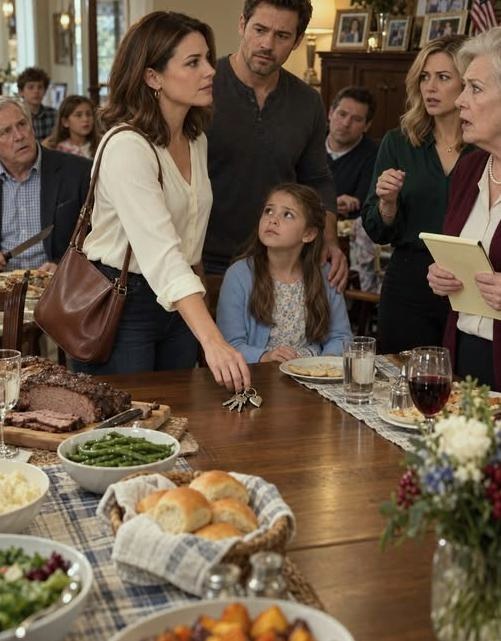
My mother had already erased my eight-year-old stepdaughter from the family reunion when she lifted her glass and asked me not to make a scene.
It happened at my parents’ house on a Sunday evening, beneath the brass dining-room lamp my grandmother had chosen before I was born. Dad was carving brisket near the window. The smell of pepper and roasted onions hung over the table, while my mother checked names on a yellow legal pad.
“Cabins are booked,” she announced. “The aquarium is paid for. We have the lake picnic on Saturday.”
Sophie sat beside my husband, Michael, swinging her legs beneath the chair. She had spent the entire meal whispering questions about the stingray pool.
“Do they really let you touch them?” she asked.
Mom’s pen stopped.
My sister Lauren glanced at her. My brother suddenly began scraping applesauce from his daughter’s plate.
I felt the room tighten around us.
“Of course they do,” I said to Sophie. “You’ll love it.”
Mom folded the legal pad in half.
“There’s a small complication,” she said.
“What kind of complication?” Michael asked.
She looked at me, not at him.
“There isn’t space for Sophie at the reunion.”
For a moment, I honestly thought she meant one of the cabins had a broken bed.
“Then we’ll bring an air mattress,” I said.
“The numbers are finalized.”
“Mom, she’s eight.”
Lauren set down her fork. The porcelain made a hard little crack against the plate.
“Hannah, don’t be difficult. She isn’t really family.”
Sophie’s hands stopped over the crackers she had been arranging into a neat row.
Michael pushed back his chair. “What did you just say?”
Lauren shrugged. “She’s your daughter. She’s not one of the cousins. This is a family reunion.”
“She is family,” I said.
“Not by blood,” Mom answered.
Nobody corrected her.
Dad kept cutting the brisket, though the knife had stopped moving. My brother stared at the tablecloth. Sophie stared at her crackers as if she could disappear between them.
Something inside me went very still.
She wasn’t watching my mother. She was watching me.
Waiting to see whether I would let them decide what she was worth.
Mom reached for her legal pad again. “Please don’t turn this into some dramatic speech.”
I didn’t give one.
Instead, I reached into my purse and pulled out the key ring my parents had given me seven years earlier. The front-door key. The side-gate key. And the tiny silver heart attached to it, the one Mom had handed each of her children while saying, “Family should always be able to come home.”
I placed the ring beside her water glass.
The heart struck the tabletop with a small, bright click.
Mom frowned. “Hannah, what are you doing?”
“If Sophie isn’t family,” I said, “then neither am I.”
Lauren gave a nervous laugh. “You’re leaving because of a seating arrangement?”
“No. I’m leaving because you told a child she doesn’t belong.”
I looked at Mom. “And I’m done coming here every Sunday to fill Dad’s pill organizer, check his blood pressure, drive him to appointments, and fix everything you remember only when you need me.”
Her face lost its color.
Michael crossed the room, took Sophie’s hand, and bent toward her. “Get your coat, sweetheart.”
She slid from the chair. Her eyes were wet, but she didn’t cry.
At home, she finally asked whether Grandma didn’t want her because she wasn’t “really mine.” I held her until her breathing slowed, then canceled the three-hundred-dollar monthly transfer I had sent my parents for years.
The calls began before midnight.
By morning, my brother called me selfish. Lauren called me cruel. Mom left three messages about destroying the family.
I answered none of them.
For nearly four weeks, the house stayed quiet.
Then, on a Wednesday afternoon, my phone buzzed while I was folding Sophie’s school uniform.
Mom had sent one sentence and a photograph.
I know we aren’t speaking, but you deserve to see this.
The photograph showed Michael kissing a blonde woman in a restaurant.
My hands went cold.
I waited until Sophie went upstairs, walked into the kitchen, and placed the phone in front of Michael.
“Tell me what I’m looking at.”
He stared at the screen.
Then he opened his own phone, searched through his photographs, and turned it toward me.
The same restaurant. The same jacket. The same angle. The same kiss.
But in his photograph, the woman in his arms was not a blonde stranger.
It was me.
Michael touched the screen with one finger. “Hannah, this was taken last spring.”
“Then why did my mother send me this?”
He looked toward the ceiling, where Sophie was humming softly in her bedroom.
Before he could answer, someone knocked on our front door.
I reached for the handle, but Michael caught my wrist.
“Don’t,” he whispered. “Look through the glass first.”
A man stood on the porch holding a brown document folder against his chest. When he saw me, he raised it slightly and said, “Mrs. Carter, your mother told me you would refuse to sign unless I explained what’s inside…”
PART 2
The man on our porch was Mr. Ellis, my parents’ accountant for almost twenty years.
I knew him from birthday dinners and tax appointments, but I had never seen him look frightened. Rain had darkened the shoulders of his wool coat. One of his hands kept tightening around the brass clasp of the folder.
Michael opened the door only halfway.
“What exactly are you asking my wife to sign?” he said.
Mr. Ellis glanced past him toward the staircase. “May I come in?”
I stepped forward. “Yes.”
He entered, wiped his shoes on the mat, and placed the folder on our kitchen table. The paper inside smelled faintly of dust and printer toner.
“I was instructed to deliver these papers to Hannah before Friday,” he said. “I was not told to explain them.”
“By whom?” I asked.
He looked at me over his glasses. “Your mother.”
My stomach tightened. “Why would she need my signature?”
Mr. Ellis opened the folder, then immediately closed it again.
“Because your parents are preparing to transfer the lake property.”
“The reunion cabins?”
“The entire property. The cabins, the dock, and the old boathouse.”
Michael leaned against the counter. “Who are they transferring it to?”
Mr. Ellis’s jaw worked before he answered.
“Lauren.”
The name landed harder than it should have. Lauren had complained for years that Mom favored me, that I received more help, more attention, more trust. Yet she was the one being handed the property where my grandmother had taught me to swim.
“Why do they need me?” I asked.
“Your grandmother placed the land in a family trust. Your mother became trustee after her death. The trust requires your written consent before the property can be sold or transferred.”
“Then why didn’t she just ask?”
He gave a tired, humorless smile. “She did not expect you to ask questions.”
A floorboard creaked upstairs.
I looked toward the ceiling. “Did my mother send that photograph to make me distrust Michael?”
Mr. Ellis said nothing.
That silence answered me more clearly than words.
Michael picked up the phone and enlarged the image. “The original was taken at the Cedar Spoon last April. Hannah and I were celebrating her promotion.”
“Who took it?” I asked.
“Lauren,” he said. “She was at the next table. She wanted us to pose for a picture.”
The memory returned in fragments: Lauren laughing, her red scarf hanging over the back of a chair, the waiter carrying a lemon pie. She had taken several photographs that night.
Mr. Ellis pulled a second sheet from the folder. “Your mother sent me a copy of the altered photograph two weeks ago. She told me it was proof that Michael was unfaithful and that you were too emotional to handle the trust negotiations.”
My mouth went dry.
“She told you that?”
“She told me to prepare for you to sign quickly after the marriage ended.”
Michael’s face hardened. “They planned to break us up.”
“I don’t know whether your mother or Lauren altered the image,” Mr. Ellis said. “But I know where the original file came from. Lauren submitted it to me as part of the property paperwork.”
I took the folder from him. The first page was a transfer agreement. The second was a statement saying I had received independent advice. The third had my name typed beneath a blank signature line.
At the bottom, in small print, I saw something that made my pulse jump.
The transfer was not simply to Lauren.
It was to a company registered six days earlier.
“Who owns this company?” I asked.
Mr. Ellis looked down at the table. “Lauren and your mother.”
The kitchen seemed to tilt.
“Why hide that?” Michael asked.
“Because the trust forbids the trustee from benefiting personally,” Mr. Ellis replied. “Your mother knew the transfer would fail if the beneficiaries saw the real ownership.”
I thought of Sophie’s face at the dinner table. The careful way Mom had said there was no space. The way Lauren had insisted Sophie was not family.
They had not only been excluding a child.
They had been defining who counted as a beneficiary.
I turned to Mr. Ellis. “What happens if I don’t sign?”
“The transfer cannot be completed.”
“And if I tell the other relatives?”
He reached into his coat and removed a narrow envelope sealed with red wax. Not gray. Not plain. The wax bore the shape of a small oak leaf.
“Your grandmother left one more instruction,” he said. “I found it last week while reviewing the original trust records.”
Michael looked at me. “What instruction?”
Mr. Ellis placed the envelope between us.
“It concerns the person your family tried to exclude from the reunion.”
My fingers hovered over the seal.
Before I could touch it, my phone rang.
The caller was my mother.
I answered on speaker.
“Hannah,” she said, with a trembling sweetness I had not heard since childhood. “If Ellis has arrived, you need to listen carefully. That envelope is not what you think.”
“Then tell me what it is.”
A pause.
“Your grandmother did not leave the lake property to you.”
Mr. Ellis suddenly reached across the table and took the folder back.
“Mrs. Carter,” he said sharply, “do not sign anything until you hear the entire clause.”
My mother’s voice rose through the phone.
“Ellis, you were paid to keep this family together!”
“No,” he answered. “I was paid to keep the accounts honest.”
The call ended.
Mr. Ellis broke the wax with his thumb.
He unfolded the paper, read the first line, and looked at me as if he had just discovered the floor beneath us was missing.
“Your grandmother named Sophie,” he said.
Then every sound in the house stopped…
PART 3
“Named Sophie for what?” I asked.
Mr. Ellis kept both hands on the document. The paper trembled, though his voice did not.
“For the lake property,” he said. “As the protected beneficiary.”
Michael stared at him. “Sophie wasn’t even born when the trust was created.”
“Your grandmother anticipated that.”
He turned the page toward us. The clause had been handwritten in dark green ink, then witnessed and attached to the original trust. It stated that any child permanently raised by Hannah Carter would hold an equal beneficial interest in the property, regardless of blood relation.
I read the sentence twice.
Then a third time.
Sophie had not been an inconvenience to the trust. She had been the person it was written to protect.
My mother had known.
Lauren had known.
And they had excluded her precisely because including her would make the transfer impossible.
Michael’s chair scraped backward. “They knew she was protected?”
Mr. Ellis nodded. “Your mother signed the annual trust statements. She initialed this clause every year.”
My phone was still connected. Mom had not hung up.
“You lied to me,” I said.
Her breath came thinly through the speaker. “I was trying to prevent a disaster.”
“You called Sophie not family.”
“She is not entitled to destroy Lauren’s future.”
“Lauren’s future?” I repeated. “You tried to steal her inheritance from an eight-year-old.”
“It was never meant to be yours alone,” Mom snapped. “Your grandmother hated the way our family argued about money. She created a ridiculous condition and expected me to manage it.”
Michael stepped closer to the phone. “So you forged a transfer?”
“We were restructuring the property.”
“With a company you and Lauren secretly own.”
Silence.
Mr. Ellis removed another page from the folder. “There is more. The company has already taken a loan against the cabins.”
My lungs stopped working for a second.
“What?”
“Your mother and Lauren borrowed against the property three months ago. They used the expected transfer as collateral.”
The photograph suddenly made sense. The exclusion. The pressure. The insistence that I come alone. They needed me frightened, isolated, and desperate enough to sign before the lender discovered the trust clause.
Mom began speaking quickly. “The loan was temporary. Once the transfer went through, Lauren would refinance it. Everyone would benefit.”
“Everyone except Sophie,” I said.
“She is a child. She doesn’t understand property.”
“She understands being told she doesn’t belong.”
A sharp knock sounded at our front door.
Mr. Ellis looked toward the hallway. “They came sooner than I expected.”
Michael opened the door.
Lauren stood outside wearing the red scarf from the restaurant photograph. Behind her was my father, pale and leaning heavily on a cane. Rain glittered on Lauren’s eyelashes, but she did not look embarrassed.
She walked straight into the kitchen.
“You always make everything harder than it has to be,” she said.
I held up the trust document. “You used the property as collateral.”
Lauren’s face tightened. “Mom said you would sign.”
“So you admit it.”
“I admit nothing.”
Mr. Ellis placed the altered photograph beside the original printout. “You submitted the first image to me.”
Lauren glanced at it. “I sent a photograph. I didn’t forge anything.”
“You removed Hannah from the frame,” he said. “The image data shows the alteration.”
Dad closed his eyes.
“Lauren,” he whispered. “What did you do?”
She spun toward him. “What did I do? You both promised me that property. You told me Hannah would never fight for it because she was too busy rescuing everyone.”
Mom’s voice cracked through the phone. “Stop talking.”
Lauren laughed bitterly. “You wanted Michael gone. You said Hannah would sign if she thought he betrayed her.”
The room went still.
Michael looked at me, not with suspicion, but with a grief so deep it nearly broke me.
Dad lowered himself into a chair. “Your mother told me it was only a scare.”
“And you let it happen?” I asked.
He looked at the silver heart on my key ring, which I had carried from the dining table without realizing it.
“I thought the reunion would fix everything,” he said.
“You excluded Sophie to fix everything?”
His mouth twisted. “I was afraid of losing the property. Afraid of losing your mother. Afraid of what Lauren would do if the loan failed.”
Mr. Ellis gathered the documents. “The lender will be notified that the collateral is encumbered by a protected trust. The transfer cannot proceed.”
Lauren lunged for the papers.
Michael caught her wrist before she reached them.
“You are not touching those,” he said.
From upstairs came a small, frightened voice.
“Dad?”
Sophie stood on the landing, clutching the stuffed stingray she had bought at the aquarium last year.
I went to her immediately.
Mom was still on speaker. Her voice softened when she heard Sophie.
“Sweetheart, Grandma never meant—”
Sophie shook her head. “You said I wasn’t family.”
No one answered.
Then Mr. Ellis’s phone rang. He read the number and turned toward me.
“The bank’s representative is downstairs at your parents’ house,” he said. “They found the trust clause in the county records. Your mother’s house may also be tied to the loan.”
Mom gasped.
Lauren’s face changed.
They had expected me to lose my marriage, my courage, and my claim to the lake.
Instead, the document had given me all three back at once.
But Mr. Ellis looked at the last page, and the relief vanished from his expression.
“There is one final condition,” he said. “Hannah, you must decide whether to accept the property as trustee—or refuse it and trigger the clause your grandmother wrote for exactly this situation…”
The last clause made my mother drop the phone…
I thought the photograph was the worst thing they had done. I was wrong. The final document changed who had truly been excluded.
“Does that mean I can go to the lake?”
No one at the table could look away.
👇 The ending of the story is open now.






