PART 4
I recognized it immediately. It belonged to the locked cabinet in Robert’s study.
The cabinet had been sealed since Robert died.
Not because it held money. Because it held the original company ledgers, the documents that explained how Grant Properties had been built, sold, and divided after his death.
Michael stared at the key.
“Where did you get that?”
Vanessa’s fingers closed around it.
“Your mother gave it to me.”
“I did not.”
“She gave me access to the family records.”
Andrew stepped between them. “Then why did you attempt a transfer from the account connected to those records?”
Her face hardened.
“Because I was protecting Michael from a woman who has controlled him his entire life.”
“You tried to move money from a dormant account,” I said. “You forged a dead man’s signature. You stole from my bedroom. You shaved my head while I slept.”
“I wanted you frightened enough to leave.”
The confession was quiet.
That made it worse.
Michael looked at her as though the white satin dress had become a costume he could no longer recognize.
“Leave for where?” he asked.
“Anywhere. A care facility. Your sister’s house. I did not care.”
“You filed papers to control her medical decisions.”
“I filed papers so she could not destroy your future.”
“My future was one hundred and twenty million dollars?”
Vanessa’s expression flickered.
“You know what your father left you.”
“No,” Michael said. “I knew what he wanted me to become.”
The ballroom had fallen silent except for the faint hum of the refrigeration units behind the bar.
I looked at the key in her hand.
“Take it out,” I said.
She smiled again, but there was no warmth in it.
“You think the cabinet proves anything?”
“It proves you had access.”
“It proves nothing.”
“Then open it.”
Her hand tightened.
Michael stepped toward her. “Give my mother the key.”
Vanessa shook her head. “You are letting her manipulate you.”
“I am asking you once.”
She threw the key onto the table.
It struck a champagne flute, spun in a bright circle, and landed beside the untouched wedding cake.
No one moved to pick it up.
I did.
The metal was warm from her palm.
At 10:18 that night, we returned to the Grant house. Margaret came with us. Andrew brought the hotel manager, Caleb, and Lauren, who insisted on telling the truth in person. Michael walked behind me through the foyer, still wearing his tuxedo. The wedding band on his finger caught against the brass banister.
He stopped beneath Robert’s portrait.
“I thought she loved me,” he said.
Margaret answered gently. “She loved what she could reach through you.”
He flinched.
In Robert’s study, the cabinet stood behind a row of law books. I inserted the key. The lock turned with a dry, reluctant click.
Inside were three leather ledgers, a stack of property deeds, and a sealed envelope bearing Robert’s handwriting.
Michael took one step forward.
“My father wrote that?”
“Yes.”
I had never opened it. Robert had instructed Andrew to give it to Michael only when his marriage was established and free of financial pressure. I had assumed that meant the morning after the wedding.
I broke the seal.
The letter was dated eight days before Robert died.
“My dearest Eleanor,” it began, “if Michael marries for love, give him everything. If he marries for rescue, give him the chance to discover who is holding the rope.”
Michael covered his mouth.
Below the letter was a separate document: a clause Robert had added to the family trust. The inheritance would never pass directly to a spouse, guardian, or creditor. It would fund Michael’s work, his education, and his children, but only through an independent board.
Vanessa had not merely failed to steal the money.
She had never been able to own it.
Her entire plan had been built on a fortune she could not legally possess.
Andrew read the final page and looked up.
“There is one more condition.”
“What?” I asked.
“If anyone attempts coercive control over Eleanor’s person or property, the trustee must notify the foundation board and transfer the entire inheritance away from the family branch.”
Michael sat heavily in Robert’s chair.
Vanessa had wanted to remove me so she could reach the money.
By doing so, she had sent it beyond her reach forever.
At midnight, she returned to the house with two suitcases and a furious aunt who demanded to know why the wedding guests had been dismissed. Vanessa had changed out of the satin gown, but her face still carried the sharp outline of the bride everyone had admired.
She stopped when she saw the ledger open on the desk.
“You cannot ruin my life over a prank,” she said.
I looked at the torn blue dress folded over a chair.
“A prank is hiding a shoe. You entered my bedroom, stole my jewelry, forged documents, and tried to place my life under your control.”
“I was desperate.”
“For money?”
“For a life where I never had to beg again.”
The answer surprised me.
Not because it excused her. It explained the hunger beneath the cruelty.
Vanessa had grown up in a house where every unpaid bill became a threat. She had told Michael that her father had died owing money and that she had spent years being treated like a debt instead of a daughter. I had heard fragments before and dismissed them as another way to make herself the center of every room.
But fear did not make her innocent.
It only made her dangerous in a way she had learned to call survival.
Michael stood.
“Did you ever love me?”
She looked at him for a long time.
“I loved the man you could become.”
“That is not an answer.”
“It is the only honest one I have.”
He removed his wedding ring.
Vanessa’s eyes went to his hand.
“You cannot do this tonight.”
“I can.”
“You promised me Wyoming.”
“I promised you a life. I did not promise you my mother’s captivity.”
She turned to me.
“Are you satisfied?”
I felt the old instinct rise inside me—the instinct to soften the truth so someone else could bear it. Robert had once called that instinct my greatest strength. After his death, I learned it could also become a door through which people entered and took everything.
“No,” I said. “I am not satisfied. I am finished explaining your cruelty as fear.”
Vanessa picked up her suitcase.
At the threshold, she stopped beside Michael.
“Your mother will spend the rest of her life reminding you what you lost.”
Michael looked at the letter in his hand.
“She just showed me what I nearly lost.”
Vanessa left with the key still missing from the table, because I had placed it in Andrew’s evidence envelope. The wedding guests received their refunds. The hotel kept the abandoned cake. Lauren returned the copied forms and gave a written statement to the foundation board. Caleb kept his job, though he refused the generous tip Andrew tried to give him and asked instead that it be donated to the women’s housing program.
The stolen jewelry was found the following morning in a locked compartment inside Vanessa’s rented car. The diamond brooch had a fresh scratch across its clasp. I wore it anyway when I signed the revised trust documents.
Michael did not receive the one hundred and twenty million dollars.
He received something more difficult: a position on the foundation board, a modest independent trust for his own work, and the responsibility of proving that he could use neither grief nor love as an excuse to stop looking at the truth.
He accepted all three.
A week later, he came to the foundation’s first new housing site with a toolbox in his hand. He did not ask me to erase what happened. He did not ask for the money to be restored.
He helped repair the front steps while I reviewed the architectural plans.
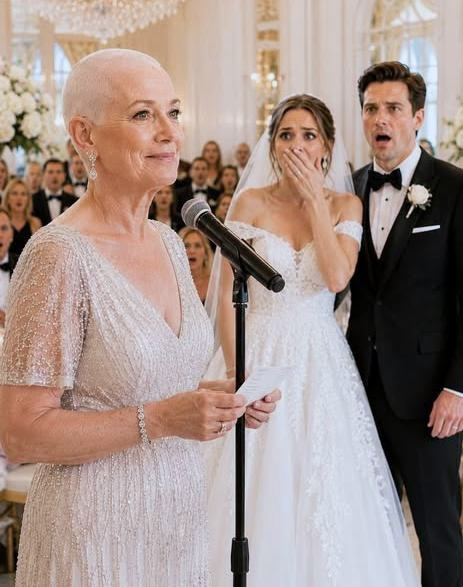
At noon, he found the torn wedding photograph in an envelope and brought it to me. In the picture, Vanessa was smiling. Michael was smiling. I stood between them in a silver wig, holding a champagne glass I never drank from.
“I want to keep one copy,” he said.
“Why?”
“So I remember the exact moment I stopped mistaking a beautiful picture for a beautiful life.”
I handed him the photograph.
Then I opened Robert’s ledger to the page where the first foundation house was listed. Beneath the property number, Robert had written a note in the margin: “Give people a place where no one can sign away their future for them.”
Michael read it twice.
“Was he always this stubborn?”
“Worse.”
He laughed, and the sound was painful but real.
That evening, he called me from the construction site. A storm had bent the temporary fence, and one of the volunteers had found a box beneath the porch floor. Inside was an old brass plaque bearing the name Grant Properties.
“Should we keep it?” he asked.
I looked at the scratch on Robert’s brooch and thought of the first office we had rented, the first contract we had nearly lost, and the fortune that had finally become useful only after it stopped belonging to one person.
“Mount it above the entrance,” I said. “Let everyone who comes in know what this place was built to prevent.”
“What should the plaque say?”
I heard the hammer pause on the other end of the call.
I remembered waking bald, humiliated, and certain that Vanessa had stolen my family from me. She had stolen a morning, a dress, a piece of jewelry, and my son’s trust. But she had also forced the truth into the light before money could turn deception into a lifetime.
“Leave the old name,” I told him. “Add the new one beneath it.”
“What new name?”
I looked at the first foundation resident’s application on my desk: a sixty-nine-year-old woman escaping a nephew who had been draining her accounts. Her hands had shaken while she signed. Mine had covered hers until they stopped.
“Eleanor Grant House,” I said.
The next morning, Michael sent me a photograph of the finished plaque. The old company name stood above the new one, both carved into the same piece of stone. Beneath them, the workers had added a line from Robert’s letter.
No one gets to inherit another person’s silence.
Michael had placed my scratched diamond brooch beside the plaque before taking the picture.
And beneath the metal, where the morning sun caught the damaged clasp, he had left a note in his own handwriting:
“Mom, I finally read what I signed.”
Missed the beginning?






