PART 4
Adrián had delivered the records to Elena Salazar, Alejandro’s younger sister and the chair of the board’s audit committee.
I learned that in the underground garage, where the rainwater had followed us down the ramp and gathered beneath the fluorescent lights.
Alejandro’s phone rang again.
He answered. “Elena.”
Her voice came through sharply enough for me to hear it.
“Bring Mariana to the old conference room. Do not bring Damián.”
“Where are you?”
“Already there.”
The call ended.
Esteban looked toward the exit. “Damián has gone to the board floor.”
Alejandro’s face tightened. “He will try to destroy the original files.”
“No,” I said. “He will try to make them disappear while everyone watches him do it.”
Alejandro studied me. “How do you know?”
“Because he always performs when he is afraid.”
We took the service elevator. Its walls were scratched steel, and every movement made the copper clasp of my folder tap against my hip. I had carried that folder into the building to leave quietly. Now it held the torn remains of my resignation and nothing else.
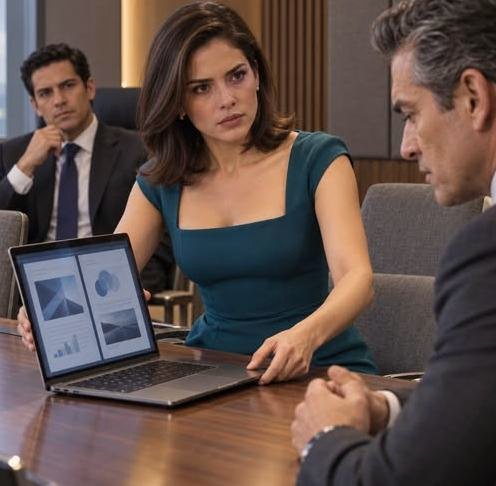
The old conference room was on the thirty-fourth floor, unused since a renovation. Elena stood beside the long table in a burgundy jacket, holding a leather document case. She was forty-two, precise, and had the same dark eyes as Alejandro, though hers offered less shelter.
Beside her stood Adrián Rojas.
He looked nothing like Damián. His shirt was wrinkled, his hair wet, and one sleeve had been ripped at the cuff. He held a canvas courier bag against his chest.
Alejandro stopped.
“You brought him here?”
Elena’s gaze stayed on Adrián. “He brought himself.”
Adrián placed the bag on the table. “Your brother is going to take all of us down.”
I stared at him. “Why help us?”
He gave a bitter smile. “Do not call it help. Damián moved money through my company without telling me the full amount. When I discovered where it came from, I tried to get out. He threatened my wife, then emptied one of my accounts.”
Alejandro stepped closer. “You ran the transfers.”
“I ran trucks. He ran the numbers.”
Elena opened the leather case. Inside were bound contracts, bank statements, and a signed letter on company stationery.
“Adrián contacted me this afternoon,” she said. “He has copies of every shipment and every payment. He also has proof that the board’s finance chair received a percentage.”
My breath caught. “The board was not just protecting Damián.”
“No,” Elena said. “Damián was protecting the board.”
Alejandro looked at her. “Why did you wait fourteen months?”
Elena’s expression did not soften. “Because you asked me to.”
The words struck the room harder than any accusation.
I turned to him. “You asked your sister to stay quiet too?”
“I asked her to trace the money.”
“You asked all of us to live inside your plan.”
Alejandro accepted the blow without reaching for an excuse. “Yes.”
“Even after you saw what it was doing to me?”
His eyes dropped to the copper clasp of my folder. “I told myself the damage would end when the network was exposed.”
“That is not an answer.”
“No,” he said. “It is the thing I used to avoid giving one.”
For a moment, the only sound was the air conditioner cycling above us.
Then footsteps pounded in the corridor.
Damián burst through the door with two directors behind him. His tie was crooked, and the corner of his mouth had begun to twitch.
“You think this changes anything?” he demanded.
Elena turned toward him. “It changes the ownership of the evidence.”
Damián looked at Adrián. “You pathetic traitor.”
Adrián flinched, but did not move away from the bag.
“You used my company,” he said. “You used my name.”
“I made you money.”
“You made me disposable.”
Damián pointed at me. “She is the disposable one. Her work was never approved by the board.”
I stepped forward. “My work saved the Álvarez account.”
“Your work created liability.”
“Then why did you put my name on the invoices?”
His mouth opened, and the answer came out before he could shape it.
“Because clients trusted your models more than they trusted me.”
The room went still.
That was the confession that mattered. Not an admission of every transfer, but the reason behind four years of theft. He had not merely wanted praise. He had needed my credibility because his own name could not move a client, calm a supplier, or justify a decision.
Elena pushed a document across the table.
“Damián, you are removed from the company’s executive structure. The board has signed the emergency resolution.”
He looked at the two directors behind him. Neither met his eyes.
“And you?” he asked Alejandro. “You are going to pretend your signature means nothing?”
“No,” Alejandro said. “My signature remains on the transfer. I will disclose it with the rest.”
I looked at him. “What does that mean for you?”
“It means I lose control of the group while an independent committee reviews what I authorized.”
“Why agree?”
“Because keeping control would make the review another version of the same lie.”
That answer did not repair fourteen months. It did something less dramatic and more difficult: it removed his protection from the table.
Elena turned to me.
“Mariana, the recovery division is yours if you want it. Direct authority. Your name on every project. A restored bonus, back pay, and a written acknowledgment sent to every client.”
My throat tightened.
The offer I had wanted for years now felt heavier than a promotion.
“What happens to the people who helped him?” I asked.
“They lose their positions and their benefits tied to the scheme,” Elena said. “The finance chair is out. The procurement director is out. The review will determine the rest.”
I looked at Damián.
He was staring at the documents as if they had betrayed him personally.
“Your office,” I said, “will be reassigned.”
He gave a thin laugh. “You think a title makes you powerful?”
“No. Knowing who did the work does.”
He stepped toward me, but Adrián moved between us. The courier bag brushed the table edge.
“Do not touch her,” Adrián said.
Damián looked at his brother. “You choose her?”
“I choose not to spend another year pretending you did not ruin everything you touched.”
Damián’s shoulders sagged. Not from remorse. From the sudden realization that no one in the room needed him to keep the machine moving.
He left with the two directors who had followed him in.
No one applauded.
I did not want applause anymore.
Elena gathered the documents. “There is one more decision.”
She placed my original project archive on the table. Esteban had recovered it from Damián’s locked cabinet. My drafts were clipped together with yellow tabs, the pages creased from being handled and copied.
“You can take the recovery division,” Elena said, “or you can walk away with the compensation and your authorship restored.”
Alejandro said nothing.
That mattered.
For four years, people had made decisions around me and called it protection, strategy, or business. This time, the room waited.
I touched the first page of the Álvarez plan. My handwriting filled the margin beside the route map. There was a coffee stain shaped like a crooked moon, left there during the weekend I had worked until dawn.
“I will lead the division,” I said.
Elena nodded.
“Under one condition.”
Alejandro lifted his eyes.
“Every employee receives ownership credit for measurable work. No hidden approvals. No secret files kept above their heads. And the audit committee reports to the staff as well as the board.”
Elena considered it for three seconds. “Agreed.”
I turned to Alejandro.
“And you do not ask me to trust you because you finally told the truth.”
“I will not.”
“Good.”
“I will earn whatever comes after that.”
I believed he meant it. Belief was not forgiveness, but it was enough to let the moment end without another wound.
That evening, I returned to the twenty-second floor with Lucía. She carried a replacement lamp under one arm. I carried the recovered archive.
Damián’s office door stood open. His nameplate had been removed, leaving four clean screw holes in the wood.
My desk still held the cold paper cup from the night before.
Lucía plugged in the new lamp. Warm light spread across the workspace, touching the pages that had been hidden in someone else’s cabinet.
“What should I do with the old one?” she asked.
I looked at the broken lamp, its wire wrapped in electrical tape, its shade tilted permanently to the left.
“Put it in the training room,” I said. “Let everyone see what was considered acceptable.”
She smiled and carried it away.
At seven the next morning, the recovery team gathered around the conference table. No one introduced me as Damián’s assistant. Elena introduced me by my full name, then read the company’s written acknowledgment aloud.
When she finished, the junior analyst at the end of the table raised her hand.
“Will our names actually stay on the work?”
I looked at the document in front of me.
“Yes,” I said. “Even when the work succeeds.”
Alejandro stood outside the glass wall, waiting for permission to enter. He did not wave. He did not interrupt.
I picked up my cream resignation letter, the pieces he had torn still tucked inside the copper-clasp folder, and slid it into the archive beside the Álvarez plan.
Then I faced the team and opened the first page.
“Tell me what you built,” I said.
Missed the beginning?






