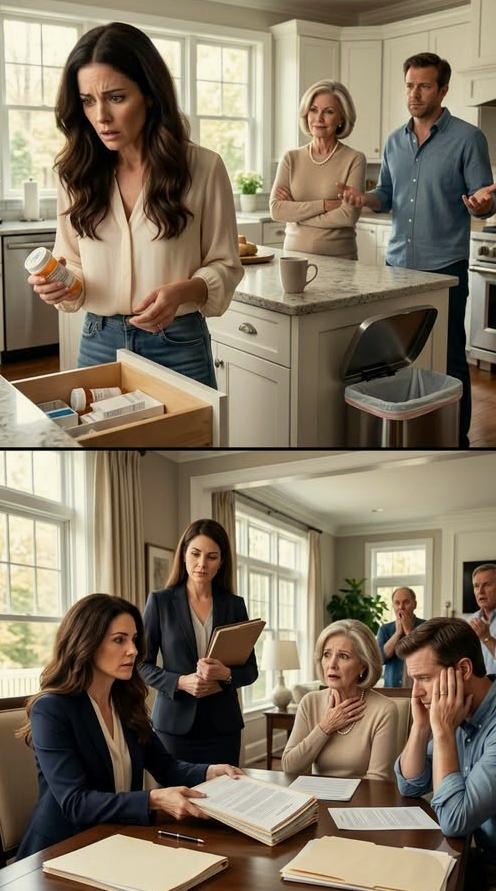
My mother-in-law stood beside the kitchen trash can while I tore through it for the medicine that kept my heart beating normally.
“Looking for these?” Patricia asked, holding up an empty prescription bottle between two fingers.
The bottle made a small plastic click against her wedding ring. I knew that sound. I had heard it every morning for three years, right before swallowing the tablets my cardiologist prescribed after my autoimmune disease began attacking my heart.
“Where are the rest?” I asked.
Patricia sipped her coffee. “I threw them away.”
For a second, the room tilted. The refrigerator hummed. A dish towel slid from my shoulder onto the floor.
“You threw away my medication?”
“You need to stop depending on chemicals,” she said. “Maybe losing them will teach you to make healthier choices.”
“My doctor told me never to stop suddenly.” My voice sounded far away. “How many doses did you throw out?”
“All of them.”
The kitchen clock pointed to 7:12 on Tuesday morning. Sunlight struck the silver pill organizer beside the sink, the one my grandmother had bought me after my first hospitalization. Its tiny compartments were still labeled with the days of the week.
Patricia leaned against the counter. “Maybe you’ll think more clearly once you sign the inheritance over to Michael.”
There it was.
Three months after my grandmother died, the number had become the center of every conversation: four hundred eighty thousand dollars, plus the little lakeside cottage where Grandma had raised me. Patricia had called it “our family’s opportunity” until I told her the money was staying in an account under my name.
Then she had moved into our house, claiming her apartment needed repairs.
Michael came in wearing his navy work shirt, fastening his watch. “Why is Rachel yelling?”
“She’s being dramatic,” Patricia said. “I disposed of some pills.”
I turned to him. “She destroyed my prescription.”
He glanced at the trash, then at me. “Mom, that wasn’t smart.”
“That wasn’t an apology,” I said.
He exhaled. “Rachel, you can get more. Don’t turn this into another inheritance argument.”
“My health is not an argument.”
Patricia’s mouth tightened. “If you cared about Michael, you’d stop treating him like a stranger. Married people share everything.”
“Not when one person is being pressured to surrender it.”
Michael’s eyes hardened. “You’re making my mother feel unwelcome in her own home.”
Our home. The words landed harder than they should have.
My fingers were already shaking, and not only from fear. I called Dr. Singh’s office at 7:19. His nurse told me to come in immediately and warned me not to take replacement doses without instructions. While she spoke, I watched Patricia scrape the last coffee grounds into the sink as if nothing important had happened.
At the clinic, the waiting room smelled of disinfectant and wet umbrellas. Dr. Singh examined my pulse and arranged an emergency refill. When he asked who had interrupted my treatment, I answered carefully.
“My mother-in-law.”
“Did she understand the risk?”
“She said she did it to make me sign papers.”
His expression changed. “Write that down while you remember it.”
So I did. Exact words. Exact time. The empty drawer. The bottle in her hand.
Then I called Elizabeth Warren, the attorney who had settled Grandma’s estate.
Elizabeth answered on the second ring. “Rachel, are you safe?”
“I’m at the clinic. But I think the medicine was only the beginning.”
“What happened?”
I told her everything. She listened without interrupting. Then she said, “Bring me every document Michael has asked you to sign. Do not warn either of them.”
By noon, I was standing outside Elizabeth’s office with my grandmother’s brass compass in my coat pocket, the one thing I carried whenever I needed courage. Elizabeth opened the door herself.
“Lock your phone,” she said. “And Rachel?”
“Yes?”
“Before we discuss the money, I need to know whether you signed anything at all.”
She reached toward the folder on her desk, and I saw a name typed across its first page—my name, beneath a signature I had never written…
PART 2
Elizabeth’s hand stopped less than an inch above the folder.
“Where did this come from?” I asked.
“Michael’s office,” she said. “His assistant left it in a public filing packet by mistake. That mistake may have saved you.”
Rain ticked against the tall windows of Elizabeth’s office. At 1:08 p.m., a forensic examiner named Harold Price placed a magnifying glass over the signature. The paper smelled faintly of toner, and a red coffee stain marked its lower corner.
“This is not a naturally written signature,” Harold said.
My throat tightened. “What does that mean?”
“The rhythm is wrong. The pen pressure disappears in places where your hand would normally accelerate. It was likely traced or transferred.”
Elizabeth turned the document toward me. “Read the title.”
Authorization to Transfer Three Hundred Fifty Thousand Dollars.
Below it was the name of a company I had never heard of: Bennett Capital Partners. Michael was listed as managing member. Patricia was listed as financial director.
I stared at the page until the letters blurred. “They wanted to move most of my inheritance.”
“Into an account they controlled,” Elizabeth replied. “And this paragraph gives Michael unrestricted authority to invest, borrow against, or distribute the funds.”
“Why would they need my signature if the money is mine?”
“Because the bank would ask exactly that question.”
At 2:30, Elizabeth called the bank while I sat beside her desk, pressing my grandmother’s brass compass into my palm. The bank manager confirmed that no transfer had gone through. Then he added something that made my stomach drop.
“Your husband visited last Friday,” he said. “He asked whether a medical power of attorney would allow him to manage your account.”
I looked at Elizabeth. “He told them I was ill?”
“He asked hypothetical questions,” the manager said. “But he was carrying paperwork.”
That evening, I returned home before Patricia expected me. In the study, I found Michael’s folder tucked behind a row of old travel books. The cardboard was warm from the radiator. Inside were incorporation papers, a lease for an expensive downtown office, and a glossy brochure for a six-bedroom house.
A handwritten note was clipped to the brochure: Transfer before Friday. Do not let Rachel speak to the bank.
I photographed every page.
Then I heard Patricia in the hallway.
“Rachel?”
I slid the folder into my coat and stepped out. “Why shouldn’t I speak to the bank?”
Her face changed for half a second before the smile returned. “What are you talking about?”
“Your note.”
Michael appeared behind her. “You went through my things?”
“Your things include a forged signature and instructions to keep me away from my own account.”
Patricia reached for my arm. “You’re confused. Your illness is affecting your judgment.”
I pulled away. “Do not touch me.”
Michael lowered his voice. “Mom is trying to help us build something. You’re destroying our future over money.”
“No. You already destroyed our marriage when you decided my inheritance belonged to you.”
At dinner, they acted as if the confrontation had never happened. Patricia served roast chicken on the blue plates Grandma had given us, then announced, “The new house has a sunroom. Michael says the deposit can be paid as soon as Rachel signs.”
“I’m not signing anything.”
Michael’s fork scraped the plate. “You don’t understand investments.”
“I understand that your company was created eleven days after my grandmother’s funeral and has no clients.”
Patricia rose so quickly her chair struck the wall. “You have no right to investigate family business.”
“Then why is my money its only source?”
She leaned across the table. “If you become medically incapable of managing your affairs, someone responsible will have to step in.”
The room went cold.
Elizabeth had warned me about that exact language. They were building a story in which my illness made me incompetent, while creating documents that would let them control my money.
At 10:17 p.m., Elizabeth called again. Her voice was unusually quiet.
“Rachel, I found the notary who witnessed the authorization.”
“Who was it?”
“She says the person who brought the document claimed to be you.”
I gripped the edge of the desk. “She saw them?”
“Yes. And she has something else.”
“What?”
Elizabeth paused. “She says the person left behind an identification card. The name on it may explain why Patricia was so certain you would never challenge them…”
PART 3
Elizabeth gave me the notary’s address at 8:00 the next morning. It was a narrow office above a pharmacy, where the stairwell smelled of dust and eucalyptus balm. The notary, June Alvarez, opened the door with a chain still fastened.
“I remember the appointment,” June said. “Thursday, 4:40 p.m.”
“Who came?” I asked.
“A woman with dark glasses and a scarf. She said she was Rachel Bennett.”
Patricia had never worn dark glasses indoors. But the scarf in June’s description was unmistakable: cream-colored wool with a brass compass pattern, a gift Patricia had once mocked as “sentimental clutter.”
June led us to a desk beneath a buzzing fluorescent tube. She opened a ledger and pointed to a line of blue ink.
“I asked for identification,” she said. “The woman handed me a state card. I copied the number, but when she left, she dropped this.”
June produced a small plastic sleeve. Inside was a building access badge from Michael’s office, bearing Patricia’s photograph.
My knees weakened. Elizabeth caught my elbow.
“Why didn’t you report this?” I asked.
June’s face tightened. “Because I did not know it was fraud. The woman told me you had a tremor and could not sign neatly. She was convincing.”
“She used my illness as an excuse,” I whispered.
June nodded. “But she made one error. Before signing, she asked whether the money would be available by Friday. Then she called someone and said, ‘The wife is no longer an obstacle.’”
Elizabeth’s eyes sharpened. “Did you recognize the voice?”
“I did not need to.” June opened a drawer and removed a receipt. “She paid with a company card. Bennett Capital Partners.”
At 11:15, we went to the bank. The manager placed the authorization, June’s ledger copy, and the company-card receipt beside one another. He then pulled up the account records.
“There was an attempted electronic transfer at 9:03 this morning,” he said.
My breath caught. “But I never approved it.”
“We stopped it because of your warning yesterday.”
Elizabeth turned to me. “This is no longer a family disagreement. They attempted to move the money after being told the account was protected.”
My phone rang before I could answer. It was Michael.
“Where are you?” he demanded.
“At the bank.”
A long pause followed. Then Patricia’s voice came through, sharp and close. “Rachel, you are making a terrible mistake.”
“Did you visit June Alvarez pretending to be me?”
Silence.
Michael snatched the phone. “You have no proof.”
“I have the notary’s ledger, your company receipt, and your office badge.”
Patricia spoke again. “You don’t know what you’re talking about.”
“Then explain why your photograph was left at the signing.”
Her breathing changed. Michael said something muffled away from the phone.
I heard Patricia answer, “I told you the bank would catch it eventually.”
The call ended.
Elizabeth looked at me. “That was enough.”
But the full truth came that afternoon, when June agreed to meet us at my house. Patricia was in the living room, and Michael stood beside the fireplace, gripping a heavy brass poker. The flames reflected in the glass cabinet where Grandma’s dishes were stored.
June placed the badge on the coffee table. “You came to my office.”
Patricia’s face drained. “I was helping Rachel.”
“You signed her name,” June said. “You told me her condition made her handwriting unreliable.”
Michael stepped forward. “You can’t accuse my mother based on a mistaken identification.”
June looked at him. “You called me from the parking lot afterward. You asked whether the authorization was complete.”
The brass poker slipped from his hand and struck the stone hearth.
Elizabeth opened the folder. “Patricia arranged the forgery. Michael prepared the company account. Together, you planned to label Rachel incapable, transfer her inheritance, and use the cottage as collateral for a business that had no revenue.”
Michael’s face went gray. “It was supposed to be temporary.”
“Temporary theft is still theft,” I said.
Patricia pointed at me. “You would have let him fail! He has spent years being overlooked because of you and your grandmother’s money.”
That sentence exposed the part neither of them had admitted. They had not been building a future for our marriage. They were trying to rescue Michael’s collapsing debts and preserve Patricia’s comfortable life.
Elizabeth gathered the documents. “The accounts are frozen. The trust will block any attempt to encumber the cottage. And the bank has notified every institution named here.”
Michael stared at me. “Rachel, please. We can fix this privately.”
Before I could answer, my phone rang. It was the clinic.
The nurse said Dr. Singh had found an unfamiliar request in my medical file—an application for a capacity evaluation submitted under my name. And the signature on that request matched the signature on the transfer authorization…
The medical request revealed what they planned next…
I thought the forged transfer was the worst of it. I was wrong.
The final discovery made every cruel word about my health suddenly dangerous.
“Your cottage was never their only target.”
Michael’s face went gray.
👇 The final chapter is already open






