PART 4
The nurse repeated the words while I stood beside the coffee table, staring at the brass badge Patricia had left behind.
“Who submitted the request?” I asked.
“Your primary care office received it from a legal service,” she said. “They wanted an evaluation completed before Friday.”
Friday was the day written on Michael’s note.
I ended the call and looked at Elizabeth. “They planned to declare me incapable before the transfer.”
Elizabeth’s expression was grim. “And they used your medical records to make it believable.”
Michael moved toward me. “Rachel, I didn’t know about that part.”
Patricia snapped, “Michael, stop talking.”
The command was so sharp that he obeyed instantly.
That told me more than his denial.
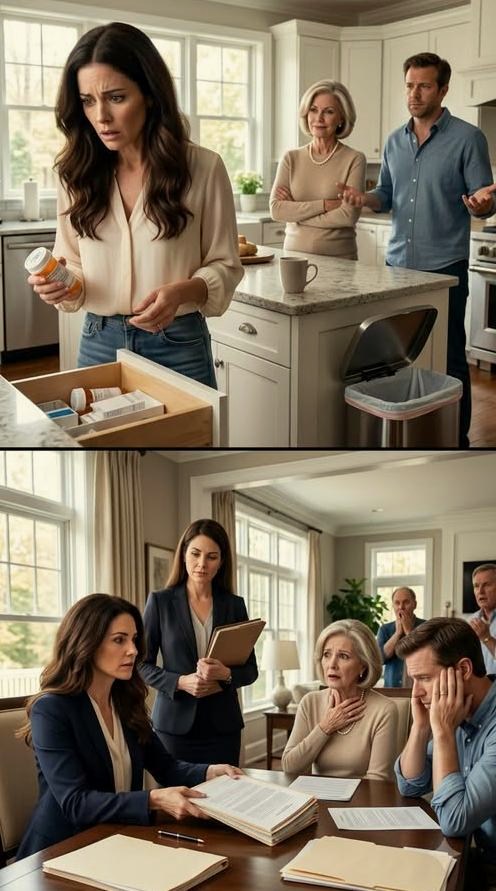
Elizabeth placed the bank papers in a neat stack. “You both need to understand what happens next. The money remains yours. The cottage remains protected. But the company has already incurred obligations based on the promised transfer.”
Michael looked at her. “What obligations?”
“Office lease. Vehicle financing. Contractor deposits. The new house deposit.”
His face changed. “The house isn’t mine.”
“No,” Elizabeth said. “The deposit was made with a loan guaranteed by Bennett Capital Partners.”
Patricia gripped the back of a chair. “That is not possible.”
Elizabeth slid a statement across the table. “It is. Your company borrowed against anticipated funds. When the transfer failed, the lender demanded repayment.”
Michael snatched up the paper. The page trembled between his fingers.
“You said the money would arrive,” he told Patricia.
“I said Rachel would understand eventually.”
“You said the documents were ready.”
“I said you needed to trust me.”
Their argument grew louder, but I heard it differently now. Every accusation was a thread pulled loose from the story they had built around me.
Michael had not merely followed Patricia. He had signed the lease, opened the company account, and asked the bank about controlling my finances. Patricia had not merely lost her temper with my medicine. She had deliberately interrupted treatment so she could describe my confusion as evidence of incapacity.
And yet there was one thing I still did not understand.
“Why did you need the cottage?” I asked.
Neither answered.
Elizabeth opened a second file. “The cottage is not just valuable property. A private lender has a lien recorded against a different parcel owned by Patricia.”
Patricia’s eyes flashed. “That has nothing to do with this.”
“It has everything to do with it,” Elizabeth said. “Your apartment was not being repaired. You were avoiding creditors.”
The room seemed to contract around us.
Patricia had moved into my house because her own apartment was at risk. The luxury car had been ordered through the company. The new house was meant to shelter them from debts they had concealed. My inheritance was not an opportunity in their minds. It was the last wall between them and ruin.
Michael looked at his mother. “You told me the apartment was being renovated.”
“It was complicated.”
“You told me the car was a business expense.”
“It was.”
“You told me Rachel would never find out.”
Patricia’s chin lifted. “She was supposed to be grateful.”
I felt the old instinct rise in me, the one that wanted to soften every sentence so nobody would break. Grandma had taught me that kindness did not require pretending a knife was a spoon.
I took out my phone and called the lender listed on Elizabeth’s statement. The manager confirmed that Michael had personally guaranteed the company’s obligations and that Patricia had submitted the proposed transfer as proof of imminent funding.
“Can the house deposit be recovered?” I asked.
“Not without releasing the contract,” he said. “But the company’s assets are available for collection.”
Michael sank into the chair.
Patricia whispered, “You wouldn’t let them take everything.”
I looked at her. “You tried to take everything from me while I was searching through the trash for medicine.”
Her eyes filled, but I did not mistake tears for remorse.
Elizabeth then gave me the decision I had not expected. “You can pursue the forged documents through the authorities, or you can make a private settlement that forces them to surrender every claim, disclose every debt, and leave your property immediately. Either choice is yours.”
Michael stood. “Rachel, please don’t ruin my life.”
“You brought a forged signature into a bank.”
“I was desperate.”
“So was I, when I realized I could not trust my own husband with my safety.”
Patricia reached for my hand. I stepped back.
That movement broke something in her face.
Not remorse. Recognition.
She finally understood that the woman she had treated as weak was the only person in the room who had been protecting anyone.
The private settlement required Michael to surrender the company’s vehicle, cancel the house contract, repay every dollar spent from joint funds, and sign away all claim to the inheritance and cottage. Patricia had to leave the house and submit a written account of every document she had forged or delivered.
If they failed, Elizabeth would release the evidence to the proper authorities without another warning.
Michael signed first. His hand shook so badly that the ink broke across the page.
Patricia refused.
“You cannot make me confess,” she said.
“No,” Elizabeth replied. “But you can choose whether the truth arrives with your explanation or without it.”
Patricia stared at the forged signature. Then she picked up the pen.
The confession was not beautiful. It contained excuses, accusations, and a claim that she had only wanted to save her son. But it named the notary, the medical request, the attempted transfer, the office lease, and the moment she threw away my medication.
When she finished, she pushed the pages toward me.
“I gave you a home,” she said.
“You gave me a room in the home I paid for.”
Michael flinched.
I did not.
The following morning, I changed the locks, but that was not the part that mattered most. The part that mattered was the appointment with Dr. Singh, where my medical file was corrected and the false capacity request was permanently attached to the names of the people who had submitted it.
My bank restored full access to my account. The cottage trust remained untouched. Elizabeth placed the original authorization in a protective sleeve and returned it to me.
I almost threw it away.
Instead, I kept it.
Not as a reminder of fear, but as proof that a lie can be examined line by line until it has nowhere left to hide.
Michael came once to collect his clothes. He stood in the hallway beside the framed photograph of Grandma and me at the lake.
“Did you ever love me?” he asked.
I thought about the man who used to warm my gloves on the radiator. I thought about the husband who watched his mother destroy my medicine and called my panic an overreaction.
“I loved the person I believed you were,” I said.
He lowered his eyes. “I’m sorry.”
“I know.”
It was the truth, but it was not forgiveness.
Patricia never returned for her coffee mugs. She sent a moving company instead, and every item she claimed was checked against the list Elizabeth had prepared. The cream scarf with the compass pattern was not among them.
June Alvarez mailed it to me a week later with a short note: I thought you should have this back.
I carried it to the cottage, where the lake wind pulled at the fringe. On the kitchen table lay my medicine organizer, filled according to Dr. Singh’s instructions, beside the brass compass Grandma had given me.
The compass needle trembled.
Then it settled, pointing across the water toward the cottage’s old boathouse, where Grandma had hidden her papers and taught me never to sign anything I had not read.
I opened the organizer, took the morning dose, and unfolded June’s note one more time.
On the back, she had written only six words: “Your signature was never the problem.”
Missed the beginning?






