PART 4
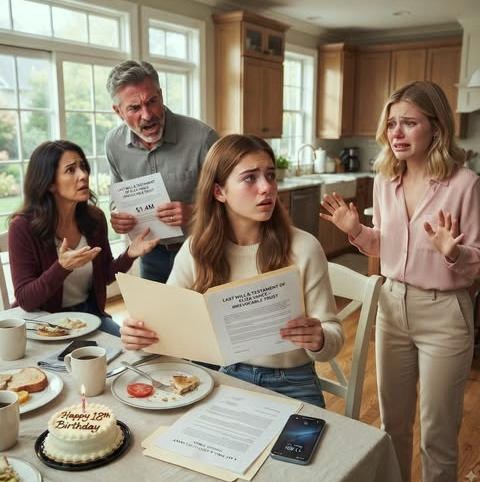
It was dated three days before my eighteenth birthday.
I stared at the signature until the black ink blurred.
“I didn’t sign this,” I said.
Dad reached for the page.
I pulled it away.
“Don’t touch it.”
The words came out louder than I expected. My hand was shaking, but I kept the paper flat against the marble.
Mara’s voice crackled through the speaker.
“Leo, put the page in an envelope. Do not fold it. Evelyn, can you confirm whether that is the title company’s copy?”
“Yes,” Evelyn said. “The embossed stamp is genuine.”
Mom looked between us. “What does it mean?”
“It means,” Mara replied, “someone submitted a guarantee claiming Leo consented to the loan before he was legally able to authorize it.”
Dad’s eyes fixed on the kitchen door.
“Everyone is making assumptions.”
“No,” I said. “We’re reading.”
Chloe bent to retrieve her phone. Its screen had cracked diagonally across the photograph of the mansion.
“Dad,” she said, “tell me you didn’t use my name too.”
He didn’t answer.
She stood.
“Tell me.”
“The purchase agreement needed a future occupant,” he said. “That’s all.”
“You listed me as a co-borrower.”
“I listed you because the lender wanted someone connected to the property.”
“You told me I was getting a house.”
“You are getting a house.”
Her laugh was thin and frightened. “You didn’t even have the money.”
Dad slammed his hand against the counter. The red cord around Evelyn’s box jumped.
“I had a plan.”
“Your plan was to put a mortgage in my name?”
“It would have been paid off.”
“With what?” I asked.
He turned on me. “With the inheritance you’re too selfish to use.”
The sentence landed in the room like a dropped plate.
Mom’s lips parted. Chloe looked at him as if she had never seen his face clearly before.
Mara spoke quietly. “Leo, we have one hour before the bank’s review meeting. Evelyn, can you bring the original authorization and notary log to the branch?”
“I already brought them.”
“Good. And I’m sending a demand to the title company withdrawing every unauthorized instruction. The trust itself is valid. The question is how many fraudulent documents your father submitted before it became active.”
Dad snatched up his briefcase.
“You can’t destroy my business over a paperwork dispute.”
“It’s not a paperwork dispute,” I said. “It’s my name.”
He stepped toward me.
For years, I had measured his moods before speaking. I knew the warning signs: the tightened jaw, the quiet voice, the way his thumb rubbed the edge of his wedding ring.
Now I recognized something else.
Fear.
Not fear of losing me.
Fear of losing access.
Evelyn opened the document box once more. Beneath the letter was a small envelope sealed with my grandfather’s blue wax.
“Your grandfather left this separately,” she said. “He instructed me to give it to you only if someone attempted to use the inheritance before you had chosen what to do with it.”
Dad moved again.
This time, Chloe stepped between us.
“Stay away from him.”
He looked at her in disbelief. “You’re taking his side?”
“I’m taking the side of my own name.”
That was the unexpected turn none of us saw coming.
Chloe picked up the false guarantee and examined the signature. Her expression shifted.
“I know how he copied this,” she whispered.
Dad went still.
She looked at me. “Last week, he asked me to sign a stack of forms for the house. He said they were inspection approvals. I refused because the pages were blank.”
“Where are they?” I asked.
“In his office.”
Dad’s face tightened.
Chloe continued, “But I took pictures before I gave them back. I thought it was strange.”
She opened her phone and scrolled. There, in a photograph taken beneath the yellow light of Dad’s office, sat a blank signature sheet beside a printer. On the desk was the same black fountain pen used on my supposed guarantee.
Mara inhaled sharply through the speaker.
“Send those to me immediately.”
Dad reached for Chloe’s phone.
She stepped away.
“No.”
The single word seemed to weaken him more than shouting would have.
At noon, we sat in a conference room at the bank. Rain tapped the tall windows, and the fluorescent lights made every document look harsher than it had in the kitchen.
Mara placed the original proxy on one side of the table. Evelyn placed the notary log beside it. The bank’s trust officer compared the pages under a magnifying lamp.
Dad sat across from me, no longer wearing the silk robe. His shirt collar was open, and a pale crescent of skin showed above the neckline.
The trust officer looked up.
“The additional page was not part of the notarized instrument.”
Dad’s attorney, a nervous man named Peter Cole, shifted in his chair.
“Perhaps there was an administrative error.”
Evelyn gave him a cold look. “Administrative errors do not reproduce a notary seal on a page that was never present.”
Mara slid the alleged guarantee forward.
“And this document is dated before Leo reached legal adulthood. It also contains a signature inconsistent with his school records and medical forms.”
Dad leaned toward me.
“You’re enjoying this.”
“No,” I said. “I’m trying to understand why you believed I would never check.”
His eyes flashed. “Because I was your father.”
“That was supposed to mean you protected me.”
“I did protect you.”
“You protected your debts.”
He looked at the table.
For a long moment, nobody spoke.
Then he said, “The company was going under. Your grandfather knew it. He wanted to punish me for refusing to sell it. I needed time. Just time. The house would have been an asset, Chloe would have had a home, and the loan would have been repaid before anyone suffered.”
Mom pressed both hands against her mouth.
“You told me the company was profitable.”
“It was going to recover.”
“You told me we were helping Chloe.”
“I was helping everyone.”
Chloe’s eyes filled, but her voice stayed steady.
“You used my dream to hide a debt.”
Dad looked at her.
“I was trying to give you what you wanted.”
“I wanted you to ask me.”
That answer seemed to reach a place his explanations could not.
The bank froze the purchase, rejected the transfer, and removed every instruction connected to Dad’s proxy. The title company returned the deposit to the trust account after Mara filed the withdrawal. The private lender, suddenly unable to seize the inheritance as collateral, canceled the loan and demanded repayment from Dad’s company alone.
He lost the mansion before lunch.
He also lost the business he had been pretending to save.
Not because I took it from him. Because it had never been solvent without my inheritance beneath it.
Chloe withdrew her name from every document. She left the bank with the cracked phone in her hand and the mansion brochure folded into four sharp squares.
Mom stayed behind.
She found me outside the conference room, where the vending machine hummed beside a row of plastic chairs.
“Leo,” she said, “I should have stopped him.”
I looked at the orange juice stain still drying on her sleeve.
“Yes.”
She nodded, accepting the answer like something heavy.
“Can you forgive me?”
“I don’t know.”
“That’s fair.”
She took off her wedding ring and held it in her palm.
“Your father says he did all this for us,” she whispered. “But I think he did it because he couldn’t bear being ordinary.”
I thought of my grandfather’s letter.
Ask which creditor is standing behind him.
“He was never ordinary,” I said. “He was just afraid of being seen clearly.”
Dad came out of the conference room behind her. He had aged during the meeting. The anger was still there, but it had nowhere left to hide.
“Leo,” he said.
I turned.
“I can repay the money.”
“You don’t have it.”
“I’ll sell the company.”
“It’s already pledged.”
“I’ll work it out.”
I believed he would try. That was the cruel part. He was not a monster from a story. He was a man who kept choosing the next lie because the truth would require him to kneel before the damage he had caused.
“What do you want from me?” I asked.
His gaze dropped to the floor.
“Nothing today.”
“Then what are you doing here?”
He reached into his pocket and placed a small brass key on the chair between us.
“Your grandfather’s office,” he said. “I kept it locked after he died. There are papers there that belong to you.”
I didn’t touch the key.
“Why give it to me now?”
“Because I opened the desk last night.”
He swallowed.
“There was another letter. I read the first line.”
“What did it say?”
Dad looked toward the window, where rainwater crawled down the glass.
“It said, ‘If my son reaches for Leo’s inheritance, it means he has already lost everything that mattered.’”
Mom closed her eyes.
Chloe stood at the end of the hallway, listening. She had folded the mansion brochure into a paper airplane.
She walked over and handed it to Dad.
“Here,” she said. “You can fly your plan somewhere else.”
He took it.
Neither of them smiled.
That evening, I returned to my grandfather’s office with Evelyn and Mara. The brass key opened a narrow drawer behind the old atlas cabinet. Inside were the original will, the complete trust instructions, and a list of every debt Dad had hidden from the family.
There was also one final instruction from my grandfather.
The trust could pay for education, medical care, and a modest home chosen by me alone. It could not be used to preserve a business built on deception.
I kept the documents.
I did not use the money to punish Dad.
I used a small portion to pay Chloe’s legitimate tuition and rent for one year, but only after she signed the papers herself and read every line with Mara. She chose a two-bedroom apartment near the community college, not a mansion. She also began working evenings at a bakery, where nobody cared about the house she had almost owned.
Mom moved out of the mansion she and Dad had rented and stayed with Chloe until she found work. She never asked me for another transfer.
Dad sold what remained of his company piece by piece. The last thing he surrendered was the polished brass sign bearing his name. Mara told me he mailed it to the bank with his final repayment check.
He never received forgiveness as a gift.
He earned small pieces of it by sending every payment, every month, without asking me to praise him for doing what he should have done from the beginning.
A year later, Chloe brought me a stack of blueprints to the community college library.
“Look,” she said. “I’m studying architecture now.”
I turned the pages. The first drawing was a small house with a covered porch and a kitchen large enough for four people.
“No theater room?” I asked.
“Not yet.”
“And the fire pit?”
“Absolutely not. They’re impossible to insure.”
We laughed, and this time the sound didn’t feel like a weapon.
That night, I placed my grandfather’s watch beside the trust documents. The syrup stain had never fully come out of the leather band. I had tried cleaning it twice, then stopped.
Some marks were better kept where they could be seen.
On the table beside it lay the brass key to his office, Chloe’s first signed lease, and the final repayment receipt from Dad.
Three objects.
One had opened a drawer.
One had opened a future.
And one had finally closed the account my family had mistaken for their own.
Missed the beginning?






