PART 4
The storage company’s message remained glowing on Leah’s phone while the responders secured the bag on the dining table.
Marcus stared at the screen.
I watched the color drain from his face, not because he was ashamed, but because he had realized the money might not be where he had left it.
“Call the bank,” I told Leah.
“I can’t think.”
“You don’t have to think. Just tell them you did not authorize anything.”
Her hand shook so badly that she dropped the phone.
I picked it up and pressed the answer button.
A woman from the bank’s fraud department introduced herself. She asked Leah to confirm her identity, then told her an online request had been submitted at 10:16 that morning. It included a scanned guardianship agreement, a copy of Leah’s driver’s license, and a request to transfer the trust funds to a business account.
“Was any money moved?” I asked.
“Not from the protected account,” the woman said. “The request was flagged because the signature verification failed.”
Leah closed her eyes.
Marcus gripped the back of a chair.
The woman continued, “However, someone did withdraw eleven thousand dollars from a personal savings account yesterday. The withdrawal was made at a branch using a temporary authorization form.”
Leah looked at Marcus.
“That money was for Mia’s surgery,” she whispered.
Marcus stared at the floor.
I felt my hands curl into fists, but Mia was standing beside me, watching every movement. I forced my fingers open.
“Can the withdrawal be stopped?” I asked.
“Not directly. We can place a hold on remaining funds and begin a fraud review. We also have the branch’s signed paperwork.”
“Whose signature?”
There was a pause.
“Your daughter’s.”
Leah made a broken sound.
Nora stepped away from Marcus. “He took her license from the bedroom.”
Marcus turned toward her. “You agreed to this.”
“I agreed to help you sell the house,” she said. “I did not agree to steal from a child.”
“You knew about the money.”
“I knew you were desperate. I didn’t know you had become this.”
Mia tugged my sleeve.
“Grandpa,” she whispered, “can we go somewhere else?”
That question settled everything that still needed settling inside me.
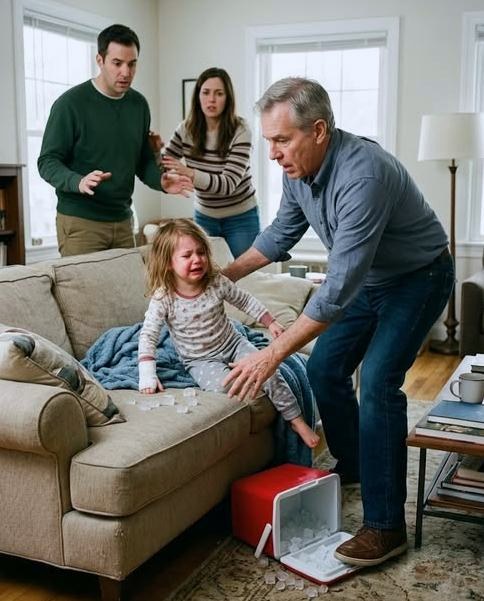
The responders examined Leah’s wrist and took Mia to the kitchen table, where one of them cleaned the bruising beneath the bandage. They discovered two narrow marks around her skin, not from a fall, not from a tantrum, but from something thin that had been tied too tightly.
Leah stood over her daughter, crying silently.
Mia watched the gauze being removed.
“Does it hurt?” Leah asked.
“A little.”
“I’m sorry.”
Mia reached up and touched her mother’s cheek. “You were crying too.”
Leah folded around her.
Marcus moved toward them.
I stepped in front of him.
“Stay where you are.”
He stopped.
For several seconds, the only sound was the snap of medical tape being torn from its roll.
Then the taller responder asked Marcus whether the Bell Street storage unit contained anything dangerous or medically significant.
Marcus said, “No.”
Nora laughed bitterly.
“He’s lying.”
Marcus turned on her. “You want to ruin me?”
“I want Mia to stop looking at that couch like it’s going to hurt her.”
The responder asked, “What is in the unit?”
Nora wiped her face with the heel of her hand. “Boxes of documents. A printer. Blank forms. And the original trust papers.”
Leah lifted her head. “Why would the original trust papers be there?”
Nora looked at Marcus.
He said nothing.
Nora’s voice fell to a whisper. “Because he found a letter from your mother.”
Leah stared at her. “What letter?”
“The one that changed the trust.”
My daughter’s face tightened. “My mother never changed it.”
“She did,” Nora said. “Three weeks before she died.”
Marcus finally spoke. “She was sick. She didn’t know what she was signing.”
“That’s not what the letter said,” Nora replied.
He turned toward her sharply.
“What letter?” I asked.
Nora looked at me with the exhausted expression of someone who had carried a secret too long. “Your former wife wrote that Marcus was not to manage any money belonging to Leah or Mia. She said he had already borrowed from her twice and lied about paying it back.”
Leah pressed one hand to the table.
“My mother knew?”
“She knew everything,” Nora said. “She left the house to you and created the trust for Mia because she was afraid Marcus would take control if anything happened to you.”
Marcus shook his head. “That letter is worthless.”
“Maybe,” Nora said. “But the lawyer who witnessed it is still alive.”
The room went still.
This was the turn I had not expected. I had believed Marcus invented the plan alone, driven by debt and resentment. But he had hidden the letter because it proved something even more painful: Leah’s mother had anticipated exactly this moment.
The bank representative remained on the phone. Leah told her about the letter, the forged papers, and the storage unit. The woman instructed her to send nothing until the bank’s investigator arrived, then placed additional restrictions on every account connected to Leah’s identity.
Marcus began to pace again.
The responder blocked the hallway.
“You’re not going anywhere.”
“I need my medication.”
“It’s in the bag.”
“I need air.”
“Stay here.”
His eyes moved to the kitchen drawer.
I followed his gaze.
The drawer was half open. Inside sat a small metal box, the kind Leah used for spare keys and birth certificates.
I pulled it out.
The brass key from the bag fit the lock.
Marcus took one step toward me.
“Don’t open that.”
Leah came beside me.
“Tell me whose name you erased,” she said.
He looked at her.
The metal box opened with a soft click.
Inside lay Leah’s mother’s original letter, folded beneath a notarized trust agreement. There was also a receipt from the Bell Street storage company and a printed list of debts. Against several names, Marcus had written amounts and dates.
At the bottom of the list was one line in red ink:
Mia’s account — enough to clear everything.
Leah read it.
Her expression changed from disbelief to something quieter and far more devastating.
Marcus reached for the paper.
She pulled it away.
“You planned this before you came here.”
“I planned to borrow it.”
“You forged my signature.”
“I was going to put it back.”
“You drugged me.”
“I needed you to listen.”
“You tied my daughter to a couch.”
Marcus glanced at Mia’s wrist. “She kept getting in the way.”
The words left his mouth before he could catch them.
Nora covered her face.
Leah looked at her brother as if she had never seen him clearly until that moment.
“Get out of my house,” she said.
Marcus laughed weakly. “You think you can throw me out? I’m family.”
“No,” Leah said. “You’re the reason my child is afraid of blankets.”
The line struck him harder than any shout.
He looked toward Mia.
She had moved behind my leg, clutching the brass zipper of my work jacket.
Marcus’s shoulders dropped.
Not from remorse. From defeat.
The responders remained with us while Leah gave them the documents and the medication bottle. The bank kept the transfer frozen. The branch withdrawal was flagged for review, and the surgery money was traced to a debt collection account under Marcus’s name.
Nora gave a written statement before leaving. She also handed Leah the cracked red notebook.
“I know it doesn’t undo what I did,” she said.
Leah held the notebook but did not answer immediately.
“Why did you finally tell the truth?” she asked.
Nora looked at Mia’s bandaged wrist.
“Because she was looking at me like I was the dangerous one.”
Leah lowered her eyes.
“Were you?”
Nora swallowed. “For a while.”
That answer mattered more than an apology would have.
She left without asking to be forgiven.
Marcus remained in the living room with one responder while Leah and I took Mia to the clinic for a full examination. The waiting room smelled of disinfectant and orange peel. Mia sat on my lap beneath a clean quilt and kept her injured hand tucked against my chest.
Leah sat beside us.
“I should have known,” she said.
“You were drugged and locked in a room.”
“I let him back into our lives.”
“You believed he was your brother.”
She stared at Mia’s bandage. “That was my mistake.”
“No,” I said. “The mistake was his. The danger was his. Don’t carry both.”
The clinic nurse called Mia’s name. She went with Leah but kept one hand wrapped around my finger.
When they returned, the doctor said the injury was superficial but would need to be watched. He recommended a child counselor who worked with children after frightening events.
Mia listened to every word.
“Will the couch come here?” she asked.
“No,” Leah said. “It stays at home.”
“Will Uncle Marcus come back?”
Leah looked at me, then answered herself.
“Not without people knowing exactly what he did.”
Mia considered that. “Can we throw away the ice cooler?”
Leah nodded. “Yes.”
That evening, I returned with her to the living room. The overturned cooler still sat near the rug, wet inside and smelling faintly of melted water. Leah lifted it with both hands and carried it to the trash.
She did not slam it down.
She simply placed it there, beside the printed guardianship papers and the fake prescription bottle.
Then she came back and picked up the blanket.
Mia had been afraid of it all day, but Leah wrapped it around her shoulders and sat on the floor with her. My granddaughter leaned against her mother’s chest while I knelt beside them.
Leah took the brass zipper of my jacket between her fingers.
“Can I keep this?” she asked.
“The whole jacket?”
“Just the zipper pull.”
I smiled faintly. “Why?”
“Because Mia held it when she needed something solid.”
I removed the little brass pull with a pair of pliers from the kitchen drawer. Leah tied it to a soft cord and placed it around Mia’s wrist, above the bandage, loose enough to move freely.
Mia lifted it toward the lamp.
“It sounds like the cooler,” she said.
“No,” Leah replied. “It sounds like Grandpa coming.”
From the hallway came the quiet shuffle of the responder gathering the last documents. On the table, the red notebook lay open beside the letter from Leah’s mother. The final line was visible beneath the fold:
Protect the child first. Everything else can be repaired.
Mia pressed the brass pull to her ear.
Then she whispered, “Grandpa, don’t let go.”
Missed the beginning?






