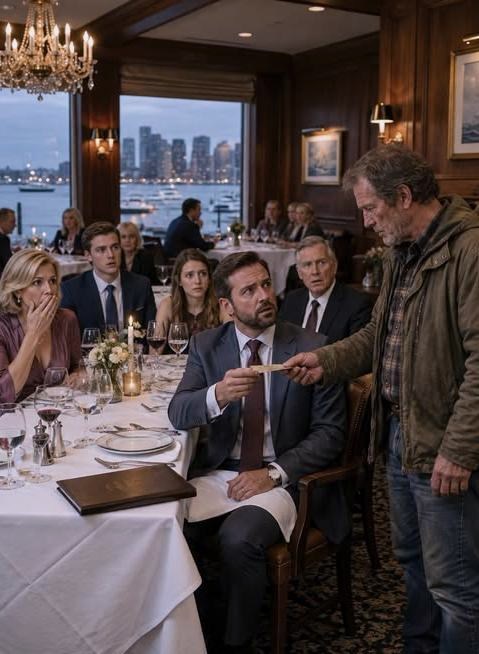
The moment Richard Bradford asked whether my son could afford to marry his daughter, Michael’s face turned the color of the linen napkin in his lap.
We were seated in a private alcove at Brookshire Country Club, overlooking Boston Harbor, beneath a brass chandelier that scattered warm light across polished silver. It was 7:40 on a Thursday evening. I wore faded jeans, scuffed work boots, a six-dollar flannel shirt, and the cracked leather jacket I had owned since 1995.
Richard had noticed every thread.
“So, Tom,” he said, lifting his wineglass, “Michael mentioned that you’re retired.”
“Mostly.”
Patricia, his wife, tilted her head. “Mostly?”
“I do some consulting.”
Christopher, their twenty-five-year-old son, gave a soft laugh. “That sounds flexible.”
Michael’s fingers tightened around his water glass. A tiny crack ran through the blue ceramic coaster beneath it, and I found myself tracing the line with my eyes so I wouldn’t say what I was thinking.
Jessica touched Michael’s knee beneath the table.
“Dad, we invited Tom to dinner, not to an interview.”
“I’m only asking questions,” Richard replied.
“No,” she said. “You’re evaluating him.”
The waiter arrived with a silver tray. Richard ordered lobster. Patricia chose Wagyu beef. Christopher requested a bottle that cost more than my monthly rent, though he had never asked what my rent was.
“I’ll have the chicken,” I said. “Plain, please. And water.”
Patricia’s eyes dipped toward my boots.
Michael looked at me. “Dad, you can order anything.”
“I’m comfortable with chicken.”
That was true. It was also part of the test.
Michael believed I lived quietly in South Boston on a modest pension. He knew about the small apartment I owned and the old Honda Civic I drove. He did not know that my investments produced approximately $120,000 every month.
I had kept that hidden since his mother, Sarah, died eight years earlier. Wealth had not saved her. It had not saved our family from the empty hospital room or the phone call at 3:17 in the morning. I wanted Michael to build a life with his own hands, not grow dependent on a number in his father’s account.
He had nearly destroyed himself after Sarah’s death. At twenty-three, he had buried himself in credit-card debt, abandoned graduate school, and filed for bankruptcy. Then he rebuilt everything. Two jobs. Night classes. Architecture school. No requests for money.
I was proud of him.
Richard leaned back as the waiter left.
“Marriage requires planning,” he said. “Children require resources.”
“I recently received a promotion,” Michael answered.
“That’s encouraging,” Patricia said, with the gentle smile people use when a child shows them a drawing.
Jessica’s jaw tightened. “Michael is doing well.”
“Doing well is relative,” Richard said. Then he looked at me. “No offense, Tom, but Michael is not prepared to support the life our daughter expects.”
The sentence landed harder because he spoke softly.
I placed my fork beside the plate.
“You’ve spent the entire dinner measuring our family,” I said.
Richard folded his napkin. “Values matter. Background matters. Resources matter.”
“Standing matters too.”
His smile thinned. “I wouldn’t put it that way.”
“But that’s what you mean.”
Michael stared at his plate. I could see the pulse beating in his neck, and shame moved through me—not because of my clothes, but because I had brought him into a room where he felt he had to apologize for me.
Then I asked, “How is Riverside Development going?”
Richard’s butter knife stopped halfway to his plate.
“Excuse me?”
“Your Cambridge project. The renovation budget rose by twenty million, and your bridge financing was delayed.”
Christopher’s expression changed.
I continued. “And Hartford? The acquisition collapsed after your lender withdrew. That must have put pressure on the company.”
Patricia lowered her glass. Jessica stared at her father.
Richard leaned forward. “Who told you about Riverside?”
I slipped my hand into the jacket they had spent an hour judging. My fingers closed around the business card I carried for emergencies but had never shown my son.
I placed it facedown beside Richard’s untouched wine.
“You wanted to discuss resources,” I said. “So let’s discuss them properly.”
Richard turned the card over.
His eyes moved across the first line, and the color drained from his face…
PART 2
His hand remained on the card, but the rest of him seemed to have retreated several inches from the table.
It was 7:52 p.m. The harbor lights trembled on the black water beyond the windows, while the embossed words on the card caught the chandelier’s glow: Thomas Warren, Managing Partner, Warren Meridian Holdings.
Underneath was a telephone number Richard knew better than his own son did.
“Warren Meridian,” he whispered.
Michael looked from the card to me. “Dad?”
Richard pushed back his chair so quickly that its wooden legs scraped the floor.
“You’re Thomas Warren?”
“I am.”
Christopher’s wineglass tipped. Red liquid crawled across the white tablecloth.
Patricia stared at me. “The Warren Meridian?”
“There’s only one.”
Richard’s lips parted, but no sound came. Jessica looked furious—not at me, but at the people sitting beside her.
“You knew?” she asked her father.
Richard ignored her. “You own the controlling position in the Riverside financing.”
“I control the fund that holds it.”
“Why didn’t you say anything?” Michael demanded.
I looked at him. His face was pale beneath the warm restaurant light, and the silver edge of his fork pressed a red mark into his finger.
“Because you never asked me for money,” I said.
“That doesn’t answer the question.”
“No. It answers a different one.”
Richard stood. “Tom, we need to speak privately.”
“We’re already speaking privately.”
“Not here.”
Jessica rose too. “You invited him here to decide whether he was worthy of me.”
Richard’s voice hardened. “This is a family matter.”
“No,” she said. “It became a business matter when you started discussing his finances.”
The manager approached with a concerned smile, but I lifted one hand. The brass cuff of my old jacket caught on the chair, and for a second I remembered Sarah teasing me about refusing to replace it.
“Sit down,” I told Richard.
He did.
That frightened me more than his anger would have.
“I know Riverside is short on cash,” I said. “I know the Hartford failure left a hole in your accounts. I also know your lenders require a covenant payment of eleven million dollars by Monday morning.”
Michael turned toward Richard. “Is that true?”
Richard’s eyes flickered.
“Commercial development has complicated timing,” he said.
“Is it true?” Jessica asked.
Patricia placed both hands around her wineglass. “Richard, answer them.”
He looked at me instead. “You came here to humiliate me.”
“I came here because your daughter invited me to dinner.”
“And you deliberately dressed like that.”
“I dressed like myself.”
Michael pushed away from the table. “You tested them?”
The question hurt more than Richard’s insult. I saw the old boy who had once stood outside my office asking whether he had ruined our family. I had promised myself I would never make him feel manipulated again.
“I tested their character,” I said quietly. “Not yours.”
“You let them speak to me like I was a liability.”
“I wanted to know whether they would.”
“And now you know.”
“Yes.”
Jessica reached for his hand. “Michael, I didn’t know my father planned this.”
Richard slammed his palm against the table. The water in my glass jumped.
“Enough. I brought everyone together because this marriage needs responsible planning. Tom, if you’re truly the person you claim to be, you can solve Riverside’s temporary problem.”
There it was.
Not an apology. Not embarrassment. A request disguised as an accusation.
“You want a loan,” I said.
“I want a partnership.”
“You want eleven million dollars before Monday.”
His jaw tightened. “You can afford it.”
Michael looked at him with disbelief. “You invited my father here to ask for money?”
Richard’s expression shifted, and I saw something colder beneath the polished manners.
“I invited him to determine whether this family could support our future.”
“No,” I said. “You invited me to see whether I was useful.”
The waiter placed the check near my elbow and retreated immediately.
I opened my jacket again and removed a folded sheet of paper. It was not a contract. It was a list of transfers, dates, and account numbers collected by someone who had stopped working for Richard three days earlier.
Richard saw the page.
His face tightened.
“Where did you get that?”
“From the person who prepared the figures.”
He reached for it, but I laid my hand over the paper.
“Before you touch it,” I said, “you should know she’s waiting downstairs.”
Richard stared toward the elevator lobby.
At that exact moment, the doors opened, and a woman holding a red document folder stepped into the alcove…
PART 3
The woman from the elevator walked toward us at 7:58 p.m., holding the red folder against her chest as if it were protecting her from the room.
She was in her early fifties, with silver hair pinned tightly behind one ear and a wool coat still damp from the harbor mist. Richard recognized her before anyone else did.
“Elena,” he said.
She stopped beside our table. “Good evening, Richard.”
Michael looked at me. “Who is she?”
“Elena Morales,” I said. “Former financial controller at Bradford Development.”
Richard’s chair creaked beneath him. “You had no right to bring her here.”
“I didn’t bring her. She came because I asked whether she was willing to tell the truth.”
Elena placed the folder on the table. A brass clasp snapped against the wood.
Patricia’s voice shook. “Richard, what is happening?”
He ignored her. “Elena resigned under pressure. Her information is confidential.”
“I resigned,” Elena replied, “after you instructed me to move Riverside escrow funds into the Hartford acquisition.”
The room seemed to contract around her words.
Jessica stared at her father. “You took money meant for Riverside?”
“I borrowed it,” Richard said. “The funds were going back.”
“They were due back six weeks ago,” Elena said. “And when the lender demanded proof of liquidity, you ordered me to alter the internal schedule.”
Richard’s face reddened. “That is a serious accusation.”
“It is an exact description.”
She opened the folder and laid out three pages. Each bore Richard’s signature beside dates and transfer amounts. Eleven million dollars had moved from Riverside’s protected account to a company registered in Delaware. Two million had gone to cover a personal loan secured against the Bradford house.
Patricia pressed a hand to her mouth.
“You pledged our home?”
Richard turned on Elena. “You’re trying to destroy me because I refused your severance.”
“No,” she said. “I’m trying to keep construction workers, tenants, and investors from losing everything because you kept pretending the hole was temporary.”
Michael picked up one page. His hand trembled as he read the signature.
“Dad,” he said to me, “you knew about this?”
“I knew enough to ask questions. I needed the person who signed the transfers.”
Elena pointed to the final page. “There is more. Richard prepared an agreement naming Michael as design guarantor on Riverside’s next financing. He intended to present it at the engagement dinner.”
Michael looked at Richard. “You wanted me to sign for your debt?”
Richard’s shoulders dropped, but his voice remained sharp. “You would have received an equity stake.”
“After I became responsible for eleven million dollars?”
“It was a standard guarantee.”
“No,” I said. “It was a trap built to make his income carry your failure.”
Jessica moved away from her father. Her chair struck the wall with a hollow knock.
“Tell me you didn’t invite Michael here for that.”
Richard reached for her. “Jessica, listen to me.”
She pulled her hand back. “You measured him, insulted Tom, and planned to bind Michael to a company you already emptied.”
Elena turned one more page.
“There’s a second signature,” she said. “The transfer to the overseas buyer was completed this afternoon. Riverside is scheduled to change ownership at midnight unless the lender receives a replacement commitment.”
Richard stared at her. “You said the buyer had not approved the final documents.”
“He approved them at 4:12.”
The color returned to Richard’s face as panic replaced calculation.
I took out my phone. Three messages waited from my investment committee. The first said the lender was ready to freeze Riverside. The second confirmed the buyer’s transfer. The third contained a photograph of a signed page.
Michael leaned closer. “What is it?”
I opened the photograph.
At the bottom of the page was a name none of us expected.
Sarah Warren.
My wife had been dead for eight years. Yet beside her name was a proxy authorization dated three days earlier, granting Richard access to a dormant trust connected to Riverside.
My breath stopped.
Richard looked at the screen and staggered against the table.
“That signature was never supposed to be found,” he whispered.
I looked at Elena. “Who gave him access?”
She swallowed.
“Someone inside Warren Meridian.”
Before I could ask who, my phone rang. The call came from the one person who could open Sarah’s sealed trust—and his first words made every face around the table change…
Richard read the final clause—and reached for the table…
I thought the humiliation was the worst part of that dinner. I was wrong. The truth waiting inside Sarah’s trust changed what my son and I owed each other.
“Where should we put the bench?”
I pointed to the place Sarah had drawn for everyone.
👇 The finale is already open.






