PART 4
Judith’s confession hung over the dining room like smoke.
Richard stared at her.
“You?”
She closed the ledger.
“Your father trusted me because you never noticed me.”
“I noticed you.”
“No,” Judith said. “You noticed the people who could approve your requests.”
Chloe lowered herself into a chair. Her hand remained on her stomach, but her eyes stayed fixed on Richard.
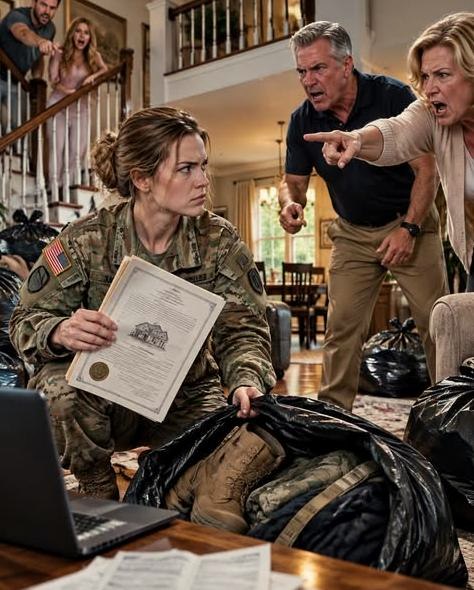
I could hear the rain in the gutters and the faint mechanical hum of the refrigerator. The house smelled of wet wool, burnt charcoal, and the lavender cleaner my mother had used to erase every trace of me from the upstairs hallway.
Captain Morales stood near the door.
“What exactly does the alternative clause do?” I asked.
Judith opened the ledger again.
“Your grandfather believed the trust should protect you, not trap you. If you determined that your family had violated the agreement, you could appoint a permanent steward for the property. That steward would manage the house for your benefit, but could never sell it, mortgage it, or transfer it to your relatives.”
“To you.”
“To me,” Judith said. “I would have to live here, maintain it, and report every expense to an independent trustee.”
Richard gave a humorless laugh.
“So she gets the house?”
“No,” Dalton said through the phone. “Mara retains ownership. Judith becomes the steward. The arrangement prevents anyone from pressuring Mara into signing away the property.”
My father’s face tightened.
“That is absurd.”
“It was designed for you,” I said.
His eyes snapped toward me.
I had spent my entire childhood believing Richard’s anger was proof that I had failed him. If he raised his voice, I searched for my mistake. If he withdrew affection, I worked harder to earn it back.
But standing there with his forged documents and my stolen money spread across the table, I finally saw the pattern clearly.
He did not want my agreement.
He wanted the moment before it—the moment when I doubted myself enough to surrender.
“What happens to the money?” I asked.
Captain Morales answered.
“The accounts are being frozen. The transfers will be reviewed. You can pursue repayment through the military claims process and the estate trustee. You can also request disciplinary action over the forged authorization.”
Mother’s shoulders shook.
“Please, Mara.”
I looked at her.
She had carried the papers. She had opened my account. She had watched my belongings disappear into bags and told me I was lucky to have a basement.
Yet she also looked older than she had that morning, as if every lie had taken a small piece of her face.
“Did you know about his debts?” I asked.
She nodded.
“Did you know he used my pay?”
Another nod.
“Why?”
Her voice broke.
“Because he said the family would fall apart if I didn’t help him. He said Chloe would lose the baby’s home. He said you were strong enough to recover.”
I looked at Chloe.
“Were you involved?”
She began to cry.
“I knew they were moving into the house. I didn’t know about the signature. I thought you had agreed before deployment.”
“You never called to ask.”
“I was ashamed.”
“You were comfortable.”
She pressed her lips together.
“That too.”
The honesty hurt more than another lie would have.
Richard grabbed his coat from the chair.
“This is ridiculous. I’m leaving.”
Captain Morales moved aside but pointed toward the table.
“Leave the pen.”
He looked down.
The black fountain pen lay beside the forged deed. Its silver clip was bent from years of being carried in his pocket. He had brought it because he believed the transfer was already his.
Richard picked it up.
I spoke before he reached the door.
“Put it down.”
He turned.
“You don’t give me orders.”
“No,” I said. “I’m giving you a choice.”
His expression sharpened.
“What choice?”
“Put the pen down, leave every copy of my financial records here, and sign a repayment agreement witnessed by Captain Morales and Judith. Or keep pretending you did nothing and let the trustee pursue every account you touched.”
“You think a piece of paper frightens me?”
“No. I think losing control does.”
His fingers tightened around the pen.
For several seconds, nobody spoke.
Then Chloe stood.
“Dad,” she said, “put it down.”
He looked at her.
“You’re taking her side?”
“I’m taking the side of the truth.”
Richard’s hand opened.
The pen struck the table with a hard plastic click.
That sound carried through the room more clearly than any apology could have.
He signed the repayment agreement before midnight. Not because he regretted what he had done, but because Judith explained that every unsigned page would trigger an immediate trustee review of the family business. He had spent years treating loyalty as a currency. Now the people who had depended on him wanted receipts.
Evelyn signed after him.
Her hand shook so badly that the final letter of her name became a dark crooked line.
Chloe refused to sign anything until Dalton explained every paragraph to her. Then she signed a separate statement confirming that she had never authorized the house transfer and had been misled about my account.
She did not ask me to forgive her.
That mattered.
At two in the morning, she carried the pink crib out of the foyer with Vance, who had arrived pale and silent after reading the bank records. He had not known the details either, but he had accepted the furniture, the house, and the comfort without asking whose money paid for it.
Before she left, Chloe stopped beside the bags of my belongings.
“I’ll help put everything back,” she said.
“You don’t have to.”
“I know.”
She touched the edge of one bag.
“I want to.”
We worked without pretending the family could be repaired in one night. She returned my grandfather’s compass from the mantel. Vance carried the sectional into the garage. My mother took down the wedding portrait and stood holding it against her chest, staring at the pale rectangle left on the wall.
Richard left last.
At the porch, he turned to me.
“You’ve always thought I was your enemy.”
“I thought you were my father.”
His face tightened.
“That’s worse.”
“No,” I said. “It’s why this took so long.”
He looked toward the dining room, where Judith was making notes in the ledger and Captain Morales was checking the account forms.
“You’re handing the house to a stranger.”
“I’m placing it with someone who protected it.”
“She’ll own your life.”
I shook my head.
“She’ll protect the part of it you tried to sell.”
Richard had no answer that could change the documents. He walked to the curb without another word.
By dawn, the house looked unfamiliar again, but not because of new furniture. The walls were bare where my family’s decorations had hung. My clothes were folded on the sofa. My boots sat beneath the coat rack, still stained with desert dust.
Judith stood in the kitchen with a measuring tape, checking the warped cabinet beneath the sink.
“I’ll need to repair this,” she said.
“You don’t have to move in.”
She gave me a tired smile.
“Your grandfather asked me to keep watch. I should have done it sooner.”
“You tried.”
“I waited until I had proof.”
“That may be the only reason the house is still here.”
Captain Morales gathered her folders.
“The command review will take time, but the access has been cut off. No one can touch your account without you present.”
“And the promotion?”
She paused.
“Your father’s threat was empty. The review board received the facts this morning.”
I felt no triumph. Only exhaustion.
“What happens to him?”
“That depends on whether he cooperates with the financial review.”
I looked at the black pen on the table.
“He will.”
Morales followed my gaze.
“Why?”
“Because he can survive losing money. He cannot survive losing the story that he is in charge.”
She nodded once.
Chloe returned before noon, alone. She carried a small cardboard box. Inside were three things she had found in the master bedroom: my grandfather’s compass, a brass key to the safe, and the framed photograph she had packed in the towel.
“I should have stopped them,” she said.
“Yes.”
Her eyes filled.
“I don’t know how to fix that.”
“You can start by telling the truth when it costs you something.”
She looked at the photograph.
“Will you ever trust me again?”
“I don’t know.”
It was the first honest answer I had given her, and she accepted it without asking me to soften it.
At the county office that afternoon, I signed the stewardship appointment. Judith signed beneath me, then placed the ledger in a locked archive drawer. The house remained mine, but it would no longer be a weapon my family could use against me or a prize they could quietly claim.
Before I left, Judith handed me a folded page.
It was a note from my grandfather, written in the same slanting hand as the trust clause.
He had left it for me to read only if the alternative steward was appointed.
The note contained one sentence.
“Do not confuse being needed with being loved.”
I read it twice.
Then I folded it and placed it inside the waterproof sleeve with the deed.
That evening, I returned to the house and set my combat boots beneath the staircase. Not hidden. Not discarded. Just there, beside the brass compass and the key to the safe.
Judith was in the dining room, drawing a new maintenance schedule. Chloe stood in the doorway holding a box of my old photographs.
“Where should these go?” she asked.
I looked at the empty wall above the fireplace.
“Not there,” I said. “That space belongs to the house.”
She nodded and carried the box toward the room where my grandfather had once taught me how to read a deed.
Behind her, Judith opened the ledger.
The first line of the new record read: “Property steward appointed by beneficiary Mara Bennett.”
She dipped the black fountain pen into fresh ink and added one final word beneath it.
“Protected.”
Missed the beginning?






