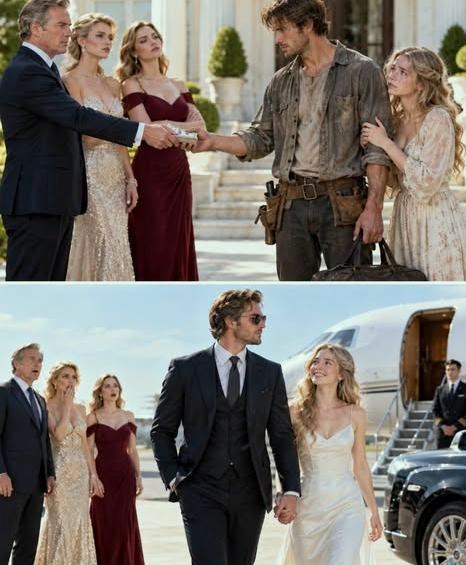
PART 4
“The bank has called the loan,” he said. “But that isn’t the worst of it. Someone just filed papers claiming Emma is legally married already…”
The man in the gray coat stopped beneath the chandelier, breathing hard.
I knew him. Caleb Morris had worked as my father’s corporate secretary for six years. He was the quiet one who carried folders, remembered birthdays, and never looked directly at me when my father told me I was being ungrateful.
My father stared at him.
“What did you say?”
Caleb held out the envelope to Noah.
“Someone filed a marriage certificate this afternoon. It lists Emma Caldwell and Travis Caldwell.”
The room broke apart.
Denise gasped.
Travis shouted, “That’s impossible!”
I felt the blood leave my face.
Noah opened the envelope and scanned the document. His eyes stopped on the signature.
“Emma,” he said carefully, “this is not a marriage certificate. It’s an application.”
My father lunged for it.
Noah lifted it out of reach.
“An application using Emma’s name,” he continued. “And it contains a declaration that she transferred all marital and financial claims to Richard Caldwell.”
My fingers went numb.
I remembered the night before: my father had placed a stack of papers beside my dinner plate and told me they were insurance forms. I had signed the last page without reading it because Denise had been shouting about a leaking pipe and Travis had been demanding my help with payroll.
“What did I sign?” I asked.
My father’s mouth tightened.
“Routine authorization.”
“Answer me.”
Caleb lowered his head. “It was a limited power of attorney. But the final page was replaced after you signed.”
The sentence landed like a stone dropped into deep water.
“Who replaced it?” I asked.
Caleb looked at my father.
My father looked at Denise.
Denise’s bracelet slipped from her wrist and struck the floor. One pearl rolled beneath the dining table.
“No,” she said. “Richard, don’t.”
He turned on her. “You handled the filings.”
“Because you told me to.”
“I told you to prepare the documents.”
“You told me to make sure Emma couldn’t interfere before the birthday deadline.”
Travis backed away from both of them.
“Stop talking,” he said.
Denise swung toward him. “You wanted her gone. You said the company would be yours once your father retired.”
“I never asked you to forge anything.”
“You asked me to find a husband who would keep her quiet.”
Noah set the papers on the table.
The room became brutally clear. The envelope. The money. The fake transfer. The rushed marriage application. None of it had been about giving me a better life.
It had been about making me legally powerless before I reached twenty-five.
My father sank into his chair.
For years, I had imagined the moment he would finally understand what he had done. I had thought it would look like tears or an apology or both arms wrapped around me.
Instead, he looked at the table where my life had been priced.
“Emma,” he said, “I was trying to save the mill.”
“No. You were trying to keep control of it.”
“It was your mother’s debt.”
“Noah said the debt came from transfers.”
My father’s eyes flicked toward him. “You don’t know what you’re talking about.”
Noah opened a leather folder and removed a stack of bank statements.
“I know exactly what I’m talking about. Money left the mill through consulting contracts and went into accounts controlled by Denise. Some of it went to cover the house. Some paid Travis’s gambling debts. The rest was used to buy shares through a holding company in your name.”
Travis turned toward his father.
“You used the company to pay my debts?”
Richard’s face hardened. “You’re my son.”
“And Emma was what?”
No one answered.
That question hurt because it came from Travis, the same man who had called me something to be taken off their hands. For one terrible second, I saw the frightened boy he had been before Denise entered our family, before our father began measuring love in usefulness.
Then I remembered the envelope in his hand.
I did not excuse him.
Caleb stepped closer to Noah. “There’s more. I brought the original filing from the county office. The clerk rejected the marriage application because the witness signature was missing.”
I stared at him.
“Who was the witness?”
Caleb swallowed. “My signature was on the draft, but I never signed it.”
“So you came here because you were afraid?”
“I came because I was tired of helping him lie.”
My father rose slowly.
“You’ll regret this.”
Caleb’s hands trembled, but he did not move away.
“No, sir. I regret waiting.”
That was the unexpected turn. Not Noah’s fortune. Not the trust. Caleb had been the invisible hinge holding the machinery together, and he had finally stepped away from it.
Margaret was still on the phone. Her voice came through the speaker.
“Emma, I’m at the mill with the original letter. Do you want me to read it?”
I looked around the dining room. At the towels scattered in the hall. At the envelope with the red wax seal. At my father’s wedding ring, which he kept twisting whenever the truth came too close.
“Yes,” I said. “Read it.”
Margaret unfolded the paper.
“Dear Emma, if you are hearing this through Margaret, then your father has tried to make you believe you inherited nothing. That is not true. I placed my controlling shares in trust for you because I knew Richard would confuse possession with love. When you turn twenty-five, the shares become yours. Do not give them to anyone who says they are saving you.”
My eyes burned.
Margaret continued.
“Your only duty is to decide what kind of life those shares should build. If the mill survives, let it survive because it gives honest work to honest people. If it cannot, sell it without guilt. You were never born to carry a family that refuses to carry you.”
The old workshop behind the mill creaked over the phone. I could imagine my mother standing there among the cedar boards and iron clamps, writing those words with the blue fountain pen she used for every birthday card.
Noah looked at me.
“I knew part of the letter,” he said. “My father told me your mother asked him to protect the trust if Richard interfered. I didn’t know the rest until today.”
“Why did you come here as a carpenter?”
His answer took time.
“Because I wanted to see whether you were surrounded by people who loved you or people who wanted something from you.”
“And what did you want?”
He looked at the envelope between us.
“To help you get out without making you feel rescued.”
That answer broke through the last of my defenses.
I picked up the white envelope and tore it in half.
Cash spilled onto the table.
Fifteen thousand dollars, arranged in neat bundles. The price they had put on my disappearance.
I pushed it toward Travis.
“Take it.”
He stared at me.
“What?”
“You said everybody has a price. Take yours.”
His face twisted. “I don’t want your money.”
“You wanted me gone.”
“I was angry.”
“You were cruel.”
He looked toward our father. “He said the company would be mine.”
“And you believed him.”
Travis lowered himself into a chair. The money remained between us like a wound neither of us could bandage.
Denise bent to retrieve her pearl. Her fingers missed it twice.
My father watched her, then looked at me.
“Your mother would have turned against us too.”
I felt something inside me settle.
“No,” I said. “She would have stopped pretending this was a family.”
He flinched.
The next morning, we went to the mill together. Not as a family. As people tied to the same collapsing structure by different ropes.
The building stood along the river, its brick walls blackened from years of furnace smoke. Inside, the machines were silent, and dust covered the brass nameplates of workers who had spent their lives there.
Margaret met us in the office with the original trust papers. She placed them on the desk beside my mother’s letter.
Noah stood behind me but did not touch me.
“What will you do?” Margaret asked.
I looked through the glass wall at the empty production floor.
“First, I’ll cancel every contract connected to my father and Denise. Then I’ll pay the workers what they’re owed.”
Noah nodded. “That will leave the mill with almost no operating capital.”
“I know.”
“You could sell the land.”
“I know.”
“You could shut it down.”
I turned toward him. “What would you do?”
“I would keep the parts that deserve to live and let the rest go.”
It was not a grand promise. It was better than one.
I spent the day reviewing ledgers with Margaret and Caleb. We found fourteen unpaid workers, two falsified contracts, three private accounts, and a shipment of walnut lumber my father had ordered under the company name for a resort he planned to build for himself.
By sunset, I had signed the papers transferring the lumber back to the mill.
Denise called once. I did not answer.
My father came to the office alone.
He looked smaller without the dining room around him.
“Emma,” he said, “I don’t know what happens to me now.”
“You sell the house.”
His lips parted.
“The house?”
“It was bought with company money. The accounts show it. The mill gets the proceeds.”
“You would take my home?”
“You took my mother’s company.”
He looked at the trust papers. “You hate me.”
“I hated needing you to be different.”
His eyes filled, but I did not move toward him.
“I loved you,” I said. “That is why this hurt so much. But love does not erase records.”
He left with the same wedding ring he had been twisting the night before.
Travis stayed behind in the parking lot. He had not touched the money.
“I’m going to the treatment center,” he said.
I studied his face.
“For gambling?”
He nodded.
“Not because you told me to. Because if I stay here, I’ll become him.”
That was not an apology. It was not enough to repair what he had done.
But it was the first honest decision I had ever seen him make.
“Then go,” I said.
He left the envelope on the hood of his car.
Noah found me later in the old workshop, standing beside my mother’s workbench. A shallow groove cut across the wood where she had once clamped a cabinet door. Her fountain pen lay inside the drawer with the trust papers.
He picked up the pen and examined its cracked blue barrel.
“Your mother used this to sign the first mill charter,” he said.
“You knew her well?”
“Not well enough. My father did. She believed furniture should outlast the people who made it.”
I looked at the silent machines beyond the workshop wall.
“Do you think the mill can survive?”
“Not as it is.”
“Can you help me rebuild it?”
He set the pen down carefully.
“Only if you stop calling me a carpenter like it’s an insult.”
A laugh escaped me before I could stop it.
“I never called you that.”
“Your brother did.”
“My brother was wrong about most things.”
Noah’s smile was small, but real.
I took the pen from the workbench and signed the first authorization as controlling trustee of Caldwell Mill. Not a marriage document. Not a transfer. Not permission for someone else to decide where I belonged.
The ink trembled once beneath my hand.
Then it held.
Outside, the first truck of returned lumber rolled through the mill gate. The driver leaned on the horn, and the sound rang through the empty building like something waking up.
Noah glanced toward the floor.
“Your workers are waiting.”
I closed my mother’s letter and carried it with me.
At the threshold of the workshop, I stopped and looked back at the envelope torn across the middle, its spilled money still scattered on the table.
I left every bill where it was.
The mill needed proof of what had been done to it before it could be rebuilt.
Then I walked toward the workers, my mother’s pen warm in my palm, while behind me the old machines began to turn.






