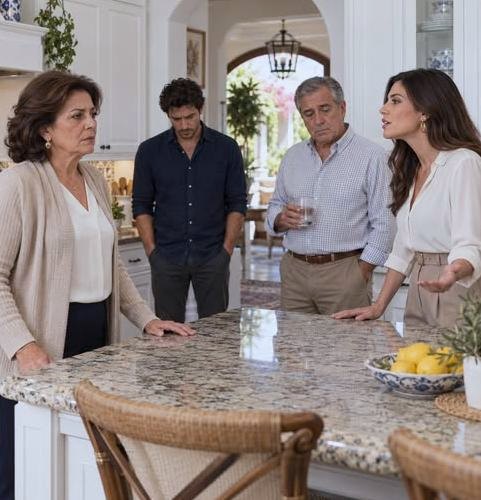
My daughter-in-law was standing in my kitchen with a tape measure when she announced that her father would be living there by the end of the month.
“What are you measuring?” I asked.
Lorena did not even look embarrassed. She stretched the tape from the refrigerator to the pantry and wrote the number on the back of a grocery receipt.
“The new cabinet for Dad,” she said. “He needs somewhere to keep his medicines.”
My hand tightened around the handle of my coffee cup.
“Your father is moving into my house?”
“Our house has four bedrooms,” she replied. “You only use one.”
Andrés sat at the table, staring at a piece of toast as if it had become the most important thing in the world.
I turned toward him.
“Did you know about this?”
He rubbed his forehead. “Mom, please don’t make it dramatic.”
That sentence hurt more than Lorena’s assumption. I had spent thirty years making that house into a home, and my son had reduced my objection to a performance.
The kitchen still carried the faint scent of lemon polish and warm bread. Ricardo had installed the wooden shelves himself, long before cancer took his strength. I could still see the small burn mark near the stove where he had dropped a pan while teaching Andrés to make pancakes.
I had buried my husband four years earlier.
I had not buried my right to decide who slept under my roof.
Rogelio, Lorena’s father, sat stiffly near the window. His fingers kept worrying the brass button on his cardigan.
“Elena,” he said quietly, “I told her I didn’t want to impose.”
“You are not imposing,” I said. “You were not asked.”
Lorena placed both palms on the counter.
“Dad already gave up his apartment.”
The room seemed to tilt.
“What did you say?”
“He trusted me to handle it,” Lorena answered too quickly. “The lease ended. Everything is settled.”
I looked at Rogelio.
His face had gone pale. “I thought you had agreed.”
“Agreed to what?”
Lorena’s smile became thin. “I told Dad you were reasonable.”
“I am reasonable. That is why I am saying no.”
Andrés finally lifted his eyes. “Mom, he would have his own room. We could help with expenses.”
“Could you?” I asked. “Or did you already decide that I would?”
No one answered.
Lorena picked up her handbag.
“Family helps family.”
“Family asks before making decisions for someone else’s home.”
Her jaw tightened. “You always soften after a few days.”
I stood and carried my cup to the sink.
“Then you are about to meet a version of me you have never seen.”
Four days later, at 8:40 in the morning, Lorena arrived with two large boxes.
“These are only some of Dad’s things,” she said.
“Take them back.”
She walked past me and dropped them beside the staircase.
“Don’t be difficult, Elena. I’ll return when the closet is cleared.”
I dragged the old wooden handcart Ricardo had used for garden soil and pushed the boxes onto the porch. Then I texted Andrés.
“Your father’s things are outside. Pick them up today.”
He called within minutes.
“Mom, they’re just two boxes.”
“Today they are two boxes.”
“You’re exaggerating.”
“No. I am noticing how this begins.”
He collected them that afternoon.
Two days later, at 7:15 in the morning, I heard my front door open.
Lorena stood in the hallway with a key, packing tape, and three empty cartons.
“Where did you get that?” I demanded.
“Andrés gave it to me years ago, in case something happened to you.”
“Hand it over.”
She tossed it onto the entry table.
“You will regret pushing your family away.”
I picked up the key. “I am not pushing anyone away. I am stopping people from walking in without permission.”
That afternoon, a locksmith replaced every lock in the house.
Then I opened my bank account. For six years, I had sent Andrés eight thousand pesos every month for the children. I canceled the automatic transfer and made an appointment to open separate accounts for Sofía and Mateo.
The next morning, Lorena called without saying hello.
“Where is the money?”
I stared at the new keys on the table.
And I understood that the problem had never been only one bedroom…
PART 2
And I understood that the problem had never been only one bedroom.
“It was meant for the children,” Lorena snapped.
“I have not stopped helping the children.”
“You stopped sending it to us.”
“I stopped sending it through you.”
There was a sharp intake of breath on the other end.
“You cannot do that.”
“I already did.”
“Do you know what groceries cost? Do you know what school fees are?”
“I know exactly what they cost. That is why their accounts will be in their names.”
Her voice dropped. “Andrés is furious.”
“He can call me himself.”
“He is your son.”
“And you are his wife. Neither fact gives you control of my bank account.”
She hung up.
At noon, Andrés appeared at my gate. The new metal latch clicked behind him when I opened it, and the sound felt strangely final.
“You embarrassed Lorena,” he said.
“She embarrassed herself by taking a key to my bedroom hallway.”
“She is under pressure.”
“Then she should have spoken to me instead of moving your grandfather’s furniture into my house.”
His face tightened. “Rogelio has nowhere to go.”
“Why did he give up his apartment?”
Andrés glanced toward the street. “Lorena said you had agreed.”
“Did you ask me?”
He said nothing.
I stepped closer. “Did you know she was bringing those boxes?”
“I thought you would come around.”
“That is not an answer.”
His shoulders dropped. “I knew she had a key.”
The betrayal landed quietly, which somehow made it worse.
I remembered Andrés at nine years old, asleep against Ricardo’s shoulder while my husband built the first shelf in the kitchen. I had believed the child I raised could never treat my home like an empty resource.
“Your children can visit whenever I invite them,” I said. “But you and Lorena do not enter without asking.”
He stared at the new lock.
“Mom, this is cruel.”
“No. Cruel would be letting your father-in-law believe he had a home here when I never offered one.”
Before he left, he said, “You are going to lose us.”
I closed the gate after him.
That evening, Rogelio called from a number I did not recognize. His voice sounded smaller than it had at dinner.
“May I come by tomorrow?”
“You are welcome to sit with me. But I need the truth.”
“I know.”
The next morning, he arrived at ten carrying a brown folder tied with a red shoelace. He held it against his chest as if it were fragile.
“I did not sell my apartment,” he said.
I looked at him.
“Lorena told me the buyer had already paid a deposit,” he continued. “She asked me to sign papers so she could arrange a temporary move. I thought you had agreed to let me stay here.”
“What did you sign?”
He untied the folder with shaking fingers.
“Some pages about the apartment. I did not read every line. My eyes have been bad since the surgery.”
Inside were photocopies, receipts, and a document stamped by a notary’s office.
I recognized my name before I understood why.
At the bottom of one page was a signature that looked almost like mine.
My stomach turned cold.
“I never signed this.”
Rogelio lowered his head. “I knew something was wrong when the notary asked why you were granting me permanent residence.”
“Why did you leave without telling me?”
“Because Lorena said you would be ashamed if you learned I had no money left.”
No money left.
The phrase echoed through the room.
He pushed a receipt toward me. The amount was far larger than anything he should have needed for moving expenses.
“Where did this money go?” I asked.
Rogelio swallowed. “Lorena said she was paying your son’s debts.”
I looked again at the forged signature.
At that moment, a vehicle stopped outside. Lorena stepped out carrying a leather portfolio, followed by a sharply dressed man with a silver tie.
She saw her father through the glass.
Then she smiled.
“Good,” she said when I opened the door. “You are both here. This will be easier.”
The man raised the portfolio.
“I have formal documents concerning Mr. Rogelio’s residence,” he said. “You should read them before making this more complicated.”
Lorena crossed her arms.
“Sign the acknowledgment, Elena. After that, everyone can stop pretending this is optional…”
PART 3
“Sign the acknowledgment, Elena. After that, everyone can stop pretending this is optional.”
The man placed the portfolio on my dining table. His card identified him as Martin Salgado, a legal representative for Lorena and Andrés.
I did not sit.
“What exactly am I acknowledging?”
“That Mr. Rogelio has been granted residence at this address under a family accommodation agreement.”
“I never granted it.”
Lorena leaned against the chair where Ricardo used to sit. “You agreed verbally.”
“Then why is my signature on your paper?”
Her expression flickered.
Rogelio opened the brown folder and placed the photocopy beside it.
“I did not know Elena had signed anything,” he said.
Martin picked up the page. “The document appears properly executed.”
“Appears?” I repeated.
The brass clock above the pantry gave a dry click as its second hand moved.
I took the paper to the window. The signature had my looping first letter, but it leaned too far to the right. Ricardo had once taught me to sign slowly because my handwriting became unreadable when I hurried.
“This is not my signature.”
Lorena’s voice sharpened. “You are trying to humiliate me because you changed your mind.”
“No. I am telling you I never signed it.”
Rogelio stood, gripping the edge of the table.
“Lorena, tell her the truth.”
She turned on him. “You are confused.”
“I am old, not blind.”
Martin looked from one face to another.
Rogelio reached into the folder and produced a receipt from the notary’s office. “The clerk wrote my name and Elena’s name in the visitor register. But Elena was not there.”
“How do you know?” I asked.
“Because the clerk asked me why your daughter-in-law had brought your identification papers.”
Lorena’s face drained of color.
I looked at her. “You used my old copy of identification from Andrés’s emergency file.”
She said nothing.
Martin slowly closed the portfolio.
“What apartment?” I asked Rogelio.
“Mine,” he said. “Lorena sold it last week.”
The room went still.
“Sold it to whom?”
“I do not know. She said the money would cover debts and that I would be safe here.”
I turned toward Lorena. “You sold your father’s home and forged my signature so he could be placed in mine.”
“That is not what happened.”
“Then explain it.”
Her mouth opened, but no explanation came.
Andrés stepped into the room behind her. I had not heard him enter. His eyes moved from the false document to his father-in-law.
“What did you do?” he asked Lorena.
She spun around. “I did it for us.”
“For us?”
“You owed money. The business was collapsing. I found a buyer for Dad’s apartment. We could pay everything, move him here, and use this place as security until we recovered.”
My chest tightened. “Use my house as security?”
Martin looked at Andrés. “You told me your mother had agreed to the arrangement.”
Andrés stared at his wife.
“You told me she had agreed,” he said.
“I knew she would agree.”
“That is not what you told me.”
The words hung between them.
Rogelio lowered himself back into the chair. “She told me Elena wanted company. She told me Andrés had arranged everything.”
Andrés covered his face with both hands.
I felt grief, anger, and something colder than both. Lorena had not mistaken kindness for permission. She had built an entire plan on my silence.
Martin pushed the papers away.
“I will not participate in a document whose signature is disputed,” he said. “You need to resolve the apartment transaction immediately.”
Lorena grabbed his sleeve. “You cannot leave.”
“I can, and I am.”
He walked out.
For a moment, no one moved.
Then my phone rang. The caller was an unfamiliar number from the notary’s office.
I answered.
“Mrs. Ortega?” a woman asked. “I am calling because we found another page connected to the document you disputed. It changes who received the sale money.”
I looked at Lorena.
Her eyes fixed on my phone.
The woman continued, “You should come today. There is also a handwritten note from Mr. Rogelio that was left in our file…”
Lorena suddenly ran toward the porch, and her father rose after her, shouting her name…
The notary found one more page in the file…
I thought the forged signature was the worst of it. Then one hidden transfer revealed what Lorena had really risked.
“Which room may I sit in?”
Even Andrés waited for my answer.
👇 The final part is open now






