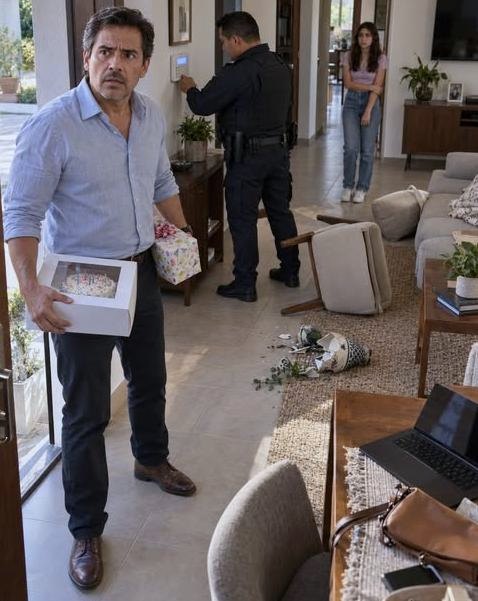
The emergency operator was still asking whether my daughter was breathing when a man I trusted walked into my bloodstained house and said my name.
I had been home less than three minutes.
At 4:07 p.m., my rideshare left me beside Maple Drive with a travel bag in one hand and a wrapped astronomy telescope in the other. Violet was turning sixteen, and I had promised myself she would not receive another birthday message through a screen.
The neighborhood looked harmless. Sprinklers clicked over green lawns. Two boys chased a basketball near the sidewalk. Mrs. Danner was trimming roses in a sun visor.
Then I saw my front door.
It stood open by six inches.
There was no splintered wood, no bent lock, no broken glass. The brass handle carried a clean, pale fingerprint where someone had wiped it. My stomach tightened before I even stepped onto the porch.
I called out, “Violet?”
Nothing answered.
The alarm panel beside the entry glowed green. Disarmed. Not damaged. Whoever had entered had known the code.
I moved through the living room slowly, every sense narrowing. The television was off. A half-finished glass of lemonade sat beside Violet’s mathematics notebook. Her yellow pencil had rolled beneath the coffee table, its eraser crushed flat.
Nothing was missing.
That was the detail that frightened me most.
I reached the hallway and saw one white sneaker near the wall. Then her backpack. Then Violet herself.
She lay curled on the hardwood, one arm over her head. Blood had dried beside her temple, darkening a strand of her brown hair. Her face was swollen, and her breathing came in shallow, uneven pulls.
“Violet.” I dropped beside her. “Sweetheart, look at me.”
Her eyelids trembled but did not open.
I pressed two fingers beneath her jaw. Nothing. I shifted them and waited, forcing my breathing to slow while panic clawed at my ribs.
There.
A pulse. Thin as a thread, but real.
“I’m her father,” I told the operator. “Sixteen years old. Severe head trauma. Possible assault.”
“Is the attacker still inside?”
I scanned the corridor. The framed photographs on the wall were straight. A vase of dried lavender had been placed back on its coaster. Even the door to the laundry room was closed.
“I don’t know.”
“Sir, leave the residence immediately.”
“I’m not leaving her.”
The sirens grew louder outside.
Beside Violet’s backpack, something small caught the light. It was a narrow brass luggage tag, the kind I had used on military bags years ago. A black star had been scratched into its surface.
I picked it up.
A folded piece of paper was tied to it with red sewing thread—not loose, not accidental, but knotted with the same double hitch I had taught Violet when she was eight and afraid of losing her camping gear.
My hands went cold.
Someone had left it for me.
I unfolded the note just as the front door opened wider and boots crossed the threshold.
“Daniel,” a familiar voice said behind me. “Don’t touch anything.”
I turned, still kneeling beside my daughter, and saw Colonel Elias Voss standing in my hallway with rainless shoes, a navy suit, and a smile that did not belong in that house.
His eyes dropped to the paper in my hand. His face changed.
Then he reached for it…
PART 2
Then he reached for it, and I closed my fist around the note.
“Don’t,” I said.
Elias stopped three feet away. Behind him, two paramedics rushed through the doorway with a red medical bag. The smell of antiseptic mixed with blood and lavender, turning my home into something cold and unfamiliar.
“I’m here to help,” Elias said.
“You arrived quickly.”
“I was nearby.”
“You were at the airport this morning.”
His jaw tightened. “Your daughter contacted me yesterday. She said you were coming home and wanted a surprise arranged.”
That was the first lie.
Violet had never mentioned Elias. She called him Colonel, even though he had retired years ago. He had been my commander during the Kandar evacuation, the man who had taught me to read a room before entering it. For twelve years, he had sent Violet birthday gifts and told everyone he was family.
A paramedic knelt beside me. “Sir, we need space.”
“I’m her father.”
“Then help us by moving back.”
I placed the brass tag on the floor and let them work. One medic fitted an oxygen mask over Violet’s face while the other cut away the sleeve of her sweatshirt. Her fingers twitched once, and my chest seized.
Elias watched the note.
“Give it to me,” he whispered.
“Why?”
“Because whoever did this wants you frightened. You’re trained to react when you’re frightened.”
“I’m trained to notice who keeps staring at the evidence.”
A police officer entered behind him, followed by a crime-scene technician. The officer asked questions while I stood beneath the crooked hallway photograph of Violet at age six, her front teeth missing and her hands covered in cake frosting.
“Was anything stolen?” the officer asked.
“No.”
“Any enemies?”
I looked at Elias.
He said, “Daniel has a long military history.”
I turned toward him. “You know exactly which part of it matters.”
The officer frowned. “What does that mean?”
“It means someone disabled my alarm, attacked my daughter, and left a message tied with a knot she learned from me.”
Elias stepped closer. “You’re making this about the past.”
“No. You are.”
At the hospital, the corridor outside trauma smelled of coffee and wet wool. A vending machine hummed beneath fluorescent lights while doctors worked behind double doors. Elias stood beside the nurses’ station, speaking softly into his phone.
I watched his reflection in the dark screen of a wall monitor.
He said, “The compartment is still closed.”
I walked toward him.
He ended the call.
“Who was that?”
“An insurance representative.”
“Insurance representatives ask about compartments?”
His expression hardened. “You’re exhausted.”
“I’m not confused.”
A nurse appeared with Violet’s backpack sealed in a clear evidence bag. “Her father?”
I nodded.
“There was a torn piece of paper inside the lining. We didn’t read it.”
Elias moved before I did.
His hand closed around my shoulder. “Let the police handle it.”
I shoved him away. “Take your hand off me.”
The nurse stepped back. “Sir?”
“Give it to me,” I said.
The officer arrived, opened the bag, and removed a narrow strip of notebook paper. Violet’s handwriting covered one side.
DAD, IF ELIAS IS WITH YOU, HE FOUND THE WRONG PLACE. LOOK UNDER THE STAIRS. DO NOT LET HIM SPEAK TO ME ALONE.
The corridor seemed to tilt.
Elias stared at the words.
I turned to him. “Why did my daughter warn me about you?”
His face went pale, but his voice stayed calm.
“Because Violet discovered something she was never supposed to see.”
“What?”
He glanced toward the trauma doors. “Ask yourself why she was looking through your old field things.”
Before I could grab him, the trauma doctor pushed through the doors, pulled off his gloves, and looked directly at me.
“Mr. Harper, your daughter is awake,” he said. “But she is terrified, and she keeps repeating one sentence.”
I stepped forward. “What sentence?”
The doctor lowered his voice.
“She says the man who attacked her wasn’t trying to hurt her. He was trying to find the name…”
PART 3
“She says the man who attacked her wasn’t trying to hurt her. He was trying to find the name…”
“Whose name?” I asked.
The doctor glanced at Elias before answering. “She needs to tell you herself.”
Inside the room, Violet looked impossibly small beneath the white blanket. A bandage covered her temple. Purple bruises climbed her cheek, but her eyes were open and fixed on the doorway.
When she saw Elias, her monitor began to beep faster.
“Get him out,” she whispered.
Elias lifted both hands. “Violet, I’m sorry you’re frightened.”
“You said you would never come back.”
The room went still.
I moved between them. “What did he do?”
Elias looked at me. “She’s confused.”
Violet gripped my wrist. Her fingers were cold.
“He came yesterday,” she said. “He said you had hidden a report under the stairs. He wanted me to tell him where.”
“What report?”
“The one about Kandar.”
Elias took one step forward. “Daniel, she found old papers and invented a story.”
“Why did you promise never to come back?” I asked Violet.
“Because he told me he had been watching our house.” Her breathing shook. “I let him in because I thought he wanted to explain what happened to Mom.”
My throat closed.
Elias had been present the night my wife, Anna, died in a highway collision after she began asking questions about my military records. I had accepted the official explanation because grief had made every unanswered question feel like a betrayal of her memory.
Violet continued, “He asked about the metal box. I said I didn’t know. Then he hit me.”
Elias’s face lost its practiced calm. “I never touched her.”
A woman standing near the medication cabinet spoke quietly. “That isn’t true.”
I turned.
She was in her fifties, wearing a hospital volunteer badge and a green cardigan with one sleeve pinned at the elbow. I recognized her after a moment.
“Marisol Rahal,” I said.
She nodded. “Your daughter found me three weeks ago.”
Elias stared at her as if she had stepped out of a grave.
Marisol had been the interpreter attached to our Kandar unit. Officially, she had died during the evacuation thirteen years earlier. I had signed the report that listed her among the missing.
“I survived,” she said. “The report said otherwise because Colonel Voss ordered the convoy doors sealed.”
Elias snapped, “You were not there.”
“I was under the truck.” Her voice did not rise. “I watched your men leave my brother and his children behind.”
I felt the room shrink around us.
Marisol held out a plastic folder. Inside was a carbon copy of my field report, marked with my signature and Elias’s handwritten amendment.
The original report stated that civilians were trapped and that extraction had been denied. Elias had altered it to say the convoy was empty.
“You hid this?” I asked him.
He looked at me. “I protected the unit.”
“You protected your promotion.”
“I protected you. If that report surfaced, you would have been charged too.”
Violet’s voice cracked. “He told me Dad would destroy everything if he knew.”
Elias turned toward her. “I was trying to keep you alive.”
“No,” I said. “You were trying to keep your contract alive.”
The door opened, and a hospital administrator entered with a security guard. Behind them stood a woman from the defense company’s board, holding a courier envelope.
She looked at Elias, then at the report.
“Colonel,” she said, “the board has just received a second copy of this document. It came from your private archive.”
Elias’s expression changed.
The woman handed me the envelope.
Inside was a signed transfer order dated the night Anna died.
Her name appeared beneath the list of witnesses Elias had ordered watched.
And at the bottom, in fresh ink, was a sentence that made Violet grab my hand:
“Anna Harper was not killed in an accident. She was scheduled to testify tomorrow…”
The sentence beneath the fold changed everything…
I thought Violet’s attacker wanted a hidden military report. I was wrong about what the document was protecting.
“Begin with the living.”
Violet closed her fingers around the brass tag.
👇 The final part is already open.






