PART 4
The line went dead before I could ask another question.
For three seconds, nobody moved.
Then Margaret stood so quickly her chair scraped the floor.
“My father’s name?”
Brandon’s face changed.
Not fear exactly.
Recognition.
Claire saw it too.
“What did your father leave in that apartment?” she asked Margaret.
“Nothing,” Margaret said. “He died with the clothes on his back and a box of fishing reels.”
Brandon turned toward the bank doors.
I stepped in front of him.
“You’re coming with us.”
“I have nothing to say.”
“That has never stopped you before.”
Lucas picked up his canvas tool bag. “I’m coming too.”
Brandon glared at him. “You’ve done enough.”
Lucas’s torn strap hung from his hand.
“No. I stopped too late.”
At 3:06, we reached the property manager’s office. The hallway smelled of wet carpet and lemon cleaner. A cardboard box sat beneath the reception desk, sealed with brown packing tape.
Margaret recognized the handwriting immediately.
“That’s your father’s,” she whispered.
I looked at Brandon.
He had gone pale around the mouth.
The property manager, Mrs. Patel, pushed the box forward. “He brought it in this morning. He said your mother had stolen documents from his desk and that you had abandoned the unit.”
“I never abandoned anything,” I said.
“I know. I kept the security deposit paperwork in your name.”
Claire crouched beside the box. “Did Brandon ask you to remove Elena from the lease?”
“He demanded it.” Mrs. Patel opened a drawer and removed a signed form. “But the lease requires both tenants. He cannot erase her with a phone call.”
Brandon’s fingers curled at his sides.
The box was not large. Inside, beneath two old sweaters, lay a black metal cash tin with a dented lid. Margaret made a sound I had never heard from her before, somewhere between a gasp and a sob.
“That was your father’s,” she said.
She lifted the tin.
The bottom was lined with yellowed envelopes, each marked with a date. At the very top was a small notebook tied with kitchen twine.
Brandon lunged.
Lucas caught his arm.
“Don’t,” Lucas said.
“Let go of me.”
“You’ve taken enough.”
Claire opened the notebook.
The pages contained my father’s careful handwriting. For years, he had repaired boats at the marina and kept private records for customers who paid in cash. One name appeared repeatedly: Gerald Hale, Brandon’s father.
Gerald had borrowed money from my father to keep the family construction company alive.
He had never repaid it.
My father had not pursued him because Gerald promised to settle the debt through a small ownership share in Northline Renovations when the business was formed.
The final page was dated three weeks before my father died.
I read it aloud.
“Gerald’s share is to be transferred to Margaret, as the debt remains unpaid. Elena is to witness the transfer if I am unable.”
Margaret pressed both hands to her mouth.
Brandon stared at the page.
Claire turned another sheet.
There it was: an original ownership agreement, signed by Gerald Hale and my father, naming Margaret as the beneficiary of a twenty-two percent share in Northline Renovations.
Lucas took one step backward.
“That share is worth more than the company debt,” he said.
Brandon looked at him.
“Which means you planned to steal from Elena and blame her mother,” Claire said, “while keeping the business that legally belongs partly to Margaret.”
“I didn’t know about the agreement,” Brandon snapped.
Lucas shook his head. “You knew enough to empty the savings.”
Brandon’s eyes flashed. “I was trying to save the company.”
“No,” I said. “You were trying to save your access to my money.”
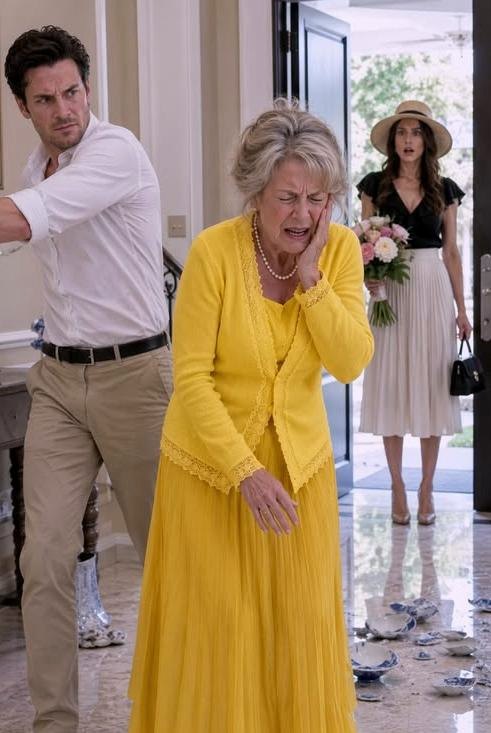
He turned to me, and for a moment I saw the man who used to bring me coffee on Sunday mornings. Then I saw the raised hand, the broken vase, the forged signature, and my mother’s swollen cheek.
“I loved you,” he said.
“Love does not need a false theft to make someone leave.”
His face collapsed inward.
Not from remorse.
From arithmetic.
He understood that the money was gone, the business was exposed, and the ownership agreement had placed Margaret between him and everything he had tried to control.
Diane arrived at the office with two bank specialists. She carried a document pouch and a grave expression.
“The internal review has confirmed unauthorized transfers,” she said. “The bank can place a recovery hold on the remaining funds and pursue the receiving accounts.”
“Will we get the money back?” I asked.
“Some of it. Not all immediately.”
It was not a miracle.
It was a beginning with a price.
Claire looked at Lucas. “You need to provide every invoice, payment, and instruction you received.”
Lucas nodded. “I will.”
“And the ownership agreement?”
Margaret held it against her chest.
“I don’t want his company,” she said.
Brandon laughed sharply. “Of course you do. That’s what this was always about.”
My mother faced him.
“My husband spent his life building things with his hands. He did not leave me a weapon. He left me proof that he trusted me.”
Brandon’s laugh died before it reached the hallway.
Margaret continued. “I will not keep a share in a company built on what my daughter lost.”
Lucas looked at her carefully. “Then what will you do with it?”
She turned to me.
I expected her to ask what I wanted. Instead, she asked what my father would have wanted.
I thought of his workbench, his cracked reading glasses, and the way he kept every receipt in a tin because he believed small things became important when people pretended not to see them.
“Sell it,” I said. “Use the proceeds to repay whatever can be recovered. Give the rest to the marina’s apprentice fund.”
Lucas bowed his head.
“My father learned there,” Margaret said. “He would like that.”
Brandon stared at us as if we had taken something from him.
“What about the apartment?” he asked.
Claire answered before I could.
“Your lease remains shared until the property manager processes a lawful separation. Elena is entitled to her personal belongings. You are not permitted to remove or destroy anything.”
Brandon looked at me.
“Are you really ending seven years over one argument?”
I felt the old reflex rise in me—the urge to explain, soften, repair, and carry the weight until everyone else could breathe.
Then Margaret touched the bruise beneath her eye.
“No,” I said. “It ended when you decided my mother was the easiest person to sacrifice.”
He had no answer that could change the shape of the room.
The next morning, Claire arranged for the bank to preserve the account records, and Diane began the recovery process. Lucas signed a statement admitting he had received the transfers and surrendered the company’s financial files. He did not ask me to forgive him. He only handed over what he had and accepted that the business might be lost.
That mattered more than an apology would have.
Brandon did not lose everything that day. Some money was already gone. The apartment still needed to be divided. The recovery would take time, paperwork, and painful conversations.
But he lost the one thing he had believed belonged to him without question: the version of me who would quietly pay, quietly endure, and quietly protect his image.
Three days later, Margaret and I returned to the bank to sign the papers for the marina fund. She wore a cream cardigan with one pearl button missing. The bruise on her cheek had faded yellow at the edges.
The dented cash tin sat beside the documents.
Diane pointed to the final signature line.
“Margaret, this transfers the ownership proceeds according to your instructions.”
My mother picked up the pen.
Her hand trembled once.
Then she signed her name in the same careful style as the man who had written the agreement years before.
I placed my hand over hers.
Outside the office, a young apprentice from the marina waited with a folded receipt for the first equipment grant. He looked nervous, as if he expected us to change our minds.
Margaret opened the tin and removed my father’s notebook.
“Tell him,” she said.
I carried the notebook to the glass doorway, where the boy stood beside a display of model boats. The smallest one had a red sail and a crooked wooden mast.
My father had built it for me when I was ten.
I handed the receipt to the apprentice.
“Your tools are paid for,” I told him.
He looked at the signature, then at me. “Why?”
I glanced back at the dented tin, the ownership papers, and my mother’s bruised but steady face.
“Because someone should get to build something without first having to beg for it.”
Behind me, Margaret closed the notebook over the old debt.
The red-sailed boat moved across the marina model’s shallow water, its crooked mast catching the light.
Missed the beginning?






