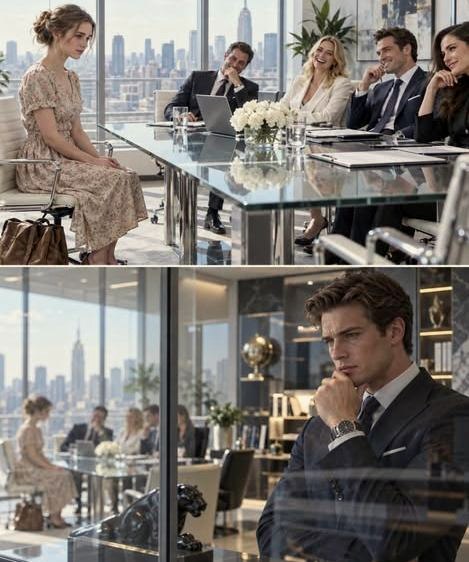
The first woman laughed at my dress before I had even found a chair.
The second woman waited until I sat down.
“Do you think she knows this is an interview?” she whispered loudly. “Maybe housekeeping is hiring on another floor.”
A man near the coffee machine snorted into his paper cup.
I kept my eyes on the folder in my lap.
The navy dress had cost nine dollars at a church sale in Milwaukee three years earlier. My mother had taken in the waist, and I had replaced the hem twice. The left sleeve still carried a neat row of stitches from the day it caught on a warehouse pallet.
My black heels looked respectable from a distance.
Up close, the right heel had been repaired with industrial adhesive at 2:17 that morning. I knew the exact time because I had been sitting at our kitchen table beside overdue utility bills, my mother’s prescription bottle, and an email reminding my younger brother that his tuition payment was due Friday.
I had almost canceled the interview.
Instead, I glued the shoe.
Now I sat on the thirty-eighth floor of Mercer Urban Group’s Chicago headquarters while people in clothes worth more than my monthly rent decided I did not belong there.
The receptionist announced a forty-minute delay.
Three candidates complained immediately.
I thanked her.
“You don’t have to thank people for wasting your time,” the woman in the cream blazer muttered.
“I know,” I said. “I’m thanking her for telling us.”
Her name was Vanessa Pike. I had seen it on the sign-in sheet. Northwestern graduate. Four years of corporate administration. Fluent in French. Excellent references.
I had an unfinished associate degree, a scattered work history, and a folder containing more practical experience than any résumé could explain.
At twenty-eight, I had worked grocery shelves, overnight cleaning shifts, shipping docks, a bakery counter, and eleven months at a small accounting office that taught me two things: numbers remembered what people tried to hide, and frightened employees often knew more than confident executives.
Across the waiting room, Vanessa leaned toward another candidate.
“If that dress gets past security,” she whispered, “they must be desperate.”
My fingers tightened around my notebook.
On the first page, I had written three sentences before leaving home.
Be useful.
Be honest.
Don’t apologize for surviving.
I read them twice.
Then a strange thing happened.
The dark glass wall beside reception reflected a man standing on the other side. He was tall, sharply dressed, and holding a tablet. I recognized him from the business magazines in my brother’s college library.
Evan Mercer.
The founder’s grandson. The heir people described as untouchable.
He was watching us.
Not the way Vanessa watched me.
His expression was still, almost severe, as if he were memorizing every laugh.
At 9:46, a recruiter opened the conference room door.
“Claire Dawson?”
I stood.
The repaired heel held.
That felt like a victory.
Inside Conference Room B, three people sat behind a walnut table. The woman in the center introduced herself as Cynthia Barr, vice president of corporate operations. Her silver-blond hair was perfect. Her smile was not.
“You found us all right?” Cynthia asked.
“Yes, ma’am.”
“You came by train?”
“Yes.”
“And you’re comfortable working around people who expect a certain level of presentation?”
The question landed exactly where she intended.
I placed my folder on the table.
“I’m comfortable meeting expectations,” I said. “I’m less comfortable pretending presentation is the same thing as competence.”
Paul Dennis from human resources shifted in his chair.
Lauren Cho glanced toward the glass wall.
Cynthia’s smile hardened.
“Then perhaps you can tell us,” she said, opening my résumé, “why someone with your background believes she belongs in an executive operations department.”
I looked at the folder beneath my hand.
There was something inside it Cynthia had never expected to see.
I slid my thumb beneath the clasp and began to open it…
PART 2
I slid my thumb beneath the clasp and began to open it.
Cynthia’s eyes dropped to the folder.
Not curiously.
Nervously.
That was the first thing that made me stop.
The clasp clicked against the table, a small metallic sound in the polished room.
“I believe I belong here,” I said, “because I know how to find what everyone else has stopped looking for.”
Paul leaned back. “That’s a broad statement.”
“It’s a practical one.”
Cynthia folded her hands. “Give us an example.”
I removed a single page from the folder.
It was a shipping reconciliation from my former employer, Lakeshore Accounting Services. At the top was a vendor name: Northline Facility Solutions.
Lauren frowned. “Why are you showing us an old invoice?”
“Because Northline has billed Mercer Urban Group for the same emergency maintenance visits three times in six months.”
The air changed.
Not dramatically. Nobody gasped. The wall clock continued ticking above Cynthia’s shoulder.
But Paul’s pen stopped moving.
Cynthia looked at the page without touching it.
“Where did you get that?”
“From an accounts file at Lakeshore.”
“You were an accounting clerk.”
“I was the clerk who found the duplicates.”
“And what happened?”
“I was told to delete the comparison.”
“By whom?” Paul asked.
I looked at Cynthia.
“By a senior client representative who said Mercer’s operations department had already approved the charges.”
Cynthia’s face remained composed, but the fingers of her left hand pressed into the walnut table.
Behind the dark glass, Evan Mercer had moved closer.
I could see only his reflection now: one hand flat against the glass, his attention fixed on the paper between us.
Cynthia noticed him too.
For the first time since I entered the room, she looked uncertain.
“You’re accusing this company of fraud during an interview?” she asked.
“No. I’m explaining why I was fired.”
Paul’s voice softened. “You were fired for refusing to alter an invoice?”
“I was told I was not a team player.”
Lauren reached toward the page. “Do you have proof this was connected to Mercer?”
I pulled out a second sheet.
“This is the delivery log. Same project code, same date, same maintenance crew. The duplicate invoice was approved under an authorization code belonging to Mercer operations.”
Cynthia stood so quickly her chair struck the wall.
“Enough.”
The word cracked through the room.
She snatched the page from the table. Her perfume smelled like bitter oranges.
“You came here with stolen company information,” she said.
“It isn’t stolen. Lakeshore gave me copies when they closed the file.”
“Who gave them to you?”
“I’m not discussing another employee’s name without permission.”
Cynthia’s eyes narrowed.
“There is no position here for someone who confuses suspicion with insight.”
“There may be no position here for someone who asks applicants to ignore duplicate payments.”
Paul went pale.
Lauren whispered, “Claire.”
Cynthia stepped around the table.
“You have no idea how this organization works.”
“I know people don’t resign in groups because of one rude manager.”
Her expression flickered.
I had read the employee complaints before coming. Not because I had access to them, but because three former Mercer workers had posted detailed accounts online. Each mentioned the same pattern: altered schedules, missing overtime, invoices no one was allowed to question, and Cynthia Barr telling staff that anyone who spoke would never work in Chicago again.
Evan had been investigating the same pattern from behind the glass.
I did not know how much he had seen.
Cynthia returned to her chair and straightened the papers with trembling fingertips.
“This interview is over.”
“Perhaps,” I said. “But the duplicate payments aren’t.”
She leaned toward Paul.
“Security should escort her out.”
The door opened before he could answer.
Evan Mercer walked in.
He did not look at Cynthia first.
He looked at me.
Then he looked at the repaired heel of my shoe, as if he had noticed the tiny smear of adhesive near the sole.
“Mr. Mercer,” Cynthia said, rising again.
“Sit down,” he replied.
She sat.
Evan took the page from her hand.
“Where is the original file?” he asked me.
“At home.”
“Who else has seen it?”
I hesitated.
“Claire,” he said, quieter now. “If this is what you believe it is, you need to tell me everything.”
Before I could answer, Cynthia’s phone vibrated on the table.
She glanced at the screen.
The color drained from her face.
Then she stood, pushed past Evan, and said, “You have no idea what you’re about to destroy.”
The conference room door slammed behind her.
Evan stared after her for two seconds before turning back to me.
“Who is Martin Vale?” he asked.
My heart dropped.
I had never said that name aloud…
PART 3
I had never said that name aloud.
Evan saw the answer in my face.
“Where did you hear it?” I asked.
“Because his resignation letter is on my desk,” Evan said. “He left Mercer six months ago and wrote one sentence: ‘Ask who benefits when the numbers look clean.’”
The clock on the wall showed 10:18.
Outside, the Chicago River flashed between the buildings like a strip of broken glass.
I opened my folder again and removed an envelope sealed with red wax. It was not elegant. The wax had cracked down the middle because my mother had dropped it while carrying groceries upstairs.
“Martin mailed this to me two weeks ago,” I said.
Evan stared at the envelope. “Why you?”
“Because I was the last person at Lakeshore who refused to erase the comparison.”
Lauren pressed both hands to her mouth.
Paul whispered, “You knew this was coming?”
“I knew someone had been moving money. I didn’t know how far it went.”
Evan broke the seal.
Inside was a signed authorization sheet, three payment summaries, and a letter in Martin Vale’s cramped handwriting.
The authorization code matched the duplicate invoices.
The signature belonged to Cynthia Barr.
For several seconds, nobody moved.
Then the door opened again.
An older man stood in the hallway, gripping a brown cane with a brass handle. His shoulders were bent, and rain darkened the collar of his coat.
“Martin,” Evan said.
Martin looked at me first.
“You came.”
“I didn’t know if you would.”
“I nearly didn’t.” He stepped inside. “Fear gets heavier when you carry it alone.”
Evan closed the door. “Tell me what happened.”
Martin placed his cane against the table.
“Northline was not a real maintenance company in the way Mercer believed. It was controlled through a holding firm owned by Cynthia’s brother-in-law. The invoices were inflated, then approved under emergency project codes. The money went out in pieces small enough to avoid immediate review.”
Paul shook his head. “How much?”
“Two million eight hundred forty-six thousand dollars over nineteen months.”
Lauren’s chair scraped the floor.
I felt the room tilt, though my feet remained planted beneath the table.
Evan looked at Martin. “Why didn’t you report it?”
“I tried.”
“To whom?”
“To the board liaison.” Martin’s mouth tightened. “Cynthia intercepted the report before it reached him. Then she told me my daughter’s contract with Mercer would disappear if I continued.”
Paul swallowed. “That was my department.”
Martin turned toward him.
“You signed the closure notice.”
Paul’s face collapsed.
“I was told the audit was complete.”
“You didn’t read it.”
“No,” Paul whispered. “I didn’t.”
Evan placed both palms on the table.
“And the employee complaints?”
Martin looked at me. “Cynthia used the same method. She moved anyone who asked questions, cut hours, or called them unstable. She needed frightened people around her because frightened people don’t compare notes.”
The door opened a third time.
Cynthia stood there with two security officers behind her.
She was holding a black leather case.
“Evan,” she said, “you need to stop this meeting.”
“No,” he answered. “You need to explain the signature.”
Her eyes jumped to Martin.
“You old coward.”
Martin’s hand trembled against the cane, but his voice did not.
“I brought the original ledger.”
He opened the leather case.
Cynthia’s face changed.
Not because of the ledger itself. Because she recognized the red stamp on its cover: BOARD REVIEW—PENDING.
“I destroyed that,” she said.
The words fell into the room before she could pull them back.
Evan slowly turned toward her.
“You destroyed a board document?”
“I meant the duplicate.”
“There was only one.”
Cynthia looked at me. “You set this up.”
“No,” I said. “You did. You just assumed nobody poor enough to be ignored could remember what she saw.”
Evan took the ledger from Martin and opened it. Every payment was listed beside a handwritten approval code. Cynthia’s initials appeared on nineteen pages.
Lauren began to cry silently.
Paul lowered his head.
Cynthia reached for the book.
Evan pulled it away.
“Do not touch another document.”
Her hand froze in the air.
Then Evan’s phone rang.
He answered, listened, and looked directly at me.
“What happened?” I asked.
“Your mother’s clinic called,” he said. “Someone using Mercer’s insurance office canceled her surgery authorization this morning.”
My blood turned cold.
Cynthia’s expression sharpened.
“I told you,” she whispered. “You have no idea what you’re about to destroy.”
But she still didn’t know that Martin had brought one more page, folded beneath the ledger, and that the name written across it was not hers…
The last page carried a name Claire never expected…
I thought the ledger would expose one dishonest executive. Instead, it revealed how deeply the silence had been purchased. The final part changes what Claire came to that interview seeking.
“Do not protect the family name before you protect the people carrying it.”
Evan lowered the brass key into his palm.
👇 The final part is already open.






