PART 4
The signature belonged to me.
Not a forged version. Not a name copied from an old form.
My own signature, written in black ink beneath a sentence I had forgotten seeing.
I reached for the page, but Dad moved faster.
“Anna, don’t.”
His hand closed over the paper.
The buyer was waiting downstairs. The company was collapsing. Grandma’s letter had exposed the trust, the stolen payments, and the false release, but the second signature still burned through the room like a match.
“What did I sign?” I asked.
Dad’s mouth tightened.
“Nothing that matters.”
Thomas stepped between us.
“Robert, give her the page.”
Dad turned on him. “You have interfered enough.”
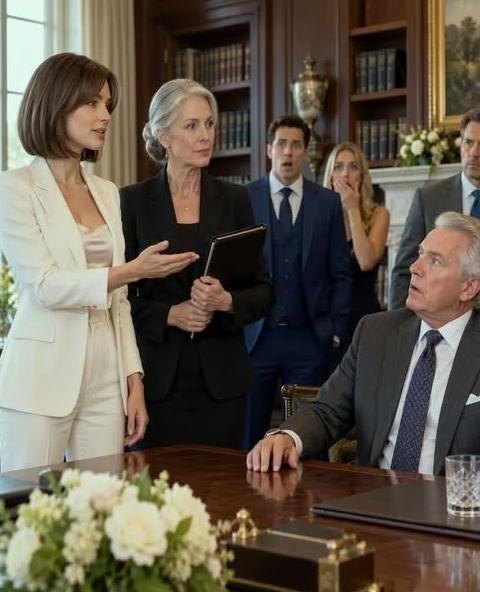
Mr. Ellis pressed the intercom button.
“Send the buyer upstairs.”
Dad’s head snapped around.
“You can’t do that.”
“I can,” Mr. Ellis said. “He is about to purchase rights that cannot legally be transferred.”
Two minutes later, the office door opened again.
A tall man in a navy suit entered with a woman carrying a notary’s case. The man held a cashier’s check in a white envelope. The woman’s silver pen was clipped to her collar, and the pen’s cap clicked repeatedly against her knuckles.
“Mr. Whitman,” the man said. “We were told the documents were ready.”
Dad forced a smile.
“There has been a minor delay.”
“No,” I said. “There has been a fraud.”
The buyer looked at me.
Mr. Ellis rose and took the trust documents from the table.
“The timber rights are held in an active family trust. The transfer release provided to your company is invalid.”
The buyer’s face hardened. “We were assured the release was genuine.”
“It carries a false signature,” Thomas said.
Dad pointed at him. “You have no proof.”
Thomas opened his case and removed an old ledger, its corners softened from years of handling.
“I have the original.”
He placed it beside the release.
The notary leaned over both pages. Her silver pen stopped clicking.
“These signatures do not match,” she said.
Dad’s shoulders rose and fell.
“I was acting for my mother.”
“You were acting without authority,” Mr. Ellis replied.
Diane stepped toward him.
“Robert, tell them the truth.”
He looked at her with disbelief. “You want the truth now?”
“I want the house.”
Blake gave a bitter laugh.
“You both lied to me.”
Dad gripped the back of a chair. The brass wheel beneath it squeaked against the floor.
I picked up Grandma’s letter.
The first paragraph explained the second signature.
Two years earlier, during one of my Wednesday visits, Grandma had asked me to sign a simple acknowledgment that she had given me access to the trust records. I had signed it at the kitchen counter while she watched, her yellow reading glasses resting on the end of her nose.
I remembered the smell of cinnamon tea.
I remembered her hand covering mine.
I had forgotten the sentence printed above my signature: Anna Whitman is the only person authorized to inspect, preserve, or transfer the trust property after my death.
Grandma had known Dad would try to use the family’s confusion against me.
She had built the answer into the paperwork.
Dad had not been afraid of my anger.
He had been afraid of my authority.
I read the next page aloud.
“Robert, you will say I was confused. You will say Anna was greedy. You will say the land belongs to the person who managed it. But management is not ownership, and fear is not family.”
Diane covered her mouth.
Blake lowered his head.
Dad stared at the letter.
“She hated me,” he said.
“No,” I answered. “She knew you.”
The buyer folded the cashier’s check and returned it to his envelope.
“Then this transaction is over.”
Dad lunged toward him.
“You cannot walk away. You signed an agreement.”
“An agreement based on a false release,” the buyer said. “My company will not touch this property.”
The buyer’s notary placed the unsigned closing papers back into her case.
One by one, the sound of paper sliding into folders filled the office.
It was strangely louder than shouting.
Dad looked at me.
“Please.”
The word landed badly because I had heard it from him before, years ago, when he wanted my signature.
He had stood in Grandma’s kitchen with a blue pen and a contract spread over the table.
“Just sign,” he had said. “You’re making this harder than it needs to be.”
I had been eighteen, frightened, and furious.
Now I was forty, and the same man was asking for mercy beside a trust he had tried to steal.
“What happens to the company?” I asked.
Mr. Ellis answered carefully. “The company loses access to the timber rights. Its creditors will decide what remains.”
Diane turned toward Dad.
“You told me the land would save us.”
“I thought it would.”
“You used my business to hide payments.”
“You accepted the money.”
“I accepted what you told me was legitimate.”
She removed her wedding ring and placed it on the table beside the cracked saucer.
It made a small, final sound.
“I am not signing anything else for you,” she said.
Then she walked out.
Blake stayed.
He looked exhausted, younger than his thirty-one years.
“Anna,” he said, “did Grandma really leave you the cottage?”
“Yes.”
“Why?”
“Because she knew I would keep it.”
He rubbed both hands over his face.
“I don’t want it.”
I studied him.
“You wanted the money.”
“I wanted the life Dad promised me. The dealership. The house. The easy version of everything.”
His voice cracked.
“I never knew he was taking it from her.”
“That doesn’t erase what happened.”
“I know.”
He reached into his jacket and removed a small bundle of papers held together by a rubber band.
“I found these in his office last night. I thought they were dealership records.”
Thomas took them and scanned the first page.
His expression changed.
“What?” I asked.
“These are copies of every payment Robert made from the care account,” he said. “He kept them because he planned to use them as deductions against the trust.”
Dad stepped forward.
“Give me those.”
Blake moved between us.
“No.”
It was a small word, but Dad stopped as if Blake had struck him.
Blake handed the papers to me.
“I am sorry,” he said.
I believed that he was sorry.
I did not mistake it for repair.
Mr. Ellis explained what came next. The accounts would be separated, the timber contracts canceled, and the cottage placed in my name according to the trust. The stolen funds would be listed as debts owed to the estate. No dramatic procession followed. No one was dragged away. There was only paperwork, signatures, and the slow collapse of a story Dad had repeated until everyone almost believed it.
He signed the inventory with a trembling hand.
When he reached the line identifying him as a debtor to his mother’s estate, he looked up.
“You’re going to take everything.”
“No,” I said. “You already gave it away.”
His eyes went to the brass thimble in my palm.
“Your grandmother gave you that?”
“She gave it to me when you put me out.”
“I didn’t know she found you.”
“You didn’t ask.”
The words hurt more than I expected.
For twenty-two years, I had imagined this moment as triumph. I thought I would feel taller, stronger, vindicated.
Instead, I felt tired.
Grandma was gone. The cottage had survived, but she had not lived to see me claim it. Dad had lost the thing he wanted most, yet watching him lose it did not return the Wednesdays I spent outside her gate, waiting for someone to let me in.
Mr. Ellis gathered the documents.
“Anna, there is one final instruction in the will.”
I looked at him.
He handed me a narrow envelope sealed with a strip of pale green paper.
The handwriting was Grandma’s.
“For the first evening at the cottage.”
I opened it alone in the small reading room next to the office. Inside was a single key tied to a scrap of fabric from her old kitchen curtain, patterned with tiny yellow pears.
Beneath it she had written:
“Do not turn the cottage into a monument to what he did. Fill it with the work you were too afraid to begin.”
I pressed the fabric to my lips.
Outside, Blake waited near the stairwell.
“What will you do with the place?” he asked.
“I’m going to keep the lake room open for young people who need somewhere to start.”
He looked surprised.
“Like you did?”
“Like I did.”
“Could I help?”
I studied his face for a long moment.
“Start by paying back what you can.”
He nodded.
“I will.”
It was not forgiveness.
It was a beginning with terms.
When I returned to the conference room, Dad was alone beside the signed inventory. The buyer was gone. Diane was gone. The envelope containing the cashier’s check was gone with them.
Dad looked at me.
“Your grandmother always chose you.”
“No,” I said. “She chose the person who would tell the truth when it cost something.”
He glanced at the trust papers.
“Do you hate me?”
I thought about the laundry-room floor, the garden gate, the cottage windows, and the little brass thimble warming in my hand.
“Hate would make you too important,” I said.
His face tightened, but I did not stay to watch it change.
That afternoon, I drove to the lake cottage with Grandma’s key on the passenger seat. The road curved through the timberland Dad had tried to sell, past the old red barn and the stone marker bearing my grandfather’s name.
At the cottage, the front steps were covered in pine needles. Inside, dust lay across the piano, and one of Grandma’s measuring tapes was still curled beside the sewing basket.
I placed the brass thimble on the kitchen counter.
Then I unfolded the yellow pear fabric and pinned it above the doorway of the room that would become a small office.
A week later, the first young woman arrived carrying a backpack, a folder of applications, and the same frightened look I remembered seeing in my own reflection.
She stood on the porch.
“Are you sure I can stay here?” she asked.
I held out the cottage key.
“Your grandmother’s rule,” I told her. “No one starts over alone.”
Behind me, the old sewing basket creaked as the lake wind moved through the open screen door, and the brass thimble rolled once across the counter before coming to rest beside the key.
Missed the beginning?






