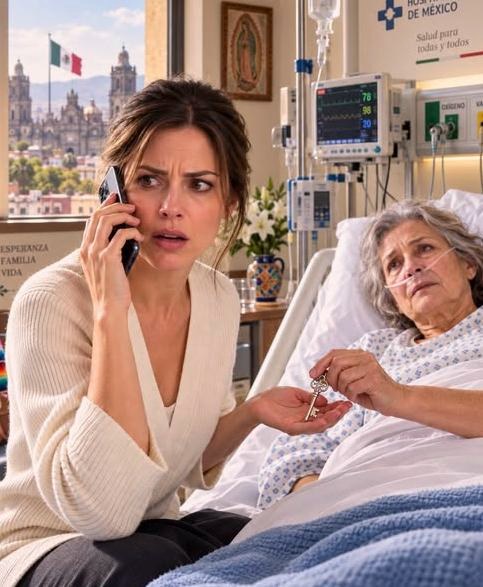
On my thirty-first call from the intensive care room, a woman answered my husband’s phone and laughed while his dying mother listened beside me.
“Adrian is taking a shower,” she said. “We’re in Maui. Stop bothering us.”
The call ended before I could speak.
Across the bed, Beatriz’s eyes remained open beneath the pale hospital light. A thin oxygen tube curved under her nose, and the heart monitor clicked steadily beside her like a nervous metronome. She had heard every word.
Adrian had told me he was in Monterrey, closing an urgent contract for the family company. His mother had been in the Guadalajara hospital for two days. I had spent both nights beside her, sorting pills, changing damp towels, and bribing her with spoonfuls of peach yogurt when she refused to eat.
Adrian had offered explanations for twenty years.
Meetings.
Flights.
Clients.
Exhaustion.
That night, the doctor pulled me into the corridor at 11:40 and said Beatriz might not survive until morning. I called Adrian once. Then again. By the tenth call, my hands were shaking. By the thirtieth, I was whispering apologies to a dead phone.
I still believed a son would come running when told his mother was dying.
I was wrong.
I lowered the phone and returned to her bedside.
“I’m sorry,” I whispered. “He isn’t coming.”
Beatriz did not cry. She did not look surprised, either.
Instead, she lifted one trembling hand and beckoned me closer. I thought she wanted water. I reached for the paper cup beside her, but her fingers caught my wrist.
Then she slid her hand beneath the pillow.
The small silver key she pulled out was cold enough to sting my palm. It had a narrow oval bow and three tiny scratches near the teeth, as if someone had carried it for years beside coins. Beatriz closed my fingers around it with astonishing strength.
“Do not give it…” Her breath caught. “Do not give it to Adrian.”
Twenty minutes later, the monitor shrieked.
Beatriz died with her fingers wrapped around my wrist.
I stayed until a nurse asked whether she should call her son. My phone lay faceup on the chair, displaying thirty unanswered calls and one cruel silence.
“No,” I said. “He knows where she is.”
At nine the next morning, I went straight to Arturo Medina’s office. He had handled Beatriz’s affairs for more than twenty-five years. When he saw the key in my hand, the color drained from his face.
“Where did you get that?”
“She gave it to me before she died.”
Arturo crossed the office, locked the door, and pulled a dark wooden box from the bottom of a cabinet. Dust clung to its brass corners. The key fit perfectly.
Inside were bank statements, property deeds, insurance policies, photographs, and a folder bearing my name.
LAURA.
My stomach tightened.
Arturo unfolded a letter written in Beatriz’s sloping handwriting.
Laura, if you are reading this, my son was not beside me when I needed him, and you were. Do not let him use your loyalty against you again.
Beneath the letter were loan agreements carrying signatures identical to mine.
I had never signed them.
Credit lines. Business guarantees. Refinancing documents. Obligations totaling more than forty-eight million pesos.
“What is this?” I asked.
Arturo placed both palms on the desk.
“Your husband’s plan,” he said quietly, “to leave you with his debts when he walked away.”
My phone began vibrating.
Thirty-seven missed calls from Adrian.
Now he wanted me.
Arturo pushed another folder toward me. Inside were transfers made over five years to a company called Pacific Crest Holdings. Its owner was Victoria Shaw, the woman who had answered Adrian’s phone from Maui.
One listed asset was a seaside villa.
I had paid for Beatriz’s night nurse because Adrian claimed the company could not afford one. He had sent millions to Victoria instead.
Something inside me broke.
Not my heart. The last excuse I had been willing to invent for him.
“How far do you want to go?” Arturo asked.
I looked at the silver key on his desk.
“All the way.”
Arturo opened a drawer and removed a second key, larger than the first. The number 317 was stamped into its square metal head.
“Beatriz instructed me to give you this only if you chose to investigate Adrian,” he said.
He placed it beside the first key.
Then he leaned toward me.
“Laura, your mother-in-law was not investigating money alone…”
PART 2
“What else was she investigating?” I asked.
Arturo did not answer immediately. He slipped the large key into a leather envelope and checked the locked office door as though the walls might be listening. Outside, phones rang and assistants hurried across the marble hallway. Inside, the only sound was the faint tap of the silver key against the desk.
“Key 317 opens a private storage compartment at the old family warehouse,” he said. “Beatriz rented it under a name Adrian never knew.”
“Why hide it from him?”
“Because she believed he was reading her mail.”
My throat tightened. “You knew?”
“I suspected. She had proof of something, but she refused to tell me over the telephone.”
My phone rang again. Adrian’s name flashed across the screen.
I answered.
“Where are you?” he demanded.
“At Arturo’s office.”
A pause. Then his voice became soft, almost tender.
“Laura, listen to me. My mother died, and you are sitting with a man who wants to tear this family apart.”
“She died while you were in Maui.”
“You don’t know what happened.”
“Your mistress answered your phone.”
The softness vanished.
“Be careful,” he said. “Those papers you signed make you responsible for every company loan. If you start making accusations, creditors will come after you before the funeral is over.”
I looked at the folder with my forged signature.
“Did I sign them?”
“You signed plenty of things over the years.”
“Did I sign these?”
Silence stretched between us. I heard waves behind him, not traffic, not an office, not Monterrey.
“Come home,” he said. “We can fix this privately.”
“You are not home.”
I ended the call.
At 2:15 that afternoon, Arturo drove me to the warehouse. The building stood behind a row of shuttered furniture stores, its corrugated roof shining beneath a hard Guadalajara sun. A rusted fan rattled above the entrance, pushing hot air that smelled of cardboard, oil, and old wood.
The caretaker, Rosa Villalba, recognized the key before I showed it to her.
“So she finally gave it to you,” Rosa said.
I stopped. “You knew about this?”
Rosa wiped her hands on a flour-colored apron. “Beatriz told me to wait.”
“Wait for what?”
“For you to stop protecting her son.”
The words landed harder than any accusation Adrian had made.
Rosa led us through narrow aisles stacked with broken chairs and boxed account books. At the far end, a steel door bore the number 317. My fingers slipped on the key because my palms were sweating.
“Why did Beatriz trust you?” I asked.
“Because I worked in the family office before Adrian took control. I prepared payments. I saw who approved them.”
Arturo’s jaw tightened. “Rosa, you told me you had no copies.”
“I lied to Adrian,” she replied. “Not to Beatriz.”
The lock opened with a heavy metallic click.
Inside sat three filing cabinets, a canvas suitcase, and a child’s red tin lunchbox resting on top of a table. Beatriz had once packed my lunches in one exactly like it when Adrian and I were newly married. Seeing it there made my chest ache.
Rosa opened the first cabinet.
“Your mother-in-law discovered the guarantees were being prepared before you ever saw them,” she said. “She also found payments made from the company account to a medical consultant.”
“What consultant?”
“Dr. Salgado. The doctor who kept increasing her sedatives.”
My knees weakened. Beatriz had spent her last year saying she felt foggy, frightened, and unable to remember conversations. Adrian had told me it was simply age and heart disease.
Arturo opened the suitcase. Inside were envelopes tied with yellow ribbon, a small notebook, and several forms bearing Adrian’s handwriting.
I reached for the notebook.
Rosa caught my wrist.
“Read the last page first,” she said. “That is where she wrote what she wanted done if she died.”
I turned to the final page. Beatriz’s handwriting filled the paper in shaky lines, and beneath it was a date from six weeks earlier.
I read the first sentence.
Then the warehouse lights went out.
Somewhere behind us, the steel door slammed shut, and a man said, “Step away from that notebook…”
PART 3
The voice belonged to Adrian.
Emergency light spilled beneath the steel door, turning the warehouse floor the color of old blood. Rosa moved in front of me. Arturo reached for his phone, but Adrian struck it from his hand before he could unlock the screen.
Victoria stood behind him in a white linen dress, her Maui tan impossible to miss beneath the flickering light.
“You followed us,” I said.
Adrian’s eyes fixed on the notebook. “Give it to me.”
“No.”
“Laura, you have no idea what you’re holding.”
Rosa gave a bitter laugh. “She knows enough.”
Adrian stepped closer. “You were always useful when you followed instructions. Do not become foolish now.”
The words hit me with such clarity that the warehouse seemed to sharpen around them: dust on the filing cabinets, a loose nail near my shoe, the smell of hot metal in the air.
I opened the notebook.
“Beatriz wrote this,” I said. “You don’t get to decide what it means.”
Adrian lunged.
Rosa shoved the table between us. The red lunchbox fell, struck the concrete, and sprang open. Inside were stamped copies of payment orders and a bundle of handwritten notes.
Arturo picked up the top sheet.
“Adrian,” he said, “this transfer bears your authorization.”
“It was a routine payment.”
“To Dr. Salgado?” Rosa asked. “For changing your mother’s medication?”
Victoria’s face tightened. “He was trying to keep Beatriz calm.”
“Calm?” Rosa’s voice rose. “She was barely conscious when he brought the notary to her house.”
My blood turned cold. “What notary?”
Rosa looked directly at me.
“The one who witnessed the documents transferring Beatriz’s controlling shares to Adrian. She could not stand, could barely speak, and he told everyone she was confused because of her illness.”
Adrian grabbed the edge of the table.
“She wanted me to run the company.”
“She wanted Laura to inherit it,” Arturo said.
The room went still.
I stared at him. “What?”
Arturo opened the notebook to the last page and read aloud.
“My son has not merely stolen money. He has arranged for Laura to carry the debts, then plans to sell the company and claim I was no longer competent to object. The guarantees in her name are false. Rosa saw the forms before they were filed. I have left copies where Adrian cannot reach them.”
My breath caught.
Adrian shook his head. “She was sick. She imagined things.”
Rosa stepped forward. “I saw you sign Laura’s name.”
He turned on her. “You copied the forms.”
“No. You did.”
“You were paid to keep quiet.”
“I was paid by Beatriz to preserve the truth.”
Victoria’s eyes darted toward Adrian. “You said the documents were clean.”
He rounded on her. “You knew exactly what we were doing.”
That sentence destroyed the last shelter he had.
Arturo collected the papers. “The bank already has notice that the guarantees are disputed. Beatriz sent the originals to an independent vault yesterday.”
Adrian stared at him. “You would betray me?”
“I served your mother. Not your appetite.”
For a moment, Adrian looked less like my husband than a stranger wearing his face.
Then my phone rang.
The caller was the hospital administrator. I answered on speaker.
“Mrs. Alvarez,” she said, “we found a sealed envelope in your mother-in-law’s personal effects. It was marked for delivery only after her death. There is also a message from the notary who visited her home.”
Adrian’s expression changed.
“What message?” I asked.
The administrator hesitated.
“He says Beatriz did not sign the transfer papers willingly. He wants to meet you tonight, but he is frightened. He says Adrian has already learned where he lives…”
The document Beatriz left behind changed what I chose…
I thought the forged papers were the worst betrayal. I was wrong. The final decision belonged to me, and no one could make it for me.
“Take the company only long enough to protect the people who built it.”
My hands stopped shaking.
👇 The final part is open now.






