PART 4
The call ended, and nobody moved.
Adrian’s hand remained on the table, inches from the red lunchbox.
Victoria stared at him as though she had just discovered the villa in Maui was built on a grave.
“Where is the notary?” I asked.
The administrator gave me an address and told me to come alone.
Adrian heard it too.
“You are not going anywhere,” he said.
I looked at the steel door behind him.
“You locked us in.”
His face tightened.
Rosa walked to the wall and pulled a red emergency cord. A bell erupted somewhere in the warehouse. Footsteps answered from the loading bay.
Adrian moved toward me.
Arturo stepped between us.
“Touch her,” he said, “and every document in this room goes to the bank before sunset.”
Adrian stopped.
That was the first thing he truly feared: not shame, not grief, not losing me, but losing control of the papers he had spent years hiding.
A warehouse supervisor opened the steel door from outside. Adrian pushed past him and disappeared into the sunlight. Victoria followed, then stopped beside me.
“You think you won,” she said.
“I think your name is on the accounts.”
Her lips parted.
“You don’t understand. Adrian told me Beatriz had already approved everything. He said Laura would receive the debts and he would be free to sell the company.”
“You still took the money.”
“I did.”
“Then you will have to explain that.”
Victoria looked toward the road, where Adrian’s car was accelerating away.
“He promised me the Maui villa.”
“He promised you a life built from stolen money.”
Her eyes filled, but I felt no triumph. Only exhaustion.
At 6:40 that evening, Arturo drove me to the notary’s apartment. It was above a bakery, and the stairwell smelled of cinnamon, dust, and hot wiring. An elderly man named Ernesto Palacios opened the door with a chain still fastened.
When he saw me, his shoulders collapsed.
“Beatriz told me you would come,” he said.
“You witnessed the transfer papers.”
“I witnessed Adrian forcing the situation.”
His living room was crowded with dictionaries, legal books, and old clocks. On a glass table lay a small brass stamp pad and a sealed envelope bearing Beatriz’s handwriting.
Ernesto sat heavily in an armchair.
“Your mother-in-law was lucid,” he said. “She knew exactly what Adrian was attempting. He brought me to her home and told me she wished to transfer the controlling shares. She could barely lift her hand because of the medication.”
“Why did you sign?”
His eyes lowered.
“Because Adrian showed me a medical report saying she was confused. I believed it. Then she pressed her thumb against the paper and whispered, ‘This is not my consent.’ I should have stopped everything.”
“Why didn’t you?”
“He threatened my grandson. He said he could make a tax investigation disappear or appear, depending on what I did.”
Ernesto opened a drawer and removed a folded sheet.
“I copied the transfer papers before I left. But Beatriz saw me. She wrote a note on the back and made me promise to keep it until after her death.”
He handed it to me.
The note said: Laura, do not fight to keep what was never yours to carry. Take the company only long enough to protect the people who built it. Then choose what lets you sleep.
My eyes burned.
Beatriz had known I might inherit everything. She had also known I might refuse it.
Ernesto gave Arturo a second document: a signed statement admitting that the transfer had been coerced and that I had never signed the guarantees in the loan folder. He also provided the name of the bank officer who had received the originals from Beatriz the day before she died.
That night, Arturo sent the statement, the payment records, and the forged guarantees to every lender involved. He sent copies to the company’s board and to Victoria’s bank.
Adrian’s plan collapsed without a courtroom.
The lenders froze the disputed accounts. The board suspended his authority. The Maui villa was no longer a secret asset but a question attached to his name. Victoria returned the company card before midnight and agreed to cooperate with the financial review.
The next morning, Adrian came to Arturo’s office alone.
His shirt was wrinkled. His expensive watch had stopped at 3:17.
He placed it on the desk.
“Your mother gave me the warehouse number,” I said.
He flinched at the mention of her.
“I did what I had to do,” he said. “The company was failing. Father left debts. I was trying to save it.”
“You sent seventy million pesos to Maui.”
“I needed someone loyal.”
“You bought someone.”
His jaw worked.
“She would have taken everything from me.”
“No. She was going to leave you the company.”
He looked at Arturo.
“Is that true?”
Arturo slid Beatriz’s will across the desk. “She left Adrian operational control only if he maintained the workers’ pensions and repaid the company’s obligations. She left the controlling shares to Laura in trust.”
Adrian read the page.
The color drained from his face.
“She knew,” he whispered.
“She knew you were drowning,” I said. “She did not know you would pull everyone under with you.”
He looked at me then, and for one painful second I saw the boy Beatriz had once defended: frightened, proud, desperate to be admired.
“Laura,” he said, “I never meant for you to be hurt.”
“You forged my name.”
“I thought I could repair it before you found out.”
“You let me pay her nurses while you paid for a villa.”
His eyes reddened.
“I was ashamed.”
“Shame is not a repayment.”
He reached into his pocket and placed my wedding ring on the desk. I had not realized he had taken it from the jewelry tray at home.
“I thought you would want this.”
I pushed it back toward him.
“Keep it. It belongs to the person who believed your promises.”
He stared at the ring.
“What will you do with the company?”
“I will sell the villa and use the money to cover the workers’ pensions and the legitimate debts.”
“And me?”
“You will sign nothing without Arturo present.”
His shoulders sagged.
“Will you destroy me?”
“No. You did not need my help.”
That afternoon, I went to Beatriz’s house. Her medication boxes still sat in a neat row beside the kettle. On the refrigerator was a shopping list with my handwriting beneath hers: peaches, ginger tea, batteries.
I took the list down and folded it into my purse.
Not because it was valuable.
Because it was evidence of the life I had actually lived, while Adrian had been inventing another one behind my back.
At the company meeting, the employees waited in the same conference room where Adrian had once announced impossible targets and blamed everyone else for missing them. Arturo placed the trust documents on the table. Rosa sat beside me. Ernesto joined by telephone from his apartment above the bakery.
I told the workers the truth.
I told them which debts were false, which payments were real, and why their pensions would be protected before anyone received a cent of inheritance.
An accountant raised her hand.
“Are you taking over?”
I looked at Beatriz’s signature on the trust page.
“For a little while,” I said. “Long enough to put the company back in the hands of the people who keep it alive.”
Rosa smiled faintly.
“And after that?”
“After that, we turn the warehouse into a training center and use the profits to fund night care for elderly families who cannot afford it.”
Arturo glanced at me. “Beatriz would approve.”
“No,” I said. “She would complain about the budget first.”
Rosa laughed, and the sound loosened something in my chest.
Adrian did not return to the office. He signed the repayment agreement through Arturo and surrendered control of the accounts. Victoria sold the Maui villa and paid back the portion of the money she could trace. She did not ask for forgiveness, and I did not offer it. Some consequences did not need a speech to become real.
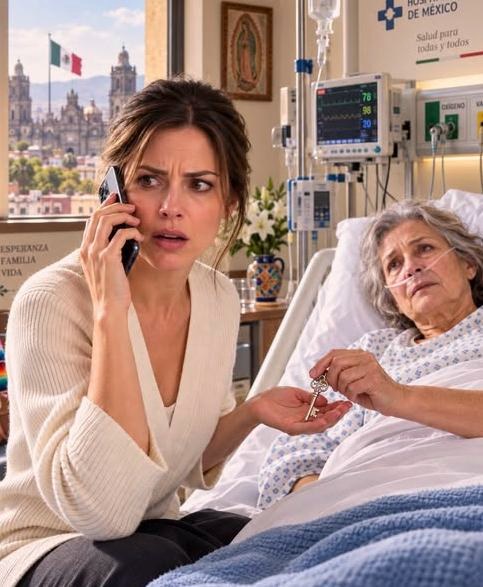
Weeks later, I returned to the hospital archive to collect Beatriz’s personal effects. The nurse handed me a small envelope containing the silver key, a comb, and the thin cotton scarf Beatriz wore on her final night.
The nurse touched the key.
“She held this very tightly,” she said.
“I know.”
I carried it to the warehouse and placed it inside the red lunchbox. The large key marked 317 went beside it. On the lid, I taped a new label: Beatriz Alvarez Family Care Fund.
Rosa stood in the doorway with a stack of applications from caregivers seeking help.
“The first family is waiting,” she said.
I opened the lunchbox and took out the silver key.
It no longer felt cold.
I handed it to Rosa.
“Then let’s use what she left us.”
Rosa looked at the key, then at the room Beatriz had hidden for years.
Outside, the warehouse bell rang for the morning shift, and the people Adrian had tried to turn into numbers began carrying tables into the space marked 317.
On the old red lunchbox, beneath Beatriz’s name, someone had written the first appointment: Mrs. Ortega, night care, Friday at seven.
Missed the beginning?






