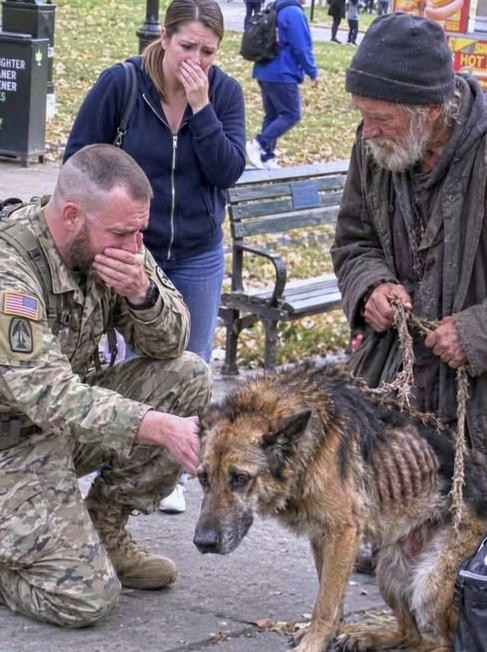
The federal clerk was still whispering about a four-thousand-dollar monthly payment when Rocky collapsed beside my kitchen table.
I caught him before his ribs struck the floor. His body felt frighteningly light beneath the dirty coat, and the old blast scar along his side trembled under my palm.
“Rocky,” I said. “Stay with me, partner.”
His amber eyes opened, but they looked past me toward some battlefield only he could see. I pressed my fingers against his shoulder and counted every breath until the emergency veterinarian arrived. The room smelled of antiseptic, wet wool, and the chicken broth Earl had carried in a chipped thermos.
At six the next morning, Dr. Lena Ortiz stood beside the examination table with Rocky’s bloodwork in her hand.
“He’s severely malnourished,” she said. “Anemic, dehydrated, infected wounds, muscle wasting. But he’s fighting.”
“He always did,” I answered.
She lowered her voice. “Sergeant, the registry says Northbridge certified him healthy six weeks ago.”
“Then the registry is lying.”
“No. Someone is.”
That sentence followed me home.
By noon, my kitchen table had disappeared beneath printouts, microchip reports, veterinary invoices, and the letter that had once told me Rocky belonged in a permanent sanctuary. I had received it while recovering in a German hospital after the roadside blast that put me there. I could barely hold a pen then, but I had signed every adoption request the Army sent me.
Northbridge had answered with a clean letterhead and a cold sentence: Rocky was under specialized lifetime care and could not be transferred to his former handler.
I had believed the government had made a decision I was too weak to fight.
Now Rocky slept on an orthopedic pad beside my chair, his paws twitching against the blanket. Every few minutes, his nose searched for the smell of the cheap soup Earl had fed him beneath the bench.
Earl sat across from me, both hands wrapped around a mug.
“I found him behind the bus depot,” he said. “Rain coming down hard. He couldn’t stand, but he still tried to bite anyone who came near.”
“Why didn’t you take him to a shelter?”
Earl looked offended. “Because shelters ask questions, son. I had no answers. So I gave him what I had.”
He pulled the filthy rope from a grocery bag and laid it on the table. Fibers stuck out like broken whiskers.
“Three months,” he continued. “Three months I washed those sores with bottled water while somebody somewhere got paid to do it.”
My phone rang.
The caller was a junior procurement clerk named Melissa Grant. Her voice shook as she read the federal care ledger.
“Premium feed. Climate-controlled boarding. Rehabilitation therapy. Monthly disbursement, four thousand dollars.”
“For Rocky?”
“For Rocky Bennett.”
I stared at the dog sleeping beside me.
“Where did Northbridge say he was housed?”
There was a long pause.
“An address in Cedar Valley.”
I wrote it down. Earl leaned forward.
“What’s there?”
Melissa swallowed. “That’s the problem, Sergeant. The address is an abandoned freight warehouse.”
At that moment, Rocky lifted his head and growled toward the front door.
No one had knocked.
Then my phone rang again. This time, the number was blocked. I answered, but a man said only one sentence before disconnecting.
“Stop digging, Sergeant.”
The rope on my table seemed to tighten by itself beneath Earl’s hand. I looked at Rocky, at his hollow flanks, and at the federal documents spread between us.
I had spent years learning how to move toward danger without announcing it.
So I called Sarah Coleman, a veterans’ legal advocate known for making powerful people regret underestimating wounded soldiers.
She arrived that evening with a locked blue folder and one instruction.
“Do not open this until the director lies to your face.”
Two days later, beneath the brass seal of a federal oversight chamber, the heavy doors opened. Victor Hale, Northbridge’s director, entered in a tailored suit, smiling as though he had already won.
Sarah touched my wrist.
“Wait.”
Victor took his seat, adjusted his silk tie, and looked directly at me.
“Sergeant Hayes,” he said, “I’m told you’ve made some emotional allegations about a dog who has been safely cared for.”
My hand closed around the edge of the blue folder. Sarah leaned toward my ear.
“Let him finish.”
Victor folded his hands over the polished wood and turned toward the committee.
“Rocky Bennett was never abandoned,” he said. “He was transferred under proper authorization, and Mr. Hayes has simply misunderstood—”
Sarah’s fingers tapped once against the folder.
Victor smiled wider.
“—where the animal was placed.”
Sarah gave me the signal, and I reached for the clasp…
PART 2
The clasp snapped open beneath my thumb.
Inside lay pages stamped with the federal seal, each one marked with dates, account numbers, and signatures. The paper smelled faintly of toner and dust. Across the chamber, Victor Hale’s smile remained fixed, but his right hand stopped moving.
Sarah rose.
“Mr. Hale,” she said, “you just testified that Rocky Bennett was transferred under proper authorization. Would you like to name the facility?”
Victor glanced at the committee chair.
“Cedar Valley Canine Rehabilitation Center.”
“Street address?”
“Our operations department handles that information.”
“Then perhaps the invoices will help.”
Sarah took the first page from my folder and handed it to the clerk. The document was projected onto the screen behind the committee.
It showed Rocky’s microchip number, the abandoned freight warehouse, and a monthly charge for climate-controlled boarding.
A murmur moved through the room.
Victor leaned toward his microphone.
“That address may have been entered incorrectly.”
“The same error occurred for eleven consecutive months?” Sarah asked.
“It is possible.”
“Is it also possible that the invoices were approved by your office?”
Victor’s jaw tightened. “I sign hundreds of documents.”
I felt my pulse beating against the table. Rocky was lying in a quiet veterinary recovery room three floors below, cleared to travel but too weak to sit through the hearing. Earl sat behind me with the rope in his lap, his thumb rubbing the frayed knot over and over.
The committee chair lifted another page.
“This invoice lists premium food delivered every Tuesday.”
Earl gave a rough laugh.
“Then someone fed him on Tuesdays and Thursdays,” he said. “Because I was the one buying soup the other days.”
Victor turned toward him.
“And you are?”
“Earl Mercer.”
“A former employee?”
“No.”
“A veterinarian?”
“No.”
“Then your observations are hardly reliable.”
Earl’s knuckles whitened around the rope.
“My observations kept that dog alive.”
The room went still.
Sarah placed the notarized affidavit on the table. It contained the bus depot address, the date Earl found Rocky, the wounds he cleaned, and photographs taken on an old disposable camera. The images showed the dog beneath a bench, ribs exposed, rope cutting into his neck.
Victor barely looked at them.
“Anyone can stage photographs,” he said.
That was when I stood.
“My dog was trained to respond to three commands in two languages,” I said. “He has a scar beneath his left shoulder from an explosive device that killed two men beside me. He recognized my voice after six years. Mr. Hale, did you ever see him?”
Victor stared at me.
“I reviewed his file.”
“That wasn’t my question.”
His lawyer rose. “This is becoming theatrical.”
Sarah turned on him. “Your client has charged the government for the care of a living veteran while denying that veteran access to his own partner. The theater began when he put a price on an empty kennel.”
The chair ordered Victor to answer.
He adjusted his tie again, but the silk had twisted beneath his collar.
“I never personally handled the animal,” he admitted.
A committee member frowned. “Then who did?”
Victor looked toward the rear of the chamber.
A woman in a Northbridge badge stood beside the exit. She was pale, clutching a stack of papers against her chest.
“Mr. Hale,” she said, “you told me not to come.”
His face changed.
Her name was Naomi Price, Northbridge’s former records coordinator. She walked to the witness table carrying a metal key ring and a sealed envelope.
“I kept copies,” she said. “Because I knew someone would eventually ask where the dogs went.”
Victor whispered, “Naomi, don’t.”
She placed the envelope before the committee chair.
Inside was a transfer authorization dated three months before Earl found Rocky. It carried the forged signature of a military veterinarian and an instruction written in Victor’s own handwriting: “Remove from active care list. Continue billing under sanctuary classification.”
The chair looked up.
“Mr. Hale, is this your handwriting?”
Victor’s mouth opened, then closed.
Naomi pointed to the last line.
“They weren’t at a sanctuary,” she said. “They were sent to a private holding yard outside town. When the contractor stopped paying the yard, the animals were released.”
“Which animals?” I asked.
Naomi looked at me with tears gathering in her eyes.
“All twelve.”
The committee erupted in questions. Victor’s lawyers crowded around him. Earl gripped my shoulder.
Then Melissa Grant called my phone from procurement.
Her voice was barely audible.
“Sergeant Hayes, I found a second ledger. It isn’t about the invoices.”
“What does it show?”
“It shows Northbridge received a final payment yesterday.”
“Why?”
A pause.
“Because someone certified that Rocky was dead…”
PART 3
The chamber doors slammed shut as security moved to keep the reporters outside.
Victor’s attorney objected, the committee chair shouted for order, and Naomi stood trembling beside the witness table with the metal key ring still clenched in her fist.
I held the phone against my ear.
“Melissa, read the certification.”
“It says Rocky Bennett died during an emergency procedure nine days ago.”
I looked down at my hands. Dirt from the park still lived beneath one fingernail. Rocky was alive in a veterinary room below us, breathing through a narrow plastic tube.
“Who signed it?”
Melissa’s voice cracked. “Victor Hale.”
The room seemed to tilt.
Sarah took the phone from me and put it on speaker.
“Melissa, can you send the document to the committee?”
“It’s already being transmitted.”
Victor shoved back from the table.
“That is an administrative mistake.”
Naomi shook her head. “No, it isn’t.”
Victor turned on her. “You have no idea what you’re talking about.”
“I typed the certification,” she said. “You dictated every word.”
The chair leaned forward. “Why would you certify the death of a dog who was still alive?”
Victor’s eyes flicked toward me.
Because he had finally understood that Rocky was not the only witness in the room.
“Northbridge had exceeded its contract ceiling,” Naomi continued. “The department was preparing an audit. Mr. Hale needed the outstanding care payments released before the files were reviewed.”
Victor pointed at her. “She was fired for stealing company records.”
“I copied them because twelve dogs vanished,” Naomi replied. “I stole nothing.”
Sarah placed another ledger on the table.
“This one shows the transfer of funds into a private account controlled by Hale Development Group,” she said. “A company owned by Victor Hale’s wife.”
Victor’s skin lost its color.
The committee chair turned to him. “Were government funds used to purchase the lake property listed here?”
“My wife manages several investments.”
“Answer the question.”
Victor’s lawyer whispered urgently in his ear.
Victor slapped the table. “I built Northbridge from nothing. Do you know what it costs to maintain a facility like that? Do you know how many animals arrive broken, dangerous, impossible to place?”
“Then why bill for food you never bought?” I asked.
His eyes met mine.
“Because no one cared,” he said.
The words came out before he could stop them.
Even his lawyer froze.
Victor looked around the chamber as if searching for someone willing to rescue him.
“The government wanted clean reports,” he continued, voice rising. “The military wanted retired dogs out of sight. Everyone wanted the paperwork to say they were healthy. I gave them what they wanted.”
“You gave yourself their money,” Sarah said.
“I kept the contract alive.”
“You abandoned the dogs.”
“I made a business decision!”
Earl stood behind me.
His chair scraped hard against the floor.
“No,” he said. “You made a decision about who was worth feeding.”
Victor turned toward him, breathing heavily.
The committee ordered an immediate suspension of Northbridge’s contract, froze the remaining disbursements, and demanded that every surviving K9 be located. No dramatic handcuffs followed. Sarah had warned me that real accountability moved slower than anger, but it could reach farther.
Then Naomi handed me the metal key ring.
“There’s one more place,” she said. “The old training compound. Hale kept something there.”
“What?”
She looked toward the elevator.
“Records he didn’t want destroyed.”
My phone rang again before we could move.
Dr. Ortiz was calling from the clinic.
“Daniel,” she said, “Rocky woke up. He’s trying to stand.”
I closed my eyes.
“Tell him I’m coming.”
“I will. But there’s a problem.”
“What problem?”
Her voice became careful.
“A man arrived here claiming to be Northbridge’s emergency handler. He has paperwork authorizing him to take Rocky immediately.”
My hand tightened around the key ring.
“Did you let him in?”
“No. But Daniel, he knows Rocky’s full medical history, and he says he has a federal transport order.”
Across the chamber, Victor heard enough to understand.
For the first time, fear broke through his anger.
“Do not let them take him,” he said.
I stared at him.
“You just said he was dead.”
Victor’s gaze dropped to the ledger.
Naomi moved closer and whispered, “The transport order came from the same office that signed the death certificate.”
Sarah grabbed her coat.
“Then we get to the clinic before the paperwork becomes a weapon.”
As the elevator doors opened, Victor called after me.
“Sergeant Hayes, if you go there, you’ll learn what happened to the other eleven.”
I turned.
His face had gone pale again.
“No,” I said. “You’ll learn what happens when they come home.”
The elevator began to descend, but the key ring in my hand carried a small brass tag I hadn’t noticed before.
It was stamped with a room number.
Room 12…
The key opened a room Victor never wanted found…
I thought the ledger had exposed everything. I was wrong.
The last room revealed why Rocky had been hidden—and who else had been erased.
“Your name stays here, boy.”
Rocky pressed his nose against the brass.
👇 The final part of the story is now open.






