PART 4
Room 12 was at the end of the old training compound, past a chain-link gate whose padlock had been cut recently.
The building stood behind a row of dead kennels, its windows covered with plywood and its roof sagging over the loading bay.
Sarah drove faster than I thought her battered sedan could manage. Naomi sat beside her, clutching the records she had copied. Earl and I followed in my truck, the filthy rope on the seat between us.
My phone stayed pressed to my ear.
“Dr. Ortiz,” I said, “keep Rocky in the treatment room.”
“He’s surrounded by two technicians and a very angry receptionist,” she answered. “The man with the transport papers is still arguing.”
“Does he have a weapon?”
“No. But he has a federal seal on every page.”
“Then don’t let him touch my dog.”
When we reached the clinic, two uniformed guards were standing beside the reception desk. A thin man in a Northbridge jacket held a document folder against his chest.
He looked at me and smiled.
“Sergeant Hayes?”
“Step away from the treatment wing.”
“I’m authorized to retrieve Rocky Bennett.”
“By whom?”
He lifted the order.
“The Department of Veterans’ Animal Services.”
Sarah took the paper without asking. She read it once, then again.
“This office does not exist,” she said.
The man’s smile vanished.
Naomi pointed at the signature. “That is Victor’s assistant’s handwriting.”
The man backed toward the entrance.
Earl moved in front of him.
“You’ll need a different hallway,” Earl said.
The guards escorted the man outside while Sarah called the procurement office. Melissa confirmed that the transport order was fraudulent and that the person who issued it had used a stolen government seal.
Victor had tried to erase Rocky twice in two days.
He had failed both times.
I entered the treatment room.
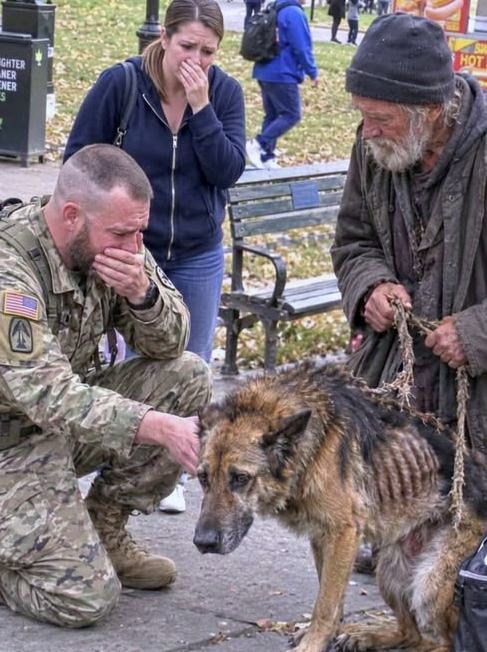
Rocky was standing between two padded rails, trembling so violently that his claws clicked against the floor. His head lifted when he heard my boots.
“Hey, partner.”
His ears rose.
I knelt and held out my hand.
He crossed the short distance one careful step at a time, then pressed his forehead into my chest.
The smell of medication, warm fur, and old dust filled my lungs. I wrapped both arms around him and felt every bone beneath his coat.
“I’m here,” I whispered.
His breath shuddered against my neck.
Behind me, Earl began to cry silently. He turned toward the supply cabinet and pretended to read a label.
That night, Sarah, Naomi, Earl, and I went to the compound.
Room 12 was not an office. It was a records vault.
Naomi unlocked it with the brass key.
Inside were shelves of paper files, each marked with a dog’s name, microchip number, and status. Some folders were stamped healthy. Others were stamped transferred. Twelve bore the same final classification: deceased.
Earl took one file from the shelf.
“Bishop,” he said. “I remember that name.”
Naomi opened it. “Belgian Malinois. Explosive detection. Transferred to Northbridge four years ago.”
“Where was he found?” I asked.
“An industrial lot outside Millbrook.”
Sarah scanned the next pages.
“Six dogs were released. Three were sold to private security companies. Two disappeared.”
“And Rocky?”
Naomi pulled his file from the middle shelf.
“Rocky was marked for disposal after Northbridge received the final payment.”
The words struck harder than any accusation Victor had made.
“Disposal?” Earl whispered.
Naomi nodded. “He was considered too damaged for resale.”
I looked at the photograph clipped to the file. Rocky was younger, alert, standing beside me in a training yard. I was smiling at the camera. He was watching the perimeter.
Sarah found another page beneath the photograph.
“This is why they blocked your adoption request,” she said.
It was a private valuation. Rocky’s training history, combat certifications, and medical profile had been calculated for sale to a foreign security firm. Northbridge had planned to sell him after retirement, but the blast scar made him unreliable for deployment.
They hadn’t protected Rocky from me.
They had hidden him because I might have stopped the sale.
Earl sat heavily on a crate.
“That dog saved your life,” he said.
“And they put a price on what was left of it.”
At dawn, Victor arrived at the compound with his lawyer and three members of the oversight committee. He looked smaller without the hearing room around him. His suit was wrinkled, and the silk tie hung loose beneath his collar.
He saw the open vault.
“You had no right to enter,” he said.
Sarah held up the file. “You had no right to falsify a death certificate.”
Victor’s lawyer stepped forward. “My client is prepared to cooperate.”
“Cooperation is not repentance,” Earl said.
Victor looked at him. “You were paid to watch the bus depot?”
Earl’s face hardened.
“What are you talking about?” I asked.
Victor rubbed his forehead. “The holding yard manager hired him. He was supposed to report when the dogs wandered off.”
Earl stared at the floor.
I felt something cold move through me.
“Is that true?”
Earl’s mouth tightened.
“Yes.”
The room changed.
He reached into his coat and removed a folded receipt, worn almost transparent at the creases.
“I worked maintenance at the yard,” he said. “Not for Northbridge. For the owner. When the pay stopped, I stayed because the animals had nobody else.”
“You never told me.”
“I thought you’d see me as part of it.”
“Were you?”
His eyes filled.
“I should have taken Rocky away sooner. I should have found you. But I didn’t know your name until he started reacting to that brass insignia on your sleeve.”
I looked at the old rope on the crate.
“You fed him with your own money.”
“I lied about some things,” Earl said. “Not that.”
Victor gave a bitter laugh. “He was never supposed to survive.”
I stepped toward him.
“Why?”
“Because the contract paid for living animals. Dead animals ended the money. If I reported the deaths, the department would have investigated. If I kept the files active, the payments continued.”
“And the money?”
Victor glanced toward the lake property listed in the ledger.
“My daughter needed surgery,” he said. “The company was failing. I borrowed from the accounts.”
Sarah’s expression did not soften.
“You bought a mansion.”
“The surgery worked.”
That answer hung in the vault, ugly and human.
I had expected a monster. Instead, I found a man who had used one desperate excuse until it became a machine that crushed everyone beneath it.
“Where is your daughter?” I asked.
“Children’s hospital downtown.”
“Does she know how you paid for it?”
Victor looked away.
By afternoon, the oversight committee seized Northbridge’s contract records, canceled its certifications, and transferred the surviving dogs into independent care. The money recovered from the frozen accounts was placed into a rehabilitation fund, not because it erased anything, but because the animals still needed food, surgery, and handlers.
Victor’s lake property was sold to cover restitution. His company disappeared under debts he had built in its name. The formal investigation continued, but I did not wait for a courtroom to decide what the ledgers already proved.
I went back to the clinic.
Rocky had eaten half a bowl of food and was asleep beneath a clean blanket. Dr. Ortiz handed me a new identification tag.
“His old one was too damaged to scan,” she said.
I turned it over.
Rocky Bennett.
Retired military working dog.
Handler: Daniel Hayes.
I fastened it beneath his collar. The metal clicked softly against the buckle.
Earl stood near the doorway.
“I can leave if you want,” he said.
Rocky opened his eyes.
He tried to rise, failed, and dragged himself toward Earl instead.
Earl dropped to his knees.
The dog pressed his muzzle into the old man’s palms.
Earl covered his face.
“I’m sorry,” he whispered. “I’m so sorry, boy.”
Rocky licked his wrist.
I watched them for a long moment before speaking.
“Come home with us.”
Earl looked up. “You sure?”
“No.”
He flinched.
I touched Rocky’s shoulder.
“But I’m sure he wants you there.”
Earl nodded, unable to answer.
Weeks later, the federal program hired him to help run the temporary rehabilitation yard. He kept every receipt, measured every meal, and wrote each dog’s name in a notebook with a red cover. He never called himself a hero.
Neither did I.
Victor sent no apology. He did, however, provide a sworn statement naming the officials who had accepted Northbridge’s clean reports. That testimony recovered enough money to build a permanent sanctuary for the retired dogs.
He lost the company, the property, and the illusion that good intentions could excuse cruelty.
His daughter received the surgery.
I never met her.
Some debts belong between a person and the choices that created them.
Rocky took months to regain strength. He still startled at polished brass. He still slept with one paw hooked over the edge of his blanket, as if guarding an exit.
But he ate.
He gained weight.
And whenever Earl entered the yard carrying a dented can of soup, Rocky lifted his head before anyone else heard the gate.
On the morning the sanctuary opened, Rocky stood beside the memorial plaque bearing the names of the twelve dogs. His legs shook, but he refused the harness.
Earl carried the old rope in both hands.
“What should we do with this?” he asked.
I took it from him and placed it beneath the plaque, where the sunlight touched the frayed knot.
Rocky walked forward and rested his nose against the brass plate beneath his own name.
Then he turned toward me.
I raised my hand, not to command him, but to offer it.
His tail struck the ground once.
“Come on, Rocky,” I said. “Your bowl is waiting.”
He stepped beside me, carrying the new tag against his chest, while Earl followed with the red notebook and twelve names that would never be erased again.
Missed the beginning?






