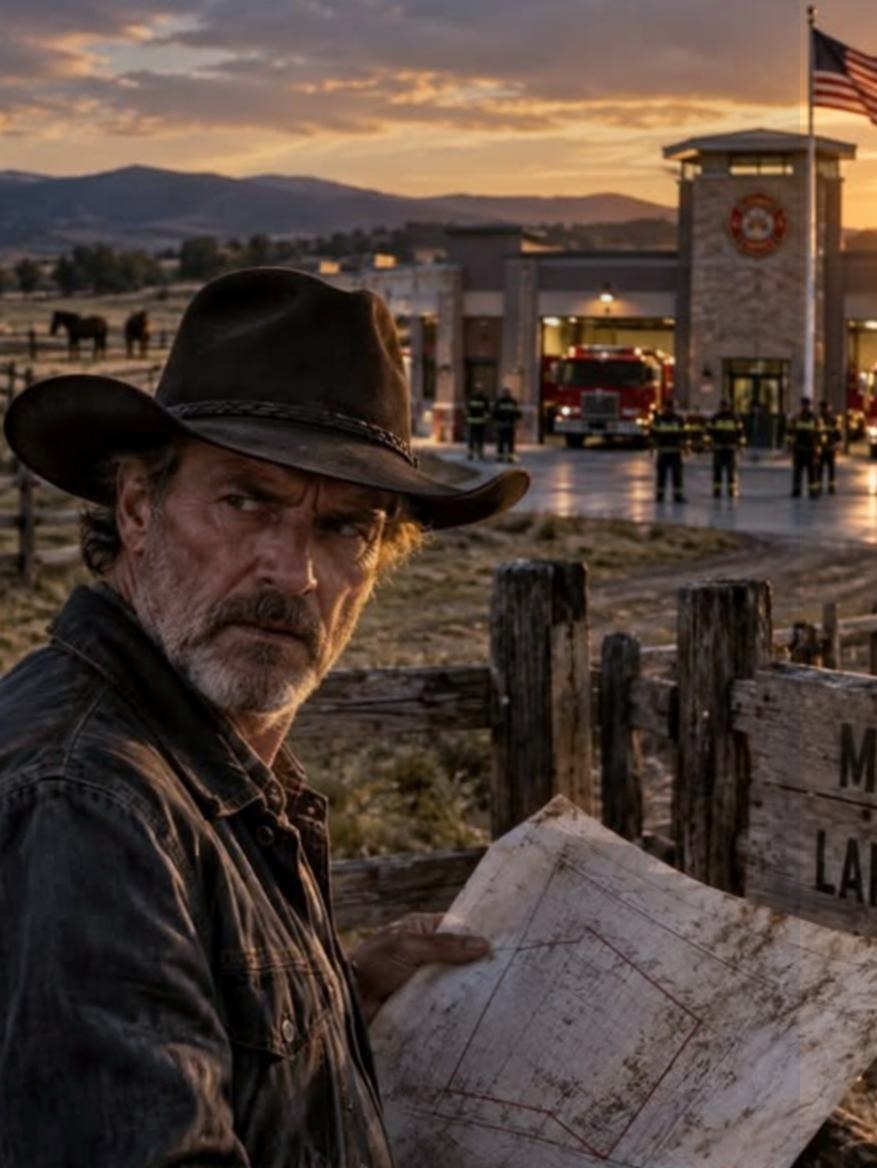
That morning I found orange flags in the eastern pasture of my ranch, and a few hours later the teeth of an excavator tore open the earth, as if my family had never owned this land.
I noticed the flags themselves first, not the trucks. In the motionless morning they flashed against the pale grass and looked like warnings. I was drinking coffee on the veranda when a yellow excavator appeared in the distance. Behind it came a concrete mixer, a flatbed truck, and several white pickups.
I put the cup down on the table.
My name is Daniel Mercer. I am forty-seven years old and own one hundred and forty-three hectares of land outside Texas. This is not a beautiful, orderly estate with white fences. Here there are pastures, a dried-up creek, mesquite trees, two water reservoirs, and a barn that leans sideways during strong wind.
My grandfather, Caleb Mercer, bought this land after returning from Korea. One leg hurt him, but he never missed checking the boundaries. When I was a child, every spring he took me to the eastern fence and showed me an iron pipe driven into a huge live oak.
“This is not decoration,” he would tell me.
“A boundary marker?”
“This is the difference between your land and someone else’s land.”
That morning his voice came back to me so clearly that the skin on my hands tightened.
I took my hat and went inside. My wife, Laura, was washing dishes at the sink.
“Did you see something?”
“Survey flags.”
“On our side?”
“I’m going to find out exactly that.”
Laura slowly dried her hands.
“Take photographs.”
The entire construction site was already waiting for me in the eastern pasture. A large sign stood beside the concrete fence: “Northridge Fire and Emergency Assistance Center.” Below it said that this was a twelve-million-dollar public safety project.
Northridge was the expensive development across the road. My ranch had never been part of it.
A man dressed in a white hard hat approached me.
“Entry here is prohibited,” he told me.
“Why is entry onto my land prohibited?”
“Are you the owner?”
“That depends on which boundary you are using.”
He introduced himself as Mike Reynolds, the site supervisor.
“You are building the station on my land,” I said.
“This is Northridge property. Everything is approved.”
“Then show me the deed.”
“I don’t carry such a thing on a construction site.”
“Then do not pour concrete there until someone sees the legal boundary.”
His smile disappeared.
“Mr. Mercer, two surveys have been conducted. We also have permits.”
“A permit cannot change ownership.”
He demanded that I leave. I did not argue. I took out my phone and photographed everything: the sign, the flags, the heavy equipment, the permits, and Mike’s face.
In the evening I told Laura that Northridge considered the land its own.
“What do you think?”
“I think someone has a bad map.”
The next day I called the county records office. An elderly clerk found my parcel number and told me that on the digital map the fire station was outside my boundary.
“And in the old records?”
“There is no indication that the boundary was changed.”
“How can the boundary move on a map if not one document was changed?”
A long silence fell.
“A digital map is not a legal record,” he finally told me. “Look for the old survey and the original boundary markers.”
That night I hardly slept. At four in the morning I went into the back storage room of my grandfather’s workshop. Boxes, old tools, and tax receipts lay in the dust. At last I found a rotten leather folder with a small copper clasp.
Inside was a survey sheet dated 1968. The lines, the creek, and the oak were exactly where my grandfather had told me they were. The boundary ran hundreds of meters east of the one shown on the digital map.
Laura came to me and, leaning over the sheet, asked:
“Where is the station?”
I put my finger on the sheet.
“Here.”
She noticed a handwritten note in the corner: “Eastern marker checked on site. Do not touch.” Beneath it were the old county surveyor’s signature and the date.
Grandfather had not been paranoid.
He had kept evidence.
A week later the head of the Northridge association, Karen Whitmore, came to my house. She got out of a white car, held a thin folder in her hand, and looked at me as if my existence were an inconvenient delay to the project.
“You are obstructing construction,” she told me.
“You are building on my land.”
“This land is not yours.”
“Then show me the deed.”
She handed me the plan. The lines looked clean and precise, but they were wrong.
“This is only a project plan,” I said.
“It is approved.”
“Approval is not ownership.”
Karen gave a little laugh.
“Rural landowners always become overly emotional when development arrives.”
Those words hurt more than a direct insult.
“I am not against the fire station,” I told her. “I am against it being built on someone else’s land.”
“Construction will continue.”
“Then every day will be evidence of your choice.”
She shifted her gaze to the eastern pasture. The first foundation forms already stood there.
“You have no idea who you are fighting,” she said.
“I know only whose land you are standing on.”
The next day I brought a licensed surveyor, David Mercer. He was not my relative, but when he saw the old documents he immediately understood that the matter was serious.
He measured for three days. At last he called me to the oak. He showed me a rusty iron pipe sticking halfway out of the ground.
“This is the original marker.”
With his equipment we followed the boundary. The line ran directly under the future parking lot, crossed the foundation, and entered the middle of the equipment hall.
David checked the records again.
“Approximately sixty percent of the building is on your land.”
At that moment every sound disappeared. I heard only the little copper clasp rattling in the wind, hanging from my grandfather’s folder.
Then Karen called me again.
“Remove your marker immediately,” she told me.
“No.”
“You cannot stop the project.”
“Maybe I cannot. But the truth might.”
The next morning a police car arrived. Karen stood with two advisers. The senior deputy read my documents, then looked at the construction foundation.
“Do you have the original?”
“It is at home.”
“Bring it tomorrow.”
Karen raised her hand.
“This man is stopping a public safety project with an old piece of paper!”
The deputy calmly replied:
“Sometimes old papers last the longest.”
That evening the county scheduled a meeting. Karen, lawyers, surveyors, and the sheriff were to come to the site. I pressed the leather folder to my chest and headed toward the oak when the sheriff asked everyone to be quiet and David pointed toward the first point of the boundary. Then he lit up the screen of his device and said……
David slowly followed the boundary line. Pink ribbons moved in the grass and went straight into the half-built station.
The sheriff asked:
“Is this marker truly original?”
“It matches the 1968 survey,” David answered. “The county’s old field book also has the same coordinates.”
Karen said angrily:
“That is impossible. The project is approved.”
“The approved map may be wrong,” David replied.
Mike Reynolds took off his hard hat.
“If the line runs here, we have to stop the work.”
Karen looked at him.
“You are the construction supervisor, not a lawyer.”
“I am also the man who signs for this concrete.”
The county representative finally issued an order: the work had to be temporarily stopped. The excavator was turned off. The generator went silent. Such silence fell in the dust that it seemed as if the earth had breathed out for the first time.
But Karen snatched the folder from me.
“This is only an old copy,” she said.
“The original is with me.”
“Then submit it.”
That same night the lawyer Patricia Novak invited me to my office. On the table she placed not only the survey, but also the old field book.
“Daniel,” she told me, “did you look at the back of the folder?”
“No.”
“Then open it.”
The copper clasp froze between my fingers. Inside was another sheet, one my grandfather had never mentioned. Patricia wrote down how I read its first sentence. Then she raised the sheet toward the window and quietly said:
“This is not only evidence of the boundary. It says who knew about the error……
I took the sheet from Patricia’s hand. The paper was so thin that light showed through it, but the ink was clearly readable.
“Caleb Mercer—I checked the eastern marker on site together with the county man. Do not trust the development line drawn later until you reach the old oak. This boundary does not change.”
Below were the date, the surveyor’s initials, and half of the county seal.
“My grandfather wrote this,” I said.
“Yes,” Patricia replied. “But what matters is whose hands it ended up in afterward.”
She unfolded a second document. It was a copy of the county field book from 1983. The record contained exactly the same coordinates. David compared both sheets with each other.
“This is final,” he said. “The boundary is confirmed by the physical marker, the old survey, and the county record.”
The next day everyone gathered at the construction site again. It was nine in the morning. Cold wind moved through the iron frame, and the unfinished building looked like a huge empty skeleton.
The county’s chief surveyor, Elena Ruiz, opened the old field book.
“The boundary was transferred incorrectly in the digital map,” she said. “The error probably appeared during the electronic transfer of the maps.”
Karen asked sharply:
“So the county is responsible?”
“Responsibility will be determined later. But the boundary runs here.”
Elena stood by the oak, David turned on the equipment, and the sheriff stood beside him. The line marked with pink ribbon first crossed the grass, then the road, and finally entered the middle of the foundation.
Mike said in a low voice:
“God.”
The sheriff asked:
“What portion stands on Mercer’s land?”
“Approximately sixty percent,” David replied.
Karen shook her head.
“No. I cannot believe this.”
I raised the leather folder.
“You do not need to believe it. The land itself shows it.”
“You are destroying this project!”
“No, Karen. You built where no one had checked ownership.”
The county head handed Mike a stop-work order.
“All work is suspended until the legal boundary is finally registered.”
Mike read the order and turned to the workers.
“Turn everything off.”
One engine stopped. Then the second. Finally the compressor choked quietly. Karen watched the trucks leave her “public investment.”
Her face became like ash.
But at that very moment Patricia’s phone rang. She listened, then turned toward me.
“Daniel, another record has been found in the county archives.”
“What record?”
“Minutes of a meeting stating that Karen had already been informed about the old boundary before the project began.”
Karen heard this.
“That is a lie!”
Patricia put down the phone.
“Then you will explain in court why you signed for receiving it.”
Karen looked toward me, but there was no anger in her eyes now. There was fear.
That evening I received a call from an unknown number. It was a man’s voice, low and hurried.
“If you want your family to remain safe, drop this matter.”
“Who are you?”
“A person who knows how quickly an accident can happen on a ranch.”
The call ended.
I called Patricia immediately. She asked me only one question:
“Was it recorded?”
I looked at the phone. Call recording was on.
“Yes.”
Patricia exhaled.
“Then this is no longer only a land dispute. And Karen does not yet know that her biggest problem is not where she built the station, but what she recorded herself……
კარენმა საკუთარი მუქარა პირველად სხვისგან მოისმინა…
მეგონა, რომ საზღვრის დამტკიცებით ყველაფერი დასრულდებოდა. მაგრამ ყველაზე მძიმე შედეგი იმ ადამიანებს ელოდათ, ვინც საკუთარ სიტყვებს ვეღარ გაექცა.
„თქვენი გადაწყვეტილებების შედეგები თქვენვე უნდა ატაროთ.“
კარენმა პირველად აღარ იცოდა, რა ეპასუხა.
😱 გაიგეთ, რას მალავდნენ ისინი →
👇 ისტორიის ფინალი უკვე გახსნილია






