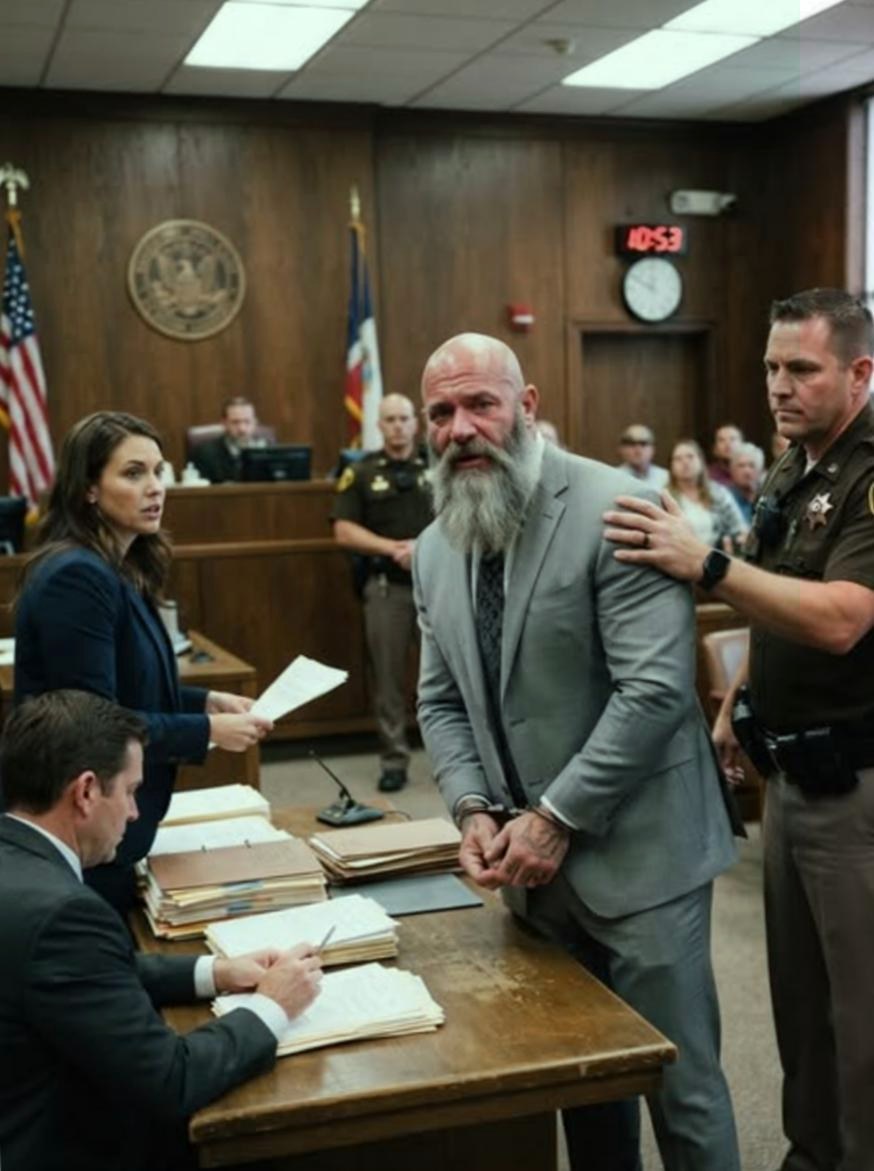

In the courtroom I raised my hand and swore that Cole Mercer had beaten three men for no reason, although I knew that every word was a lie.
It was ten o’clock on Wednesday morning. Rain struck the windows as if someone outside were insistently demanding to be let in. My fingers clung to the wooden railing, and on my wrist was Emma’s small copper bracelet, the only thing left to me from my daughter.
The prosecutor smiled at me.
“Mrs. Harper, did you see how the defendant rushed at those people?”
“Yes,” I answered.
“Did they do anything before that?”
“Nothing. They were just standing.”
That too was a lie. Everything was a lie.
On the other side of the courtroom stood Cole in a black leather vest. A healed wound was still visible on his cheek, while the fingers of his right hand slowly worried an iron chain. He looked neither at the judge nor at the prosecutor. He looked only at me.
Twelve years ago, a drunk motorcyclist killed my daughter, Emma, on the road. Since then I had hated motorcycles, leather, and every person who sat behind a wheel. That night hatred took up a place inside me and no longer wished to leave.
When I saw Cole in front of that diner, where a young waitress was trapped between three men, I no longer saw him as a person. I saw only that accident. Fire. Shattered glass. Emma’s empty seat.
“Are you sure?” the judge asked.
His silver gavel lay on the table. Beside it, a glass full of water trembled.
“Completely,” I said.
Cole lowered his head slightly. As if he already knew that his fate had been decided.
At five in the evening the verdict was announced. Five years for aggravated assault. Someone in the courtroom sighed. But my heart heard the voice of its own lie for the first time.

The bailiff put handcuffs on Cole.
When he passed beside me, he came so close that only I could hear his voice.
“I would still have pulled you out of that car.”
My breath caught.
At that very moment I understood. Months earlier, on a rainy night, when my car burned by the side of the road, someone had smashed the windshield, dragged me out of the fire, and disappeared before the ambulance arrived. I remembered only black leather on his shoulder.
It was Cole.
And now I had sent exactly that man to prison.
For two weeks I convinced myself that I had done the right thing. Then, one rainy afternoon, someone knocked on the door.

A young woman stood on the doorstep. She was wearing exactly the diner uniform she had worn that night. In her hand she held a paper bag, and the small device hidden beneath it made her fingers tremble.
“Are you Mrs. Harper?”
“Yes.”
“I am Kayla. The waitress because of whom Cole was arrested.”
Coldness spread through my stomach.
“Why did you come here?”
Kayla looked toward the street.
“Because you lied in court.”
“I don’t know what you’re talking about.”
“You do. One of those men had his phone turned on. It did not switch off when he fell. Everything was recorded.”
She held out the small device to me.
“Why didn’t you give it to the police?”
Kayla’s eyes filled with tears.
“They knew where I lived. Where my mother worked. Cole told me to hide until I was safe.”
“Then why did you come to me?”
Kayla took an old photograph from the paper bag. It was folded at the corners. In the photograph, children stood beside motorcycles. One little girl with two uneven braids looked like Emma.
And behind them stood a young Cole.
“He said that only the woman who testified against him could correct the truth,” Kayla told me quietly.
My hand reached toward the photograph, but I could not touch it yet. Kayla took out another sheet—a child’s drawing, a purple motorcycle, and words written below in Emma’s hand.

“Thank you for teaching me: motorcycles should stop for small children.”
Kayla said in a whisper:
“Cole kept this drawing in his wallet for twelve years.”
I looked at the device. Then at the photograph. Finally at the key to the lock that I was still holding in my hand.
Kayla took one step backward.
“If you listen to this, you will never again be able to tell yourself that you did not know.”
I put the device on the table and reached toward it…
…only one file was visible on the screen. The ticking of the clock could be heard in the room, while Emma’s copper bracelet on my wrist rang softly with every movement.
“You can still simply walk away,” Kayla told me.
“No. I have already walked away from the truth once.”
I turned on the file.


At first I heard noise. Breaking dishes. A man’s laughter. Then Kayla’s frightened voice.
“Let go of me!”
“Turn off the phone,” one man said.
“It isn’t on,” another answered.
Then Cole’s voice sounded, calm and stern.
“Get away from the girl.”
My breathing stopped.
“Who do you think you are?” someone roared.
A chair was dragged across the floor. The sound of a blow was heard. Kayla screamed.
I leaned on the table with both hands.
“You have to take this,” Kayla said. “But I cannot go to the police alone. They will do everything to make the recording disappear.”
“I will go with you.”
“They may arrest you.”
“They should arrest me too.”
Kayla looked at me in astonishment.
“Why did you protect them?”
I knew the answer, but saying it aloud hurt.
“Because in Cole I saw the person who killed my child. But in reality, he once saved my life.”
In the recording Cole shouted again:
“Kayla, go inside! Now!”
Then came three heavy blows and a man’s swearing. The file ended where Cole’s voice changed strangely.

“If you use this against me, there is one thing you must know first…”
Kayla stared at the screen.
“I have never heard those words from him before.”
I took the device in my hand. Just then the telephone rang. It was an unknown number.
“Don’t answer,” Kayla told me.
But on the other side of the call I could already hear quiet breathing.
“Mrs. Harper,” a man said, “if you take this recording anywhere, the next photograph will be from your granddaughter’s school…”
The call ended immediately.
…Kayla’s face turned pale. But I felt a strange calm, the kind that settles before a storm.
“They will not touch my granddaughter,” I said and put the phone on the table.
“We have to go to the police right now,” Kayla told me.
That same evening, at eight o’clock, we entered the district prosecutor’s office. A sharp smell of coffee hung in the room, and wet umbrellas were arranged by the window. Prosecutor David Morgan stood up when he heard the recording.

“Is this really the recording from that night?” he asked.
“Yes,” Kayla answered. “That is my voice.”
Morgan looked toward me.
“Mrs. Harper, do you know what it means that you gave false testimony in court?”
“Yes.”
“You may lose your freedom.”
“Cole has already lost his. Because of my lie.”
The recording was played again. This time every voice could be heard clearly. Three men were cornering Kayla. One was laughing with a phone. Cole entered, first warning them with words, and then fought only when one of the men raised a bottle.
“Look at the time,” Morgan said.
The screen showed that Cole beat them for only a few seconds. Then, when all three were lying on the ground, he stepped back and gave Kayla a chance to escape.
“He did not chase anyone,” I said. “I saw this. I simply did not say it in court.”
Morgan silently looked over the photographs I had brought. Emma’s little figure, young Cole, and the old handwritten drawing lay on the table.
“He had this?” he asked.
“He carried it in his wallet for twelve years,” Kayla said.
My voice failed me.
“I hated him, but he still remembered my daughter.”
Morgan immediately called investigators. Cole’s lawyer was contacted in prison. The recording was officially transferred, Kayla’s testimony was recorded, and I told everything again—the accident, my hatred, every lie I had said in court.

The next morning I was allowed to meet Cole. In the room of the investigative detention center, his face was tired, but his eyes were still calm.
“Why didn’t you tell me that it was you?” I asked.
“You were in the fire that night. You could not see my face. And I thought it was better for it to remain that way.”
“You knew I was Emma’s mother?”
“I recognized you from the photograph. That day, when I saw you in court.”
“And still you said nothing.”
Cole looked at the handcuffs.
“You were already suffering enough. I did not want my rescue to become another burden for you.”
My eyes filled with tears.
“And I sent you to prison.”
“Now you are telling the truth.”
“That does not mean forgiveness.”
“Nor did I say that it would be easy.”

Just then Morgan opened the door. He was holding a new folder.
“Cole, the investigation into those three men is no longer limited to the diner incident,” he said. “We found several more victims in their past. But there is a problem.”
“What problem?” I asked.
Morgan opened the folder.
“One of them knew that the recording existed. And after the trial he tried to erase the evidence from the police storage. Now we know whom he helped…”
For the first time Cole lost his calm.
Morgan took a photograph from the folder and placed it on the table. It showed the assistant prosecutor together with one of the attackers, while on the back was the address of my house.
“They did not only want Cole silenced,” Morgan said. “They planned to intimidate your family from the very beginning…”
At that moment the sound of heavy footsteps was heard in the corridor, and the handle slowly went down…
კოულმა ჩემი სახლის წინ დატოვებული წერილი გახსნა…
ფინალში სიმართლე მხოლოდ კოულს არ ათავისუფლებს. ის მეც მაიძულებს, პირველად საკუთარ თავთან დავრჩე მარტო.
„თავისუფლება ყოველთვის კარის გაღებას არ ჰგავს.“
იმ წამს პირველად აღარ მეშინოდა.
😱 გაიგეთ, რას მალავდნენ ისინი →
👇 ისტორიის ფინალი უკვე გახსნილია






